


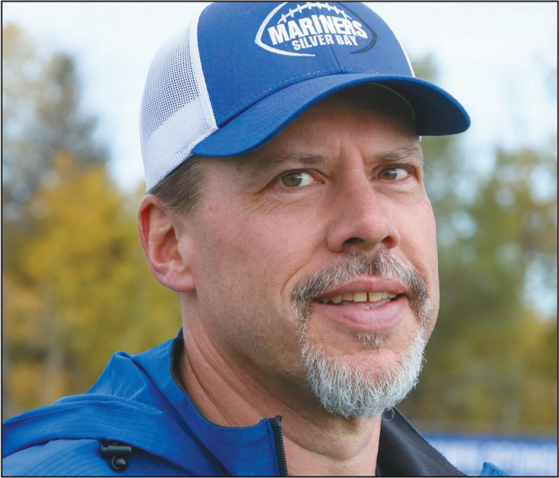
Ward Kaiser can hardly remember a fall without football. He started playing when he was ten, kept going through high school, and eventually landed a coaching job for the sport in his hometown. For 30 seasons, he has been on a sideline somewhere, teaching, rebuilding, improvising, and holding together small‑school programs that often need more than they have. This year, for the first time, he will watch from the stands.
Kaiser talks about his coaching career the way other people talk about a community project. Something that is shared, inherited, something he is grateful to be part of.
“It’s really weird now, looking back,” he said. “I feel like I’m still a young coach who just sort of got started, but now I’m looking backwards.”
The decision didn’t come suddenly. He’d been thinking about it for years, wondering how long he would balance teaching and coaching, wondering when the right moment would come. Recent groups that came through made the decision harder.
“These are the players that really stuck with us and brought the team back,” he said. “There was never going to be an easy time to step away from the players I coach.”
He still has five or six years left of teaching, but wanted the next coach to inherit something strong. He said the program is finally in a place where he feels comfortable with someone else taking the reins.
“Right now, it looks like we’ve got the guys and they could go out and win some games,” Kaiser said. “I wanted to make sure the program was in good shape for the next person.”
When he told the players, he saw the reaction immediately. The announcement led to a stunned silence that made him question how far away he should step.
“When I announced it to them, it looked like disappointment,” he said. “I had to assess whether I should just get way away from it, so the next coach doesn’t feel like I’m in their way.”
He decided he couldn’t. Not completely.
“I’m not going to disappear,” he said. “But I’m not going to get in the way either. I’ll be a big cheerleader for them. Water boy or something like that.”
The district has posted the job and expects to hire within the next few weeks. Kaiser said he feels confident the program will be in good hands and made it clear he wouldn’t have retired if he didn’t believe that.
“I would not step away if I didn’t think there was somebody that could lead the team well,” he said.
There were a few seasons when Silver Bay didn’t have the numbers to field a varsity team, and the district partnered with Two Harbors so the older players could keep competing. Kaiser said the program was grateful for that opportunity and Two Harbors was an incredible partner. It kept kids on the field, kept them developing, and kept the sport alive in the community.
While the high school players suited up for the Agates, Kaiser kept the junior high program running. He said that work mattered just as much as Friday nights. It built the pipeline that eventually brought the Mariners back to their own field.
“That was important to me,” he said. “Keeping the junior high going so we had a future. And the partnership with Two Harbors gave our older kids a place to play when we couldn’t.”
Last fall, Silver Bay fielded its own varsity team again. They played in their hometown, in their own colors, as Mariners. Kaiser said that moment, seeing the program stand on its own again, was part of why he feels now is the right time to step aside.
Kaiser’s path into coaching wasn’t limited to Silver Bay, nor was it limited to football. His first coaching job was volleyball, back when he was just trying to get his foot in the door of teaching. He coached in Cotton, Deer River, and Carlton before returning home. He spent nearly a decade coaching varsity baseball, including four years as head coach in Carlton, and three more seasons of baseball when he came back to Silver Bay.
“When you coach, you’re coaching kids, not the sport necessarily all the time,” he said.
Those years shaped him as much as anything he did on the football field. He learned from different staffs, different communities, and different expectations. He said the variety made him a better teacher and a better coach, because it forced him to adapt and pay attention to the people in front of him rather than the playbook.
“My dad having been a teacher for 37 years, 34 of them in Silver Bay, it just seemed like a natural thing to get into,” he said. “Between my dad and the great coaches I had, teaching and coaching just felt meaningful to me.”
He played under Doug Conboy and Larry Otterblad, then later coached under both of them. He still calls Conboy a mentor and “almost like family.” Early in his career, he spent time in Deer River with Steve Ott and Gary Dahlberg, two more mentors who shaped his approach.
“I couldn’t ask for another couple of really great mentors,” he said. “I learned a lot from those guys.”
Kaiser has had some amazing coaches in his career who have also coached with him, like Jamie Otterblad (Larry’s son). They coached together for roughly 15 years, through co‑ops, rebuilds, and the years when the roster barely held together.
He trusted Otterblad completely, and that kind of trust is rare in small‑school sports, where staffs are tiny, and turnover is constant. Otterblad’s presence steadied the program through some of its most uncertain years.
What kept Kaiser in football wasn’t the wins or the state trips, though Silver Bay made two under his leadership, in 2011 and 2015, and reached multiple section championships. It was the daily rhythm of stepping onto the practice field after a long school day, the shift in energy that came with it, and the relationships that formed there.
“You step on the practice field and right away it’s a great place to be,” Kaiser said. “Being called coach is probably one of the most rewarding things. It’s not because you get to be a hotshot. It’s because you know what’s behind it.”
He never saw the job as just teaching plays. He talks about the players the way his own mentors talked about him. The sport was the vehicle, not the point.
“It’s not about making good players,” he said. “It’s about helping them become even better people.”
He said he always wanted the players to understand that the team belonged to the whole school and the whole community, not just the roster and the staff.
“It’s the school’s team. It’s the community’s team,” Kaiser said. “We’re just part of the history of that.”
Small‑school football is demanding. He had to develop players from scratch, recruit kids who weren’t sure they belonged, adjust systems to fit whoever showed up, and stay flexible.
“In small schools you’ve got to coach 100 percent all the time on everything,” he said. “Sometimes you have to come up with unorthodox things. There’s not much room for error.”
He said the program’s best years came from that grind, as he remembers the teams that went to state not for their talent, but for their heart.
“We were underdogs both times,” he said. “The team went beyond its talents because of the heart they had, the dedication, the determination.”
Other coaches noticed it too.
“Coaches always said, you guys always play us tough,” he said. “Even some of your years when you’re a little bit down, you always play us tough. And with class too.”
He said the community made the job possible. The support was steady. The parents were reasonable. The players were committed. He never faced the kind of pressure that drives coaches out of the profession.
“I’m really thankful the community has always been very supportive,” Kaiser said. “I’ve never had people give me any reason to want to quit.”
What he feels now is something closer to gratitude than grief. The decision was hard, but he wanted to leave while the program was strong. He wanted to look back at the whole thing and feel good about it.
“I wanted to be able to step away feeling good about both the situation at present and a career,” he said.
He knows he’ll miss it and that fall will feel strange. He knows he’ll have moments where he wonders if he should still be out there. But he also knows he’ll be around. He’ll be in the stands. He’ll be on the sideline. He’ll be the one cheering loudest.
“It’s going to feel good, but kind of empty too,” he admitted.
On a personal note, covering Kaiser has been one of the unexpected perks of this job. I came into sports reporting as someone who could diagram a power play in my sleep but needed a moment to remember how many points a touchdown was worth. He never made me feel out of place.
In our recent conversation, in true Ward fashion, he offered to stay in touch if I ever need a football detail explained. I’ll probably take him up on it, partly for the help and partly because talking with him is just easy. He has that rare teacher-coach combination where you walk away feeling smarter without ever feeling talked down to. It’s no mystery why he’s so well-loved, or why the team is sad to see him step back, though I suspect he’ll still be around, quietly (or maybe loudly) cheering and pretending not to notice when I mix up a football term or two in my reporting!