


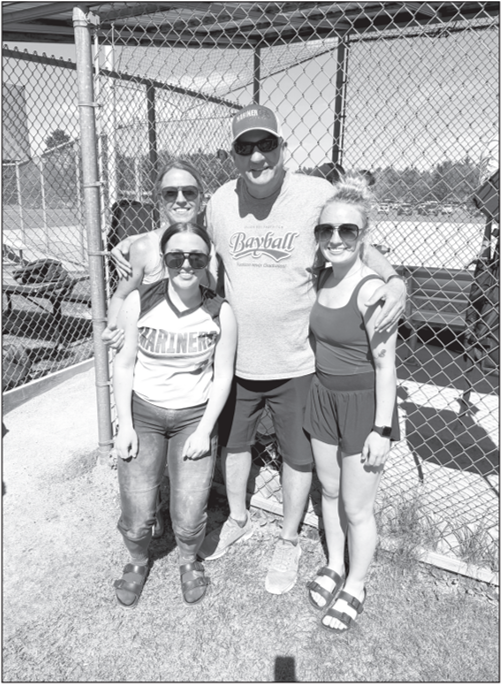
Mike Guzzo has been many things for this community. He worked for the city. He is a golf coach, he coached hockey, and he was a tennis coach before he was a softball coach. But after one of our most recent conversations, I am convinced he may have missed his true calling. Guzzo is a great actor.
I say that because he fooled me completely. I had just gotten off the phone with him after a routine postseason conversation. We talked about the team’s awards, the section run, and the usual wrap‑up details. Nothing seemed unusual.
Then my phone buzzed with a message: “Mike’s retiring.” I stared at it, confused. I had just spoken to him. He had said nothing. Not a hint. Not a pause. Not a slip.
“I tried to keep that little birdie from getting out to the media or anybody,” he said. “I didn’t want it to take away from the kids. All the all‑star stuff and all‑conference stuff was coming out. I thought, I’m not going to say anything.”
It was very Mike Guzzo. He has always been determined to make sure the spotlight stayed on the girls. Even moving into retirement from coaching the team, he wanted the story to be about them. In fact, when I asked to talk to him about his decision, he didn’t respond right away. It didn’t surprise me. I’ve known him long enough to know that he would hesitate.
“I don’t want anybody to say anything about me,” he admitted. “It’s always been the program and the kids.”
But after 27 years, 422 wins, four section titles, three state tournament trophies, and generations of athletes who grew up under his coaching, the story is his whether he wants it or not. This is the end of an era.
Guzzo tried to keep the news quiet, but the players figured it out long before the public did.
“Kids are pretty smart,” he said. “They knew. When I walked off Lynch Field, one of the girls said, Coach, we weren’t going to lose your last game.”
The girls had beaten Ely, one of their top competitors.
His numbers are remarkable, but he rarely brings them up unless pressed. He coached for nearly three decades of softball, beginning in 2000 and ending in 2026. They had only one losing season, a 9‑11 year that was “right there anyway.” They reached the state tournament four times in his first decade, finishing second, third, and fourth in consecutive years.
“We had so many good runs,” he said. “It’s unreal. Not many teams can say that.”
Kelly Ollila, now the school’s athletic director, played for him on that first state team. She later coached with him. She has seen every version of Guzzo: the young coach, the veteran coach, the colleague, the mentor.
“When it comes to Mariner softball, you think Mike Guzzo,” she said. “It is hard to think of Mariner softball without him.”
She remembers what it felt like to be coached by him and later to work alongside him.
“He is a one-of-a-kind coach and one of the best to work under,” she said. “He takes pride in every aspect of the game and it makes you proud to be part of the program.”
His precision stood out early and never faded.
“His attention to detail is unmatched,” Ollila said. “He had practice plans down to the minute. His stats were updated by hand at his computer after long game nights. He cared for his fields, even snow blowing them off in March.”
But for Ollila, the heart of his coaching was never the logistics.
“What truly set Mike apart was his ability to connect with his players,” she said. “He understood each athlete; their strengths, challenges, and potential. He knew when to encourage, when to challenge, and how far to push each player to help them become the best version of themselves.”
She has watched his influence ripple outward for decades.
“Mike’s impact on Mariner softball extends far beyond wins and losses,” she said. “His commitment to the athletes and the game itself has left a lasting legacy that has impacted myself, many young women, and the Mariner softball program.”
Two of the players on Guzzo’s first state team were Ollila and Carrie Jo Ernest. They were seniors in 2001 when the Mariners made their first trip to state. For Ernest, softball was one of the highlights of her high school sports career.
“He made it fun,” she said. “The camaraderie on the team was amazing. We had so much fun on the bus rides.”
She described his coaching style as “intense, wanted to win, competitive, but fun.” She also described something few coaches ever experience.
“He coached [two] generations,” she said. “Started with me and ended with my daughter, my youngest.”
Guzzo told me, “The coolest part for me is coaching their kids now. I coached Carrie Jo. Then I coached her daughter, Hope. Then I had Lily. That’s quite the run.”
When Guzzo started coaching softball, the sport was still new in town.
“Girls’ softball was kind of just going,” he said. “They started a team in maybe ’98 or ’99. I think they had a team for two years.”
He got involved because his daughters were involved and also because boys’ tennis was dropped, and he wanted to stay connected to coaching.
“I was pretty big with our school administration about starting girls’ softball,” he said. “I said these kids can compete right away.” They did. By 2001, they were at state.
From 2005 to 2009, they were the team everyone else had trouble getting past. They made three state tournaments in five years. They won four section titles in that decade. Then came the long stretch. Seventeen years without a state appearance, despite strong teams and deep playoff runs.
“That’s the way the cookie crumbles sometimes,” Guzzo said.
But even in the lean years, the program stayed strong. Kids kept coming out. The culture stayed intact and the expectations stayed high, which was not an accident.
Guzzo’s coaching philosophy was simple: always prepare the next group.
“I always kind of knew who was going to take that spot next year,” he said. “Or at least be getting them ready to fill in for that next spot.”
He believed JV players needed real experience, he believed varsity players needed to be pushed, and he believed the program needed continuity.
“That’s the trick of being a really good coach,” he said. “Your JV and your players next in line are getting experience. You’re squeezing them into varsity games. You’re pushing them to get better because you know you’re going to need them.”
Guzzo had been thinking about retirement since he left his city job in 2020. He wanted to hang on to something, so he kept coaching softball. He thought he would coach a couple more years. Then he saw the next wave of talent coming up.
“I saw all these good 7th and 8th graders,” he said. “I said, I’ll stick around for these kids for a couple more years and see them through.”
He wanted to hand off a strong team and for the next coach to start with something solid. Then his longtime mentor, Roger Koster, passed away in November.
“Roger was my coach, athletic director, everything to me,” he said. “When he died, that magnified it more for me. Life’s pretty precious. My wife deserves some trips. Some things where I’m not tied down all the time coaching.”
Those cold season starts may have also factored into his decision. He and his wife are already planning a long trip to Arizona in the spring, which he admits will make the transition easier.
“I’m tired of these cold springs,” he said. “Snowblown ball fields. Muddy. Cold.”
Yet despite all the good reasons that this time is right, it is still a really tough decision to step away from the field.
“This is hard,” he said. “I’ve done it my whole life.”
When I started this reporter job, I knew very little about softball. I knew even less about how to read a scorebook, how to interpret certain stats, or how to understand the flow of a game at the level he coached it. Guzzo never made me feel out of place. He never made me feel like I should already know something. He walked me through stats patiently and explained situations when I didn’t understand. As I was scrawling, he paused to ensure I had time to write down what I needed before moving on. He answered every question, no matter how basic. He helped me learn this gig, which is my favorite gig of all time.
Guzzo believes the program is in good hands as next year’s seniors are strong. And he knows the staff is ready.
“They’ve been taught to work hard,” he said. “If you’re not going to work hard, then head home. They know to help pick up stuff. They’ve been taught responsibility.”
He started with a team that took him to state. He ended with the daughters of those same players. In between were generations of athletes who learned discipline, teamwork, and how to love the game.
Mariner softball will move forward. But it will do so on the fields he cared for, in the culture he shaped, and in the program he built. And for the first time in a long time, Mike Guzzo will be following along from somewhere warm.
Enjoy your retirement, Coach Guzzo. You deserve it.