
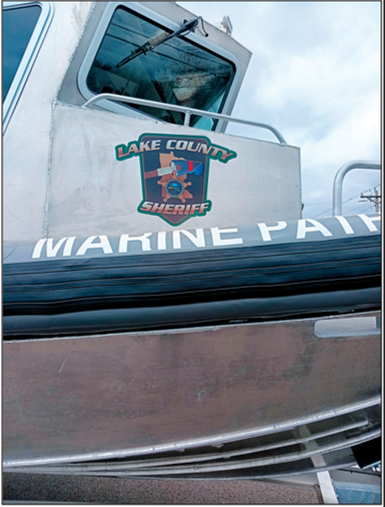
At a gathering in Two Harbors on Tuesday, Lake County Sheriff Nathan Stadler announced that his department has received a Lake Superior Patrol Boat. Standing alongside the new craft, Stadler recognized the partnership for search, rescue, and law enforcement operations on the North Shore with the Cook County Sheriff’s Office and the Grand Portage Band of Lake Superior Chippewa.
The partnership program is named Genawaaboonagak, an Ojibwe word meaning “Watchers Over the Water.” It is intended to address the gap in safety coverage left by the U.S. Coast Guard’s closure of its Grand Marais station in 2022, which left most of the North Shore waters outside the twohour safety coverage limit. Coast Guard assets were redeployed to Duluth and Sault Ste. Marie.
In response to the increased safety challenges the Coast Guard departure meant, the Grand Portage Band launched what is now recognized as the nation’s first Indigenous-led Coast Guard. Under the leadership of Tribal Chairman Robert Deschampe, along with officials of both Cook and Lake counties, Genawaaboonagak secured $3 million from the Minnesota Legislature to fund the specialized equipment and training necessary to patrol the vast stretch of water from the Canadian border to Knife River.
The funding also provided for the construction and deployment of four state-of-the-art rescue boats that were built in Duluth. Seth Moore, the Director of Biology and Environment for the Grand Portage Band of Lake Superior Chippewa, oversees the tribe’s Natural Resources Department. He was instrumental in securing the state funding and legislative support required to launch Watchers Over the Water, and he managed design and specifications for the boats.
Two of those boats are stationed in Grand Portage, one in Grand Marais, and the fourth will now be in Silver Bay.
This first-of-its-kind partnership between a sovereign tribal nation and local county governments will help assure the public that it provides a coordinated, high-speed emergency response network across the entire North Shore.
The boats are aluminum-hulled, capable of handling up to 20-foot waves and traveling at speeds over 50 mph with their twin Mercury engines. They are equipped with thermal imaging cameras, sonar, and advanced radar to locate people in the frigid waters of Lake Superior.
The Lake County vessel will be permanently slipped in the Silver Bay marina for the duration of the boating season. According to Lake County Chief Deputy Tim Luoma, he would like all deputies to be trained and certified to crew the boat if they’re willing.
The closure of the Coast Guard North Superior Station in Grand Marais was a major turning point for North Shore maritime safety, ending nearly a century of federal presence on the water. In June 2021, the USCG announced plans to consolidate the Grand Marais station with other Great Lakes facilities. It was part of a broader federal push to close “redundant” seasonal stations. The summer of 2021 was the final season of active duty for USCG personnel in Grand Marais. After Labor Day 2021, the station was effectively de-staffed — the government-speak for closed. With the closure finalized, responsibility for search and rescue (SAR) on Lake Superior was left to local agencies, including the Cook County Sheriff’s Department and the Grand Portage Tribal Council.
Explaining the closure of its base in Grand Marais, the Coast Guard cited low call volume. Officials noted that the station averaged fewer than one emergency case per year over the preceding decade. They noted that the low frequency of emergencies was a testament to the safety and self-reliance of the Lake Superior boating community. The USCG also argued that modern boat speeds, GPS, and direction-finding technology made many physical stations unnecessary.
While federal data showed low activity, local officials, emergency responders, and tribal leaders argued that these numbers were misleading for several reasons. They noted that many “calls” are handled informally by nearby boaters or local law enforcement before a formal federal SAR case is opened.
Critics of the closure argued that even one call every two years is critical on the North Shore, where extreme water temperatures mean survival times are measured in minutes rather than hours. Without the Grand Marais station, the nearest Coast Guard assets are in Duluth, which can take several hours to reach the waters off Cook and Lake County—a gap that prompted the Grand Portage Band to launch their own rescue unit.
As the thick aluminum hull of the Lake County Sheriff Marine Patrol boat gleams at Tuesday’s gathering in Two Harbors, it represents more than just a piece of advanced machinery; it is a symbol of regional self-reliance. While federal logic prioritized call volumes and consolidation, the partners behind Genawaaboonagak have prioritized the minutes that separate life from death in Superior’s frigid depths. With the “Watchers Over the Water” now on duty from Grand Portage to Knife River, the North Shore no longer waits for a response from over the horizon—it provides its own.
Since Cook County Sheriff Pat Eliason just retired, and Sheriff Stadler is leaving office at the end of the year, the vessel commissioned today stands as one of the final milestones of their long careers in North Shore law enforcement.