

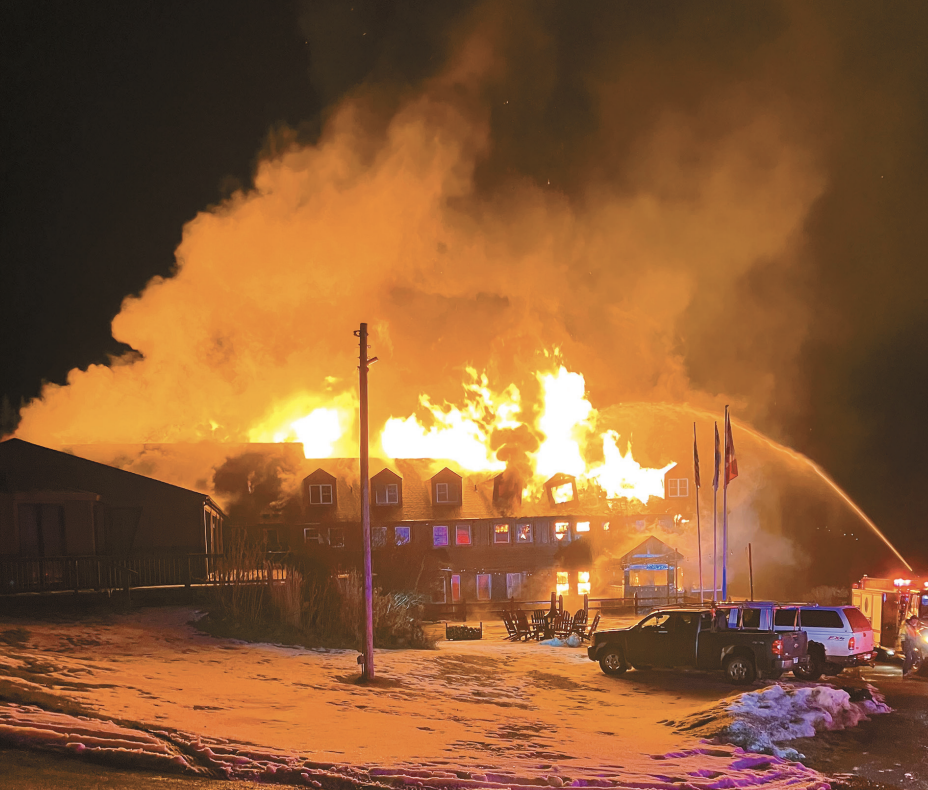
LUTSEN, MN – Barring a plea deal or a dismissal of the case, things will continue to move slowly through the legal system for Bryce Campbell, the owner of Lutsen Resort, who is accused of burning down Lutsen Resort in February 2024 to collect an insurance payout.
Last December, Campbell was arrested by special agents from the Minnesota Department of Public Safety’s Bureau of Criminal Apprehension and charged with arson and insurance fraud in connection with the fire.
Following his arrest, Campbell posted bail and continues living on the North Shore. One of the conditions of his release is that he’s not allowed to leave Minnesota. He’s appeared before a Minnesota judge numerous times since he was arrested in December.
To date, the courtroom proceedings have all been virtual. The most notable activity in the proceedings is a request from Campbell’s attorney, Eric Newmark, to dismiss the case entirely. Newmark filed a motion to dismiss the charges in early June. He filed a brief explaining why the case should be dismissed Aug. 21, citing, among other things, the fact that fire investigators could not pinpoint an exact cause for how the fire started. If the authorities don’t know exactly how the fire started, how can they charge Campbell with arson, and subsequently with fraud, reasoned Newmark in his courtroom filing.
What stands out in reading Newmark’s 12-page memorandum is that he doesn’t strive to prove that Campbell didn’t start the fire that burned Lutsen Resort to the ground. He does, however, make repeated attempts to prove that the state does not have enough evidence to prove that he started the fire. Rather than focusing on the notion that his client (Bryce Campbell) is innocent of the charges, Newmark points out that there’s no metaphorical smoking gun to prove he did start the fire. Not once during his 12-page document does he say or even allude to the idea that Campbell did not actually start the fire that burned Lutsen Resort to the ground. Rather, he focuses on the fact that the State Fire Marshal can’t prove he did start it. Therefore, Newmark states, the case lacks “probable cause” and should not proceed to trial.
“The state cannot identify, even in a general way, how it believes Mr. Campbell intentionally set this fire,” Newmark writes in his brief.
Under Minnesota (and every other state) law, an accused person never has to prove their innocence, so it’s not unreasonable or even unexpected that Campbell and his legal team would lean on what they claim is a lack of probable cause at this stage of the proceedings. In the United States, the prosecution – or specifically in this case, the Cook County attorney and the state attorney general’s office – carries the entire burden of proof. With that in mind, Campbell and his attorney remain focused on the fact that they feel this case should not proceed to trial before any plea of guilt or innocence is officially entered.
Meanwhile, the prosecution, led by Assistant Minnesota Attorney General Dan Vlieger, told the court that Campbell being linked to starting the fire is largely supported by the fact that he was in the lodge just minutes before the fire was first detected, which was around 12:20 a.m. After initially telling investigators he was not on site soon before the fire started, Campbell later admitted he was inside the building less than 30 minutes before the fire was reported to the authorities. This was a massive shift from his original story that he was asleep at his condo near Two Harbors after picking up a Domino’s pizza.
Campbell and Lutsen Resort were also saddled with significant financial woes leading up to the fire, something the state points out repeatedly in its memo specific to the probable cause claim. Just prior to the fire, Campbell and his businesses owed more than $14 million in past-due and near-due debts, while sitting on a mere $34,000 in their collective bank accounts. The National Bank of Commerce in Duluth reportedly issued a default letter on one of his mortgages for Lutsen Resort less than two weeks before the fire. Lutsen Resort was not going to make payroll the week of the fire, according to court records.
“When you consider motive, means and opportunity, taken as a whole and in conjunction with one another, this was not an accidental fire,” Vlieger wrote in his Sept. 21 filing.
Campbell and his attorney will retort that the bulk of the $14 million was tied up in a balloon payment he owed on a contract for deed for Superior Shores, another resort Campbell owned near Two Harbors. In a court hearing in July 2024, a resort executive brought in to essentially rescue the resort per court order declared the situation Campbell created at Superior Shores a “financial disaster.” There was a tremendous number of bills piling up, the court heard. “We have vendors demanding payment,” the official brought in to essentially salvage the resort told the judge.
These arguments await a ruling from Judge Michelle Anderson in connection to Campbell and his attorney’s motion to dismiss the case for lack of probable cause. In a filing last week (Sept. 30), Newmark said he will file additional reasons for why the case should be dismissed. Due to his busy schedule, which includes handling a felony Medicaid-fraud case and another where someone is accused of aggravated robbery, Newmark requested Anderson give him until Oct. 20 to submit his rebuttal to the state’s 42-page memo where attorneys detail why they believe Campbell is guilty and that the case should proceed to trial.
This newspaper, along with “The Fire: A North Shore Story,” a podcast focused on the fire at Lutsen Resort, will share updates accordingly.