


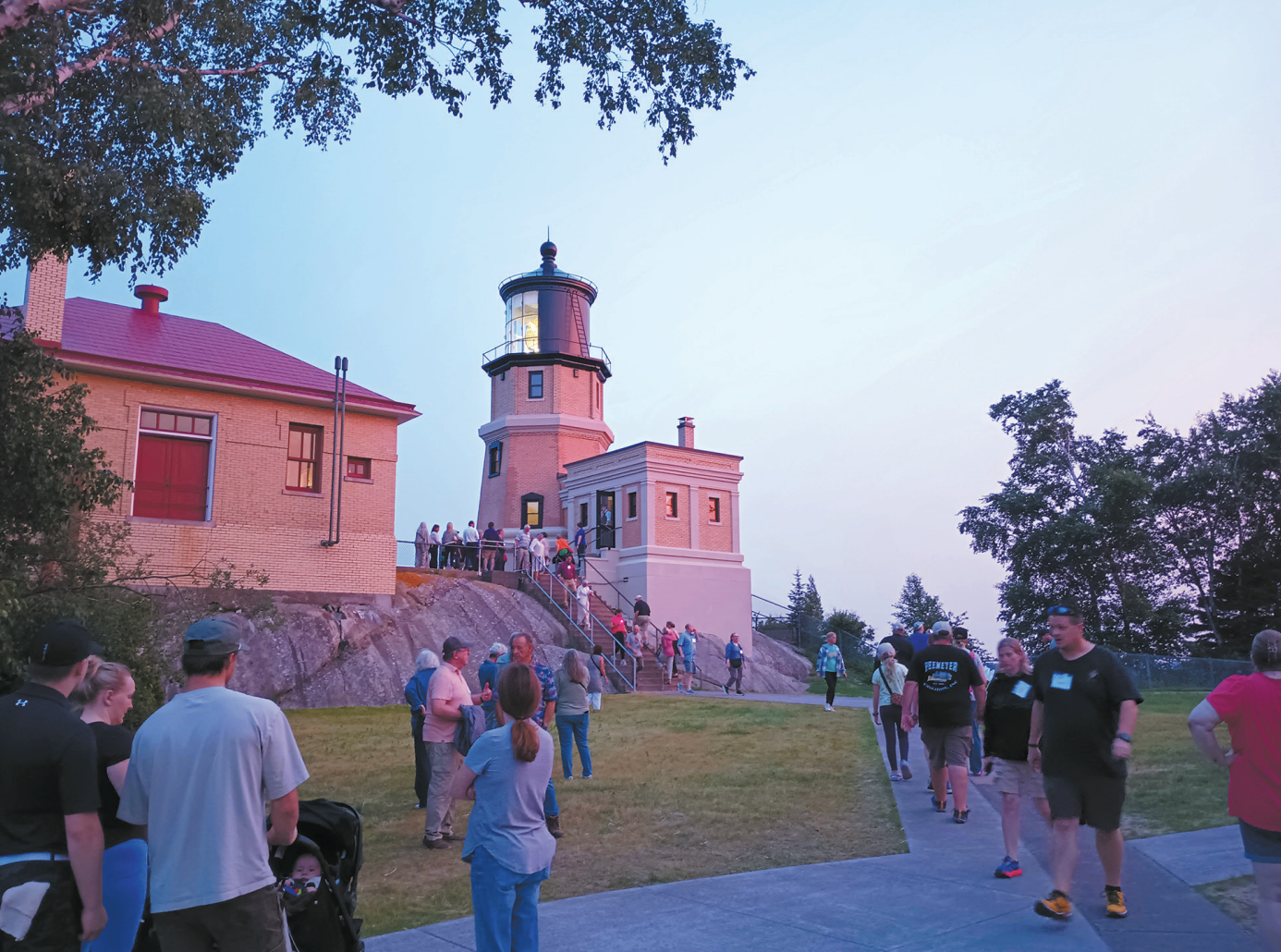
On July 31, 1910, Split Rock Lighthouse came into service guiding the ships along the western edge of Lake Superior. 116 years later, a crowd mingled around its base, enjoying a buffet, drinks, games, and music to celebrate the Lighthouse and recent achievements on the site. Attendees had free rein to roam the grounds, the Keeper’s House, and the Lighthouse interior. Although the lighthouse has been decommissioned since 1969, its role as an icon for the region and a historical landmark lives on. Due to its age, however, care for the lighthouse can be a challenge, and recently the Lighthouse has undergone two projects to not only improve historical accuracy but also the design of the facility for visitors and the stability of the Lighthouse itself.
“Places like Split Rock don’t preserve themselves,” Split Rock Lighthouse Site Manager Hayes Scriven stated in a speech during the event’s ribbon-cutting ceremony. “They require a vision, investment, partnership, and dedication, with people who believe our history is worth protecting.” The two improvement projects, the Trails and Landscape Project and the Lighthouse Moisture Mitigation Project, respectively, had been in the works for some time before Scriven took over seven years ago.
Former Site Manager Lee Radzak’s research on “how we could improve the guest experience while preserving the site’s historic character,” according to Scriven, resulted in a 2018 report that became the “blueprint” for a rehaul of pathways and other areas all across the grounds. Paths have been widened, there are more viewing platforms, and accessibility improvements across the board were top priority.
Marais Bjornberg, Senior Director of Capital Planning and Archaeology from the Minnesota Historical Society, described how they discovered evidence of a historic sidewalk built over the tramways used to carry materials to construct the Lighthouse, allowing them to reconstruct the new sidewalks in the same locations – a vast upgrade over the non-historic asphalt there previously.
Doing these types of improvements, Scriven noted, helps “people really get a better sense of what it was like living and working here.”
The second project undertaken had also been on the site’s to-do list for years. Work took place this past Spring to repair deteriorating masonry, install a modern environmental monitoring system, and better protect the lighthouse from future moisture damage. During construction, ice was discovered inside the masonry, which Scriven called “a powerful reminder that preserving a 116-year old lighthouse isn’t just about maintaining what we can see; it’s also about protecting what lies beneath the surface.”
This project, too, offered historical insight: Removing the brick exterior allowed them to see the interior of the structure, which Bjornberg said helped “build our understanding of how it was constructed and the work that it had undergone through the years.”
Guests appeared to be at home with the improvements, strolling leisurely along the new paths lined with art and clustering all evening around the overlooks for a panorama of Lake Superior and the rocky coastlines stretching north and south. The Lighthouse’s positioning makes for one of the best views of the Lake’s coast along the North Shore, and even with the crowds, there were plenty of spots to get a good look. During his thanks to the Minnesota Historical Society and donors, Minnesota Historical Society Director and CEO Kent Whitworth pointed out several special guests in attendance, including Minnesota Representative Roger Skraba, Lake County Commissioner Rick Goutermont, Duluth City Councilmember Terese Tomanek, and Former Split Rock Lighthouse Site Manager Tom Ellig.
Throughout the speeches given, it was clear over and over that the Lighthouse’s upkeep is a group effort stretching not just across the North Shore but the entire state of Minnesota, with Bjornberg mentioning the two improvement projects were only possible through appropriations made by the Minnesota state legislature and approved by the Governor. Scriven hopes that, in that spirit of collaboration, “people up and down the Shore and around Minnesota are able to come and enjoy it and take in the sight in new ways.” The prospect of more visits seems likely: while construction took place over the past two years on the two projects, Split Rock Lighthouse remained open, and during that time received over 168,000 guests.
But progress at the Lighthouse is not done yet. Jennifer Pogatchnik, Minnesota Historical Society’s Vice President of Advancement, announced that during the projects, the Society got a challenge grant to start an endowment for preservation at the Lighthouse. The Society’s goal was one million dollars; as of July 31st, they had gathered one million two hundred and fifty thousand. Site Manager Scriven is already thinking ahead to the next task, noting that the two projects completed are the first step of many.
But for now, the Keeper’s View event made for a good milestone and breather, for the public to enjoy the fruits of labor of the site’s staff and all its supporters. Many museum displays gave a wealth of information on how the lighthouse functions and past events connected to ships in the region. The nearby Keeper’s House was open for touring, with its charming interior restored for historical accuracy. Within the Lighthouse itself, the original Fresnel lens is still in place and a sight to see all on its own, slowly turning with perfect craftsmanship.
During an interview with Scriven, he noted Split Rock Lighthouse has always been a tourist attraction since its beginnings in 1910. People flocked to the site within a year of its being built, with keepers noting that visitors came by the site, leading to keepers giving impromptu tours. In a way, the Lighthouse is an accurate representation of the North Shore as a whole, being a tourist destination but also having historically been a vital piece of protecting the shipping lanes for local industry. His hope is that members of the public can continue to appreciate the Lighthouse for years to come. “We’re open, we’re here, we’re having fun, and we’re still relevant for everybody.”
Around 9 pm, the Split Rock Lighthouse was turned on for the event and met with eager cheers from the crowd. Its gleam was a reassuring sight in the quickly darkening sky, a sign of the care it has been given over the years, the role it had in protecting lives, and a connection between the past, present, and future of the North Shore.