


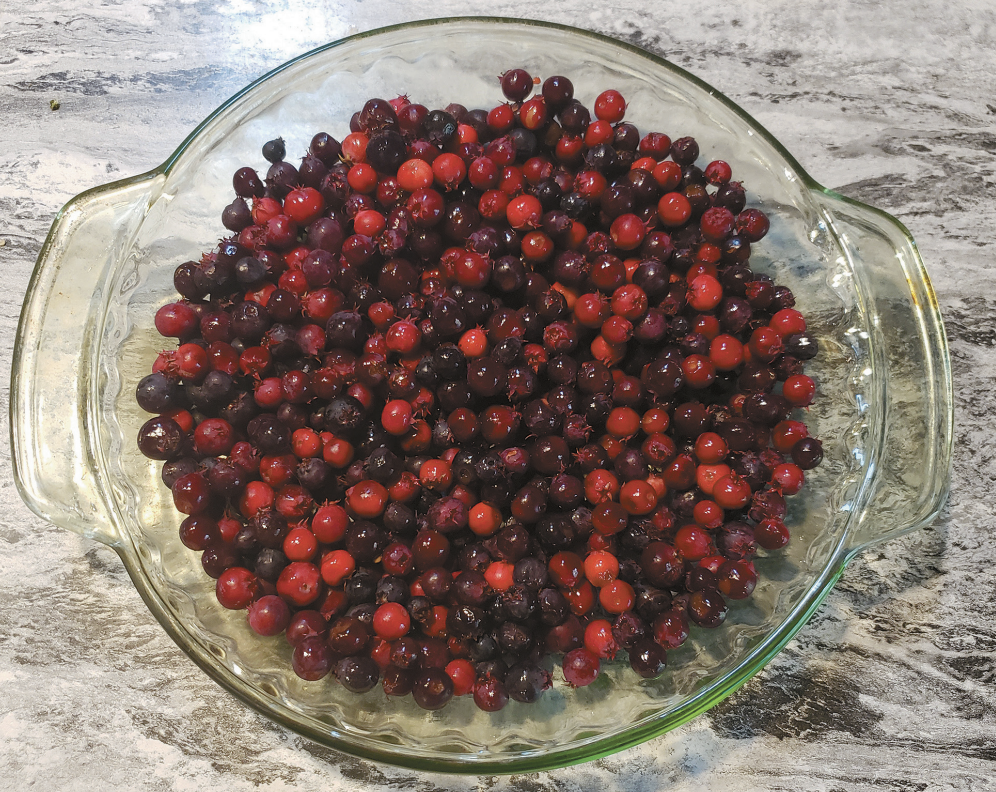
Berry Season is one of my favorite stretches of the year. The woods go sweet, the trails go fragrant, and suddenly every walk becomes a treasure hunt. Unfortunately, it arrives hand in hand with my least favorite season: Deerfly Season. And this year, conditions have been so perfect that both the berries and the bugs are showing up like they got a group rate.
We had a great strawberry patch in June, or at least the portion the birds, bunnies, and other opportunists didn’t help themselves to. I love bunnies, but now they’re eating my beans, and I’m beginning to feel like a villain in a children’s book, shaking my fist at the long‑eared rascals.
Equally frustrating, in the last week or so I’ve been quietly despairing as I drive past Juneberry shrubs drooping heavy with large purple berries, in a Saskatoon season we haven’t seen in years. The despair comes from the deer flies and horse flies that nearly block my view, swarming the vehicle like they’re trying to carry it off.
Juneberries, also called serviceberries and Saskatoons, have a long history on the North Shore. They were one of the first summer fruits people relied on, ripening right after the lean spring months. Ojibwe families dried them for winter, mashed them into pemmican, and used the wood for tools because it was strong and straight. Settlers called them serviceberries because they bloomed around the time roads cleared enough for traveling ministers to reach remote communities for spring funerals and baptisms. They’re usually modest producers, but when the weather lines up just right, they put on a show. This is one of those years.
Deer flies, on the other hand, don’t care about history. They care about heat, humidity, and movement, and we’ve given them all three. They’re visual hunters, which is why they go after dark colors and anything in motion. They circle, they dive, and they bite. Their friends, the horse flies, are their larger, meaner cousins, and they seem to have joined the party too. Old logging camps used to joke that deer flies were the real foremen because they kept everyone moving.
We haven’t found anything that will help our big black dog, Sammy, but wearing lighter colored clothes has seemed to help us humans, though it’s certainly not a cure-all. Deet doesn’t do sheet. These flies don’t have much of a sense of smell, so repellents aren’t their weakness.
I was able to sneak out this weekend and just go around the yard to pick some June berries, which we’ve been blessed with to have on our own property in droves this year. Along the way, I grabbed up some wild raspberries, while Mom picked our domesticated patches we brought with us from our last home. They’re early, and it promises to be a good year for the raspberries.
Wild raspberries have been part of northern diets forever. They grow in disturbed places: old burns, logging cuts, abandoned homesteads. That’s why they show up in stories about resilience. They’re one of the first plants to reclaim a scarred landscape. Early settlers used them for vinegar, wine, and syrups. Ojibwe families used the leaves for tea and medicine. They’re a berry with a long memory.
I also picked some bunchberries. They’re the bright red groundcover berries you see under spruce and fir. They’re not exactly delicious, but they have their uses.
Bunchberries have always been more of a helper berry than a headline berry. They were used to stretch other fruits, thicken preserves, and add color to winter stores. They grow in those cool, mossy places where the forest floor feels soft under your boots, and they show up whether the year is good or bad.
Their flowers are tiny but famous among botanists because they open with a snap, flinging pollen faster than almost any plant on earth. They’re not the berry you brag about picking, but they’re part of the landscape’s rhythm, and that’s reason enough to gather a handful.
I’ve found a couple of dewberries too. They look like tiny trailing blackberries and grow low to the ground. They’re soft, sweet, and fleeting, the kind of berry you only find if you’re already down on your knees looking for something else.
Dewberries were once a prized berry for early summer pies. Old cookbooks mention them as a delicacy because they bruise so easily that you can’t really transport them. You eat them where you find them. They’re a berry that insists you slow down.
Next will be the thimbleberries, which many would consider too sour to deal with. I think they’re great if you do a wild berry jam mix. They’re fragile, velvety, and fall apart in your fingers, but they bring a brightness that makes the whole batch taste like summer.
Thimbleberries have a long cultural history around Lake Superior. They were used fresh, dried, and mashed into cakes. Their large leaves were used as makeshift plates and bandages. I’ve been advised they are good in a pinch- excuse the pun- if you don’t have any TP in the woods.
The blueberries around me are still green. It’s been many years since we had much of a blueberry season, unless I’m looking in the wrong places. Our first year out here was wild, as we found a patch that had ice cream buckets worth of berries.
Blueberries are one of the most important traditional foods in this region. They were dried in the sun, stored in birch baskets, and used all winter. They were traded, gifted, and celebrated. Families returned to the same patches year after year. Even today, people won’t tell you where their patch is unless you’re practically family.
That patch isn’t there anymore, and before you blame us for picking too many, you gotta know that there were pines planted that overtook the area. It was a short‑lived and wonderful welcome, but boy were we disappointed to eventually learn they were a temporary treat.
It’s unfortunate that the weather that makes the berries swell and sweeten is the same weather that sends the deer flies into a frenzy. Nature doesn’t hand out perfect seasons. It bundles them.
The warm nights, the steady rain, the long stretches of humidity that coax the berries into their best year also wake up every biting insect in the county. The woods don’t separate the sweetness from the nuisance. They give you both at once. You get the heavy Juneberries, the early raspberries, the promise of thimbleberries and blueberries, and you get the deer flies circling your head like you’re the only moving thing left on earth.
It’s the trade‑off of July. You pick fast, you swat often, and you take the season as it comes. The berries are worth it, even if the deer flies think you’re part of the buffet.
Remember! Don’t eat berries or anything wild unless you know exactly what it is. A good berry year is a gift, but only if you pick safely. Otherwise you might need a lot of those thimbleberry leaves!