

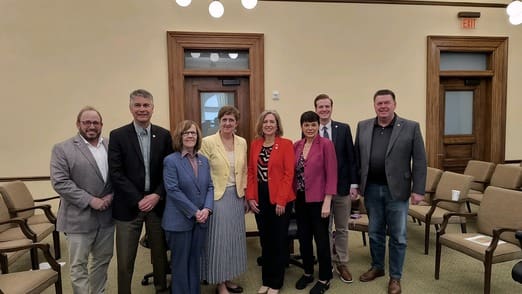
Minnesota Representative Roger Skraba made a special appearance at Silver Bay’s latest City Council meeting to give residents an update on what’s been done so far and talk over his plans and priorities for the upcoming legislative session, should he be reelected. He began with an acknowledgement of Silver Bay’s unique problem of being built all at a single time, making everything accordingly age out around the same time. The citywide street projects in particular, he said, “are what you have to do,” and he complimented the City on taking responsibility for its upkeep and its needed funding from assessments.
On a districtwide level, one of the major problems for the area is physical distance. “It’s roughly a six-hour drive from one end to the other,” Skraba explained, adding to the difficulty of getting jobs done when resources are spread out. “It’s hard for the City of Grand Marais to share a street sweeper with Silver Bay.” He appreciates the benefit of the area being politically blended, seeing an advantage to having both major political parties working together in pursuit of more resources for northeastern Minnesota. The sheer amount of roads needing upkeep is another, semi-related ongoing concern.
He had mixed feelings on the Minnesota Department of Transportation (MnDOT)’s work in the area, describing their work as ranging from great to areas feeling forgotten, such as delays during the spring floods. “I’m critical of MnDOT, but at the same time they are doing a pretty good job of what they have to work with.” He was especially concerned about the budgeting for the I-535 Blatnik Bridge project, intended to repair and replace the bridge spanning from Duluth to Superior, WI. “We care about that bridge; we think that’s important, but we also have people in greater Minnesota – Highway 73, Highway 65, Highway 1 – all these highways that are old and that need work constantly.”
He was upbeat about helium extraction becoming a benefit for everyone in the region. “That’s where the money is,” he stated, noting that conversation about the topic in the legislature has become more positive over time. He complimented the Minnesota Department of Natural Resources (MnDNR) for their work on permitting and clearing the way for further progress, such as the agreement between Two Harbors and Pulsar for a possible processing facility.
Skraba brought the focus back to Silver Bay and its recent water processing projects, which in turn have resulted in the City raising rates to pay for necessary costs and ongoing maintenance. “The citizens have to understand,” he said, “nothing is cheap anymore.” He looked to COVID as a major turning point due to prices being raised at the time and never correcting. “We have to stop that. There’s something – something’s out of kilter.” At this point, he said, the state is running out of money; a city like Silver Bay doesn’t have any money, so “you gotta go to the people. And you start going to the people, you can only do that so often before everything goes away.”
He has been taking steps to educate himself on data centers, seeing them as a decent possibility in the region. His confidence is due in part to a bipartisan bill at a state level, HF16, which was passed in 2025 and added regulations to help prevent the resident and environmental abuse happening with data centers in other states. He also sees transparency as key throughout the process, partially due to his own past experience: when mayor of Ely, he signed an NDA thinking it was necessary, only realizing afterwards that it was “the wrong thing I did, because I couldn’t even talk to my other councilors, I couldn’t talk to anyone about it,” which he found directly at odds with working for the people.
He commiserated on the poor state of healthcare. “We’re aware of that in the legislature,” he said, bringing attention to the importance of supporting the 340B Drug Pricing Program in order to keep healthcare services in the region. Without it, he explained, hospitals cannot sustain operating costs. “It was passed many, many, many years ago. And it works. It’s helping all our rural hospitals.” Although the supporting bill had not passed at a state level yet due to Republicans voting it down, he noted significant dissent within the party, especially from those representing rural districts who saw the bill’s importance in keeping hospitals open firsthand.
One truly bipartisan issue is the Minnesota Permanent School Fund vote for this upcoming election, which he said has garnered almost unheard-of unanimous support from both Republicans and Democrats. “It does not raise anybody’s taxes,” he explained. “That’s the beauty of this one.” He is also hoping the Seasonal Recreation Bill passed in 2025 will be able to help with costs once an operating levy for the district is put in place. “We are trying to keep these schools solvent,” he said, regardless of the number of students.
If reelected, he hopes to continue his work with multiple state-level groups, including the Legacy Finance Committee, the Legislative-Citizen Commission on Minnesota Resources (LCCMR), and the Capital Investment Committee. He is also hoping to take on work with the Environmental Committee.