
On August 19, the Duluth Township Town Hall on Homestead Road filled with people who had one thing in common: they were thinking seriously about fire.
The flyer for the event was direct, reading, “Want to steward a fire-dependent ecosystem? Interested in burning your meadow, field, or forested opening? Want to build a prescribed fire community of practice? Have questions, ideas, concerns about burning on private lands?”
It promised fire experts, foresters, and community leaders in the room, and floated a clear wish: “We hope to start a Prescribed Fire Association to enable landowners to better steward their lands.”
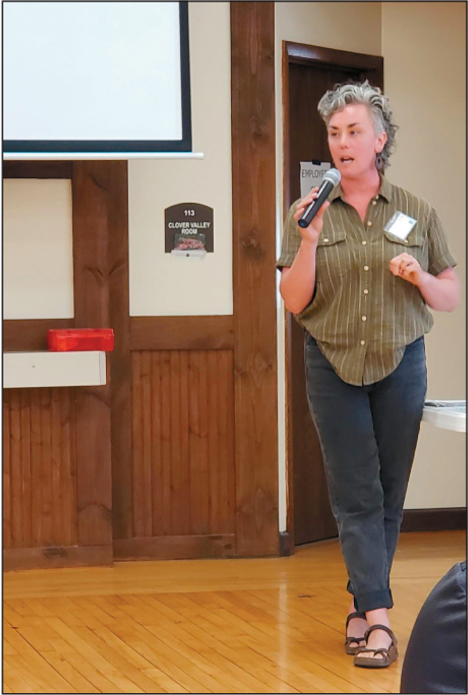
Inside, that is exactly what people talked about. Julie Allen from the Sustainable Farming Association opened by owning the invitation.
“You can thank me or blame me for why you’re here,” she said. She had called Abby Andrus and said, let’s start a prescribed burn association, “not really knowing what that all entails.”
She explained that SFA is a grassroots nonprofit whose funding comes from members and events, which gives them “a lot of freedom to do what me and our board think is important.” Their mission, she said, is “to transform agriculture one farm at a time,” and they do that through education, demonstration, and networking events.
She framed prescribed fire as part of that larger picture of stewardship.
“I just want to ground us in the bigger picture of why we are here, which is the crazy world that we live in and what we can do as landowners, land managers to have a positive impact on the world,” she said. “And I see prescribed fire as a crucial piece of that.”
Abby Andrus from Dovetail Partners and also a part-time firefighter with the DNR, introduced themselves as someone who writes forest management plans, helps people do prescribed burns, and facilitates discussions about “how to have a sustainable land stewardship culture.”
They said they loved weaving ecology, firefighting, and community together and had lived in Oregon for eleven years, where they watched a prescribed burn association form just as they were leaving.
“I’m like, all right, redo,” they told the room. “Here I am back home in Minnesota. Let’s move and pull together and make sure that it’s grounded in the realities in our location.”
Andrus started with basics: when they said, “burning on private lands,” they meant everything from pile burning and biochar kilns to broadcast burns over an area contained by fire breaks, and emphasized starting with the why.
“If you’re thinking about burning, it’s really important to start with why and where and what you’re hoping to achieve,” they said. “There’s a lot of ways to put fire on the ground.”
Not every landscape is appropriate for burning, Andrus reminded people.
“We are generally a fire dependent and fire prone ecosystem around here, but depending on where you live, your property, it may or may not be a good idea to even light a pile or do a broadcast burn depending on your tree and fuel load,” they said, and pointed people toward forest management plans, agricultural plans, and learning about their local ecosystem.
Then came the legal side.
Representation from the DNR explained burn permits. He described regular permits for piles smaller than twenty by twenty feet, usually allowed in evening and overnight windows, and variance permits for larger piles or burns outside those hours.
“Anytime that you plan on burning, you would either go online, call the number, figure out if you’re able to burn during that time period,” he said.
If conditions allowed, people could activate their permit and burn, with a physical or electronic copy available if the fire department or sheriff’s department stopped by.
He stressed that “ultimately whoever strikes the match is going to be responsible regardless of what happens, regardless of intent.”
When someone asked about safety protocols for a variance permit, he said the conversation would cover what people planned to burn, how they would maintain and extinguish it, how many people would help, whether there was water on site, and whether there was equipment.
“I’m also looking for, you know, do you have enough people that are actually going to help you? Do you have water on site? Do you have heavy equipment, that kind of thing,” he said.
He also clarified the snow rule, stating, “The time in which you don’t need a permit is when you have greater than three inches of contiguous snow.”
But even then, fires could not smolder and become a nuisance. He described recent issues where smoke settled on roads and impacted people with respiratory problems.
From there, the conversation moved into what people actually wanted to do with fire.
One landowner said he had “lots of projects going involving forest restoration” and wanted to know “what are the typical objectives for burning?”
He imagined regular burns in forests to reduce fire danger, and burns in ten-acre fields full of invasives. He described coming from northwestern Minnesota, where farmers burned bluegrass fields bounded by roads and ditches.
“I have ten-acre fields that aren’t hay, that are in decline because of Oxeye daisies and other really crazy invasions,” he said. “I’d like to come up with a way of burning.”
Another landowner described having their property logged for Firewise reasons, removing dead and dying balsam fir and spruce, and some aged aspen to pay for the work. A habitat specialist had suggested planting oak savanna species because climate projections pointed that way.
“I’m looking at how do we push toward an oak savanna here,” she said. “And the reason I’m here is because I know that that’s a fire-dependent system.”
She wondered whether they were planting too early.
“Part of me is thinking, maybe we’re doing that too early. Maybe the burning should have come first,” she said.
Andrus responded that controlled burns could be used as site preparation before planting, and later, once oaks and pines were more established, as maintenance.
Another attendee brought in the historical context. He talked about needing to remove underbrush before burning, and about funding crews to stack wood and clear fuels. He referenced Firewise programs and grants. Then he zoomed out.
“We really have to start thinking about some of the older descriptions of these systems,” he said, suggesting modeling “1491 pre-European contact conditions.”
He challenged the word “forest” itself, stating, “Maybe we look past the word forest. Maybe we define what a forest actually is. There is no definition for the term forest. It’s a European term used for land outside the castle walls or old fields of cutting wood.” He contrasted that with older terms like pine groves, pine barrens, openings.
He described places like Bloomington, where without fire, aspen and hazel had disappeared and only old bur oaks remained.
“The last surviving species and thousands of those acres down there are the bur oaks because they’re the longest-lived, and they’re going to be gone; they’re deteriorated too, without fire,” he said.
He added, “I look across the road there, and I see hell. Catastrophic regime shift is what we call that in ecosystems.”
He described nitrogen buildup like an outhouse filling up, and said invasive species were “just responding to losing those keystone controls, fire, grazing, spruce budworm.”
Allen picked up that thread and connected it to local stories. She mentioned accounts of the Duluth hillside being “entirely blue in August with blueberries because it was burned often to keep it open for blueberries.”
She asked people to imagine “a bull moose with a rack this big trying to walk through our forests as we know them today, and not being able to.”
She called it “changing baseline syndrome,” the idea that people grow up seeing a certain forest and assume it is normal, when historically it is not. She suggested silvopasture and grazing as tools where fire was not yet possible.
“For some landowners, the silvopasture makes sense, using goats, sheep, cows, even chickens, yeah, name your hobby animal, to mimic the disturbance regime that used to take place here,” she said.
Landscapes were missing “almost 200 years of fire suppression, but also with the lack of fire, a lack of heavy grazers moving through and causing the disturbance that they create.”
She encouraged people to think about inviting young grazers to use their property, and tied it to food.
“We’re in an era where we need more local foods in a really serious way,” she said. “In northern Minnesota, we could theoretically produce all of our food right here.”
The fire department’s perspective threaded through the night.
Sherry from Clifton Volunteer Fire Department explained that they had done prescribed burns for farmers with reed canary grass fields, but that it was “hard for us to do that very often.” There was “this short window of time where those kinds of things can happen.”
She described responding to pile burns, sometimes safe, sometimes not, and asked neighbors to talk to each other before calling 911.
“When you drive by, and you see a fire, maybe a pile that’s burning, and you don’t know whether it’s a legal one or not, go ask your neighbor first before you call 911, please,” she said. “That would be really, really helpful because we have to respond regardless if 911 gets called.”
She also talked about Firewise assessments, advising, “We do have resources to do free Firewise assessments on properties.”
They focus around the main structure, “trying to make sure that we will protect that,” but “we will also look at the whole property.”
Another firefighter answered a question about whether the department could help with hose lays or trucks for burns. She said it was “possible,” but their resources had priorities. They have to always be available for emergencies in our township and can’t be tied up.
They might help with a specific project if people came in advance and showed the plan to them and DNR officials. But she emphasized that “an effective burn plan shouldn’t require hose lays.”
She said, “We actually think as a department we’re enormously supportive of this because of people doing prescribed burns and we want to be present and available because the reality is with the fuel load in our township, if fires were to come through here right now, we would never have the resources that it would need to control them.”
The department can try to help “in case something gets out of hand or weird,” or for a particular sketchy spot, but “the work has to be done on the burn plan end of things, not just counting on a fire department showing up.”
Liability came up again later when a retired firefighter described a resolution he had submitted through the Soil and Water Conservation District. He said Minnesota’s liability framework “puts all the responsibility on the person who lights the fire,” even if they did everything right and something still went wrong.
He contrasted that with “gross liability,” where the damaged party would need to show negligence. He said, “Somehow or other negotiations have to happen with the fire departments and the legislatures to make it easier for prescribed burners to do their job. And they need to back them up.”
Andrus connected that to work in other states. She mentioned Oregon’s certified prescribed fire manager legislative package, which required the forestry department to develop a prescribed fire program, including a claims fund, adjusted liability language, and a standardized training and certification pathway.
“That was a pretty inspiring example,” Andrus said. “I know it took years and a lot of education, including like grassroots and policymakers.”
Throughout the evening, people from Soil and Water Conservation Districts spoke up.
A representative from Lake County SWCD said they had worked with quite a few people in the area on forest restoration and forest management projects. He described multiple programs that provide financial incentives for fuels reduction, spruce removal, tree planting, and climate resilience.
“As an SWCD, we can work with really any funding source,” he said, adding that they could be “the person in the middle,” connecting landowners to DNR, tribal money, Nature Conservancy funds, and more.
“We like being kind of a resource for landowners because we’re not tied necessarily to any one source of funding,” he said.
Another SWCD member described a training where they heard about neighbor burn crews who had received a grant for a trailer full of equipment.
“Neighbors got a grant to get a trailer full of equipment that’s available to everybody, and we can have a group go out and do burns with each other and that there was grant opportunities for that,” she said.
Biochar threaded through the conversation as a practical, near-term tool.
Sherry described submitting a Firewise grant “to try to get a ring of fire kiln and have it as a resource for our community to be able to borrow it and do a safe way, have a safe way to help mitigate their fire risk and reduce their fuel load.”
She said they had done a demonstration earlier in the year and were “amazed that the amount of material we were able to convert was really a fairly efficient way to make that happen.”
She mentioned using biochar for chickens, saying, “It keeps that odor right down, and they inoculate it, and it’s good stuff.”
Abby explained the ring of fire kiln as “just a giant steel container that, like, breaks down. You can put it back in a Subaru. It’s a little clumsy, but you can do it.”
Another person said they had spent winters making biochar piles around their house.
“Winter is a great time to make biochar because you don’t need to use water to extinguish it. You have snow,” they said. “So you make your pile, you burn it, you add more pile, and it’ll also help extinguish the coals that are underneath it so you’re producing biochar as you add more fuel.”
By the end of the discussion, the room had covered permits, liability, ecology, grazing, biochar, Firewise, SWCD programs, training, and the idea of a prescribed burn association. Andrus and Allen talked about next steps: following up with people who had checked the box indicating interest in a Prescribed Burning Association, visiting properties, starting lists, and moving from indoor conversations to outdoor work.
One line from the night captured the shared reality. “We’re all in this forest together,” someone said. It was not a metaphor. It was a description of the situation: private, state, federal, tribal lands, farms, towns, all part of the same fire issue, the same fuel load, the same changing climate.
The meeting did not solve that. It did something smaller and more concrete. It put names, questions, and tools in the same room, and began the slow work of building a prescribed fire community of practice in northern Minnesota, exactly as the flyer had hoped.
For those interested in learning more about prescribed burning, reach out to lakesuperior@sfa-mn.org to reach Julie Allen or contact your local agencies for guidance.