
I lived close enough to the Brimson Fire to spend a thousand dollars on hoses and hope they’d be enough if the wind turned our way. That summer changed how I looked at fire. Every meeting I went to afterward, every talk, every training, every conversation, someone mentioned how Indigenous people had burned this land long before we ever called it dangerous. Fire for good. Fire as care. Fire as a relationship.
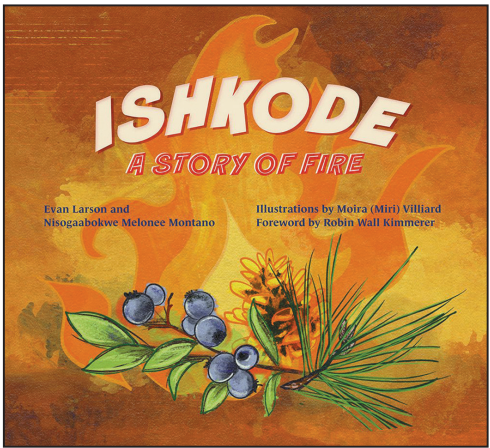
It struck me that this is something children should learn early, before fear becomes the only story they know. And now there’s a children’s book called Ishkode: A story of fire that tries to do exactly that.
The idea behind Ishkode didn’t begin with a plan. It was more of a spark. Evan Larson, a professor of Department of Environmental Sciences and Society at the University of Wisconsin– Platteville, had been talking with Robin Kimmerer about the language of trees and how knowledge moves through the world. Somewhere in that conversation, the core of the story arrived.
“In one big brainstorm, or vision, the core of it just landed,” Larson said. “It was very clearly an important story that needed to be shared.”
He carried it for a while, knowing it wasn’t his alone. He brought it to Nisogaabokwe Melonee Montano, a member of the Red Cliff Band of Lake Superior Chippewa and owner of Ethical Embers LLC, a company that helps communities incorporate Indigenous practices into land management efforts.
“Fire has been an integral part of our culture,” Montano said. “Ceremonies, stories, elders. It was always around me.”
One teaching rose immediately for her: the crow bringing fire to the people. A story she had heard since childhood. She felt it belonged inside the story that would become Ishkode.
“That was something I felt strong about,” Montano said. “We needed to pull in some of those common stories that have been passed down through our people.”
She had also been watching something shift. People were asking new questions. People were reconsidering fear and were imagining fire as a relationship instead of a threat.
“It does seem like there’s a movement emerging around it,” Montano said. “People really care and want to learn how they can shift their worldview.”
By the time the story reached artist Moira Villiard, it already had roots. What she added was motion.
“I am cursed with a constant hallucinatory state as an artist,” Villiard said. “As soon as anyone says anything, I see stuff.”
Villiard is a Fond du Lac Ojibwe direct descendant and a multidisciplinary artist. She had just gotten an iPad, was learning Procreate, and was ready for a project that would stretch her. She had also recently curated an exhibit by Fond du Lac elder Vern Northrup, whose photographs documented prescribed fire and blueberries. Those images stayed with her. That blackened ground with those bright berries. The way fire reveals the structure of a place.
“It was eye-opening to think about how different the landscape was not that long ago,” Villiard said.
She began sketching as she listened to her co-collaborators. She wanted the book to feel new but also touched by something older.
“I wanted to make it feel real but also somewhat magical,” Villiard said. “Make the mundane feel magical.”
She worked with Larson and Montano to make sure the forest looked right. She learned how to draw characters consistently from different angles.
“I’m not really a narrative drawer,” Villiard laughed. “So this was a major lesson for me.”
But she figured it out. And she figured out something else too: How to tell the parts of the story the text didn’t say.
“You’re adding to it,” she said. “Figuring out what other stories can be told in the pictures.”
The burn sequence required some additional thought on her approach but the result is a work of art. Figures moving through a prescribed fire, drawn almost like an instruction manual. Clear and calm. A way for children, and adults, to see fire as something people can work with, not run from.
Larson told me about walking his daughters to the school bus near Brainerd and stumbling onto an old fire-scarred red pine stump. He had been going by it for forty years and never noticed it. When he sampled the stump, he found the same fire history he had been studying in the Boundary Waters. The same story. The same relationship.
“It was exactly the same story,” Larson said. “The implications are that this history is connected to every inch of this place.”
His daughters helped him sample the stump. They’ve helped with small burns in prairie patches and have grown up watching him work with fire.
“They love the book,” Larson said.
“They got to meet Moira when she was first creating the characters.” He also reflected on how fire was framed for earlier generations.
“There’s a scene in Bambi that was transformative for how people thought about fire,” he said. “It made fire seem like this terrible, dangerous, destructive thing we need to avoid at all costs. But the vast majority of fires that would have burned here would have been fundamentally different. Beautiful, slow, creeping fires. Fires you could walk around.”
Montano sees that understanding returning. Communities are learning about cultural burning again. People are in conversations about prescribed fire and there is an upcoming burn on Minnesota Point, the first in 180 years.
“It’s going to be an emotional one,” Montano said. “But in a really powerful way.”
She has sat in circles lit by flame. She has watched people open up in ways they don’t in other settings.
“It has brought about wisdom and laughter and healing,” Montano said. “A lot shared that likely wouldn’t have come out in other spaces.”
She carries language with her. The book includes Ojibwe words, and she hopes to help translate the entire book into Ojibwe and possibly Spanish. Montano pointed out that the Ojibwe word for great-grandparent is the same as the word for great-grandchild.
“It’s like those generations cycling back around,” Montano said. Villiard believes art and science aren’t separate.
“They overlap completely,” she said. “The most innovation happens when you learn them together.”
All three collaborators are excited about next steps for Ishkode. They received funding to create a short animated film based on the book. They’re meeting with MIGIZI Communications, a Native youth digital media hub, to explore ways to involve young people in the animation process and in learning about fire.
Larson is excited to see Villiard’s artwork take on another medium.
“I cannot wait to see it moving,” he said.
The title of the proposal that funded the book was Nimaawanji’idimin Giiwitaashkoden. “Together we are gathering around the fire.”
Larson said it applies to campfires, wood stoves, cook stoves, prescribed burns. Anything that brings people together.
“If anything, we need connection now more than ever,” he said.
“The fire is calling upon us,” Montano added. “To rebuild our relationships with it. To reconnect with each other and heal together.”
Together we are gathering around the fire. And the fire is gathering around us too.
To learn more about Ishkode: A Story of Fire visit ishkode.org or the University of Minnesota Press at upress.umn.edu.