


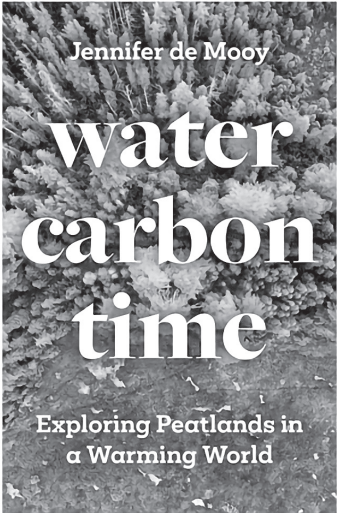
On rough days, my work girlfriends and I joke about quitting, disappearing into the swamps, and living out our lives as bog witches. The joke is only partly a joke: bogs exert a pull through their quiet, solitude, and strange beauty. In her new book, Water, Carbon, Time: Exploring Peatlands in a Warming World, Jennifer de Mooy invites readers beneath that quiet surface, revealing landscapes as varied as they are vital to the climate.
De Mooy traces her fascination with peatlands to a trip to Ireland with her father, where small peat fires warmed their cottage in the evenings. She remembers the hillsides, the weather, and the atmosphere surrounding those fires.
“We would make a little fire to warm up the sitting room and we burned peat,” she said.
Her family bought dried briquettes at the local grocery store, and she enjoyed the way they glowed as they burned. Driving past swales of bog cotton and watching people cut peat by hand and stack the bricks to dry in the sun made the connection between landscape and fire feel almost enchanted.
“It just was kind of a magical connection in my mind,” she said.
Already working in conservation after studying geography in college and spending several years with The Nature Conservancy, de Mooy viewed the landscape with a naturalist’s eye even though the trip was a vacation. Her father loved Ireland and returned each summer to the small cottage he kept there.
After her father died in 1994, circumstances required de Mooy and her brother to sell the cottage, but the memory stayed with her. Years later, when she encountered peatlands again through climate science, that old spark rose to the surface.
That memory gave her a personal way into a landscape she would later approach through conservation and climate science.
When de Mooy began working on Water, Carbon, Time, she knew she was not writing a textbook. She was building a story.
“I really love narrative nonfiction because I like to learn something new about the subject,” she said. “But I also want to feel something about the subject as well.”
She wanted readers to travel with her geographically and intellectually, discovering how peatlands differ from place to place and why they matter.
Her climate-policy work had shown her the seriousness of the subject, but she did not want that weight to overwhelm readers. She aimed to make the science understandable without diminishing its urgency.
“I wanted to translate that to people in a way that helped inform their understanding of it without all the sort of fear and trembling that comes along with the subject of climate change,” she said.
De Mooy’s beginner’s perspective shaped the book from the start. Although her background was in conservation and climate policy, peatland ecology was not her specialty; eight or nine years ago, she began studying it from scratch, step by step.
“I wanted to write in a way that was accessible to people that don’t have necessarily a science or academic or technical background,” she said.
As she traveled, one of the first things she noticed was how different peatlands looked from one another.
“I think sort of the repeated surprise throughout my travels and my research on this is just the incredible diversity of peatlands,” she said.
Northern peatlands share some traits, yet even Minnesota’s Sax Zim Bog and Big Bog differ from each other. Farther afield, climate and topography shaped Alaska’s peatlands, while Peru’s reflected a tropical setting—variations that challenged any single image of what a peatland should look like.
“There’s not a really sort of archetypal peatland,” she said. “A peatland looks different in different places.”
That curiosity shaped the geographic scope of her research. Much of the scientific literature she found focused on Europe, where peatlands have long histories of human use and study. She wanted to explore peatlands across the Western Hemisphere instead, looking at North, Central, and South America.
Minnesota gave de Mooy two useful points of comparison: Sax Zim Bog and Big Bog. Their differences illustrate the variety within the region, while their familiarity gives local readers a way to connect the wet lowlands and stunted trees they may have passed with peatlands’ global significance.
Peatlands hold an outsized place in the global climate system, something de Mooy said many readers may not realize. Her background in climate policy shaped the way she approached the book, especially when explaining how natural habitats function in the carbon cycle. She wanted people to understand that these quiet, often overlooked landscapes store enormous amounts of carbon and play a meaningful role in climate stability.
“I think people are still concerned about climate change and don’t have a really good grasp on the science behind it,” she said.
She hoped the book would help bridge that gap, offering both the ecological value of peatlands and the climate story woven through them.
From the roadside, peatlands can look simple. Beneath the surface, however, slowly accumulating plant material locks away carbon for centuries, making these landscapes powerful carbon reservoirs. For de Mooy, that means protecting peatlands is both a conservation priority and a climate imperative.
“That’s one of the things that I wanted to convey in the book,” she said. “Both the value of peatlands as ecosystems, but also the importance of natural habitats in terms of climate change and how they function in the carbon cycle.”
Artist Jeff Matheson created the illustrations. De Mooy had admired his earlier work and initially asked him to make a few maps for her book proposal; when he suggested pairing them with simple drawings, she loved the idea.
“To me it looked like something that you would see in like a naturalist’s notebook, like something that someone might sketch in the field,” she said.
The style felt right for a book built on travel, observation, and curiosity.
De Mooy will visit Zenith Bookstore in Duluth on November 5. Clinton Dexter Ninehouse, head naturalist at Sax Zim Bog, will introduce her and discuss the bog’s role in the book.
De Mooy plans to talk about how the project came together, read a few short excerpts, and take questions from the audience.
Readers who want to begin exploring before the event can find recent interviews and podcasts, including a short conversation on Minnesota Public Radio’s Minnesota Now, at the U of M Press website, www.upress.umn.edu. Together, those conversations offer another way into the quiet, complex landscapes at the heart of Water, Carbon, Time.