


I love watching the sides of the roads for all the adorable little bunnies, the alternatively nervous and bold grouse, and any other cute critter I happen to come across while traveling the back roads in the North Woods. The ditches feel like their own small world, full of quick movements and quiet pauses, and I have fallen into the habit of scanning them the way some people check the sky. This year the bunnies have been everywhere, darting in and out of the grasses like they own the place, and I have grown used to seeing them on every drive. So has my dog, Loki. But I noticed I was not seeing them as often in the last couple of weeks. The change was subtle at first, just a quieting of motion along the ditches. The grasses that had been full of little leaps and starts seemed still, as if the small world I watched each day had taken a breath. I found myself wondering where the bunnies had gone, and why the roadside felt different.
Perhaps I ran into part of the reason why. I was still thinking about the missing bunnies when a hawk swept across the front of my vehicle, its tail feathers only inches from the windshield. I slowed, though it did not seem bothered. It moved with a kind of deliberate grace, almost as if it wanted to be seen, a quiet invitation to pay attention. It skimmed the edge of the road and lifted into the trees, leaving me with the sense that I had witnessed something purposeful.
Since then, I have been seeing hawks everywhere. Four just on my way home from town. One carried a mouse in its talons, the small body hanging limp as the bird lifted off the ditch. Another perched high on a power line, keeping its eye on the ground while I kept mine on the bird, the two of us separated by a thin line of electricity. They are beautiful, these birds, slim and brown and white, built for quick choices and quiet confidence.
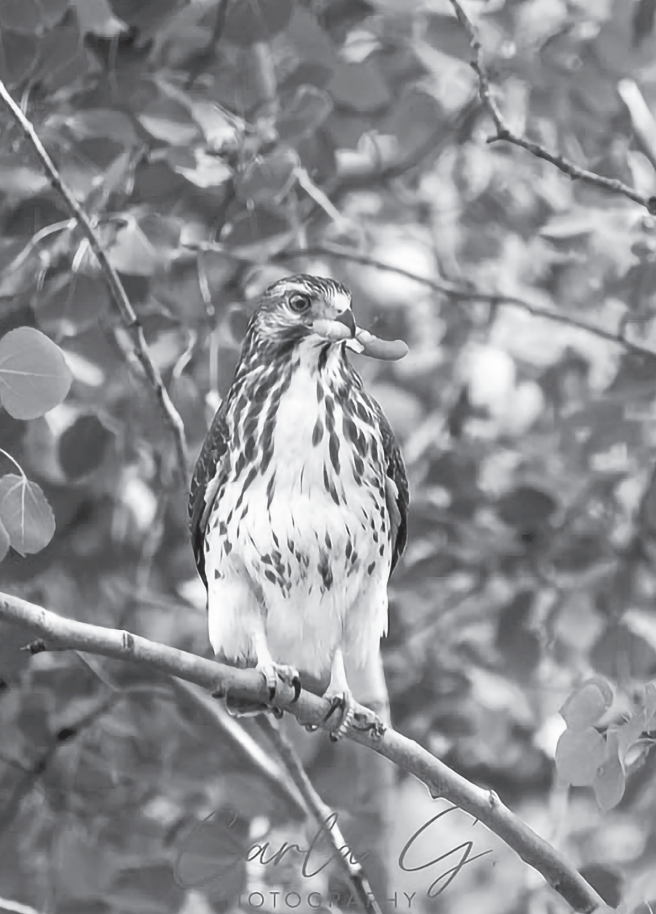
I believe what I am seeing are Cooper’s Hawks, though I am not a birdologist, and I know juvenile Broad-winged Hawks can look similar at a glance. Both species move through this area in late summer, and both carry that brown and white pattern that catches the eye.
Broad-wings tend to be stockier, with shorter tails and a more compact shape, while Cooper’s look longer and leaner, built for weaving through branches. On the road, with only a few seconds to take in a bird’s shape, it can be hard to be certain. What I do know is that both species use these woods in late summer, and both have a way of appearing just when the landscape feels like it is shifting.
Cooper’s Hawks have long lived in the mixed spruce and aspen around the area, but late summer is when they become easiest to notice. Young birds leave the nest in August and begin learning to hunt on their own. Adults shift their territories as prey populations change. The woods feel full of motion, and the hawks take advantage of it. A wildlife biologist once described Cooper’s as “arrows with feathers,” a line that fits the way they move through these trees.
Broad-winged Hawks have their own rhythm here. They nest deeper in the woods and stay quieter through most of the summer, slipping between branches in a way that makes them easy to miss. Juveniles begin to wander in August, following instinct more than experience, and sometimes they end up near roads and clearings where people finally notice them.
Cooper’s Hawks also have a long history in northeastern Minnesota. They were once considered shy woodland hunters, slipping through mature spruce and aspen stands where few people ever saw them. As the forests changed over the last century and younger stands grew back after logging, the hawks adapted. They began nesting closer to clearings, roads, and the edges of rural homes. By the late twentieth century, they were no longer rare in St. Louis County. Today they are steady residents, moving through the woods with the same confidence they have always had, but far easier to notice than they once were.
Migration adds another layer. Cooper’s Hawks do not travel in the dramatic kettles that Broad-winged Hawks form, but they do move south in a loose, quiet flow from September into October. Broad-wings gather in large swirling groups before heading south, yet many juveniles pass through alone.
We sit close enough to the Hawk Ridge flyway that our local birds mingle with migrants passing through. On some days, you can see both residents and travelers, each following its own path through the sky, the steady rhythm of late-season movement unfolding above the trees.
Their presence this year may be tied to the abundance of young rabbits and grouse. Cooper’s Hawks are versatile hunters, taking mice, chipmunks, small rabbits, and unwary birds. Broad-wings rely more on small mammals and insects, but they will take advantage of whatever the woods offer. A summer with plentiful prey often leads to a late summer with plentiful hawks, and the balance shifts almost without notice. Well, Loki will notice when the bunnies are back for sure.
Watching for hawks has become part of my daily rhythm. The season will shift again soon, and the balance will change with it, but for now the hawks hold the stage, and the forest seems to lean quietly in their direction.
As I searched for images to try to identify the hawks I had encountered, I ran into Carla Goldschmidt’s (of Carla G Photography) wonderful photo taken recently at the Gunflint Trail. She advised that the consensus is that it’s a juvenile broad-winged hawk. Her photos can be found at carla-g-photography.pixieset.com/artprint and Carla G Photography on Facebook.