


If you have electrical questions you’d like answered in a future edition of this column, send them to the Editor at northshorejournal@gmail.com, or email John directly at john@clovervalleyelectric.com.
Why does a 100-watt incandescent bulb use so much more energy than an LED?
Fair warning: I have a degree in electrical engineering, and this question is a little like handing me the keys to the candy store. When you buy an LED that says it is a “100-watt replacement” on the box, that means the bulb is going to make about 1,600 lumens of visible light. In a perfect world, light at the peak of human visual sensitivity can reach about 683 lumens per watt of input power. But that is for a specific wavelength of green light, not the kind of white light we want in a house. For “normal” white light, the lumens per watt is much lower. From a physics standpoint, 1,600 lumens (green light only) has a floor of only a little over 6 watts. The real question is how low a bulb producing “white” light can get. An LED bulb gets there the (currently) most efficient way. In an LED, electrons move through a semiconductor and release energy directly as light (photons) by breaking the “bandgap” of the semiconductor. The bulb does not need to heat up a filament first. That is why a modern LED bulb can make that 1,600 lumens of “white light” while drawing only around 14 or 15 watts from the wall. There are still some losses in the electronics inside the bulb because your house supplies alternating current, and the LED itself requires direct current, but it is still a remarkably efficient way to make light.
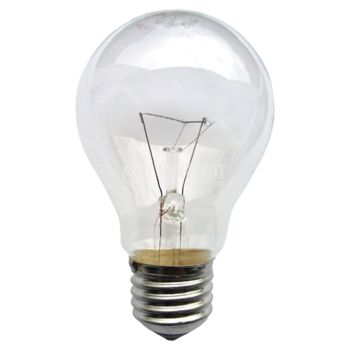
An incandescent bulb does things the hard way – electric current runs through a tungsten filament and heats up the thin wire until it glows white-hot. The trouble is that a hot filament does not just give off visible light. It gives off a broad spectrum of light, and most of that light energy lands in the infrared spectrum, which our human eyes cannot see. That is why a typical incandescent bulb only manages around 15-16 lumens of visible light per input watt of electricity. To get the same 1,600 lumens of visible light, an incandescent needs the full 100 watts of input power. Since most of the input energy really does leave as heat in the form of infrared light, the old joke is basically true: an incandescent bulb is mostly a space heater that happens to make some light.
We could reduce the amount of IR light emitted from incandescent bulbs by making them operate at higher temperatures. Hotter thermal radiators do shift more of their output into visible light, but incandescent lamps run into a built-in materials limit. Tungsten filaments can only get to about 6,192 degrees F before they melt. That ceiling is baked into the metallurgy. It is not that engineers failed to optimize the incandescent bulb. It is that the materials have internal limits.
Now here is the part that makes this more interesting. Those so called wasted infrared wavelengths from incandescent bulbs may not be completely irrelevant to us. In January 2026, a small study published in Scientific Reports found that office workers under LED lighting did better on color-contrast testing after two weeks of added incandescent lighting. The authors proposed that deeper red and infrared wavelengths might help support mitochondrial function in retinal cells of human eyes. That is a fascinating result, but it is still early evidence, not a final verdict on everyday lighting.
I bring this up with caution. For normal home and office use, LEDs are much better than incandescent on efficiency, lifespan, and operating cost. So far, scientific studies looking at LED health questions have not concluded that normal LED lighting is causing injury to the general population. At the same time, they have said there are still questions worth studying around spectrum, circadian effects, flicker, and long-term exposure.
I think that is the engineering irony here. In getting much better at making light efficiently, we may also have changed the mix of wavelengths humans have relied on for centuries. That does not mean we should all go screw incandescent bulbs back into every fixture in the house. But it does mean the story of lighting is probably not finished yet. In the meantime, daylight is still the gold standard. So, as spring arrives on the North Shore, the outdoors gives us all something no bulb has fully matched.
This column is open for reader feedback and questions. If you have an electrical question or are curious how something works in your electrical system, please send over a question.
John Christensen is a licensed Master Electrician in Minnesota and has a bachelor’s degree in electrical engineering from the University of Minnesota – Duluth. If you have electrical questions you’d like answered in a future edition of this column, send them to the editor, or email John directly at john@clovervalleyelectric.com
The advice provided in this column is intended for general informational purposes only. If you have specific concerns or a situation requiring professional assistance, you should consult with a qualified professional for advice or service tailored to your individual circumstances. The author, this newspaper, and publisher are not responsible for the outcomes or results of following any advice from this column. You are solely responsible for your actions.