

If you have electrical questions you’d like answered in a future edition of this column, send them to the Editor at northshorejournal@gmail.com, or email John directly at john@clovervalleyelectric.com.
Mixed Breakers in the Panel: When “It Fits” Doesn’t Mean “It’s Right”
A reader and column follower called me last week after recently purchasing a home with a 100-amp electrical panel. His home inspector found circuit breakers from four different manufacturers – Westinghouse, Eaton BR, GE, and SquareD Homeline – and flagged that in his report. The reader figured all the breakers should match the panel as noted in the report, but wasn’t sure if it really mattered. His thinking was that if the breakers feel tight, everything should be fine – a loose breaker would be the real concern. It’s a good question, and one worth unpacking. The US Postal Service may tell you “if it fits, it ships” – but that philosophy does not quite work with electrical systems and their components.
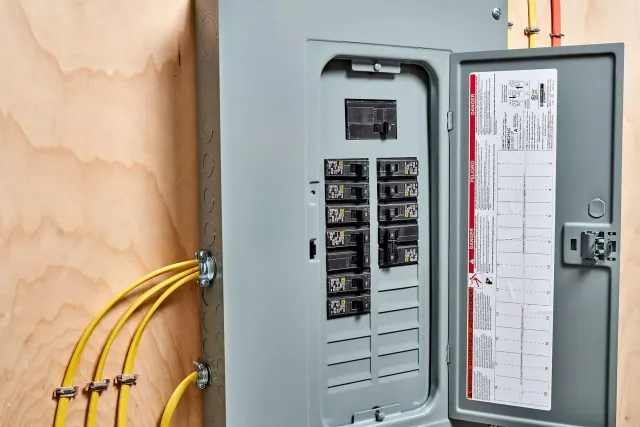
The inspector (and reader) is not wrong that a loose connection is the problem. When a breaker doesn’t make solid contact with the bus bar in the panel – the metal bars inside the panel that distribute electric power to each branch circuit – that poor connection creates resistance, and resistance creates heat. Over time, that heat can damage the breaker, the bus bar, and the surrounding plastic components.
Electrical panels and their breakers are designed, tested, and listed as a brand-matched system. The breaker’s clip is engineered to make proper contact with the bus bar in that specific panel. When the manufacturer submits equipment for safety testing, they test it with specific breakers – and those are the breakers listed on the panel’s label. The 2023 National Electrical Code, Section 110.3(B), requires that listed equipment be installed per the manufacturer’s instructions and labeling. The panel label should tell you what breakers belong in the panel, even on much older panels.
The reason this matters beyond whether the breaker snaps into place is that each manufacturer designs the contact geometry between breaker and bus bar a little differently. A breaker from another brand might clip on and feel secure, but if the contact surface isn’t quite right, the connection will experience more resistance than it should. That generates heat – maybe not enough to notice today, but enough to potentially cause damage over time. It is also worth noting that when a breaker needs to trip during a fault, performance depends on the tested combination.
There is one legitimate exception. Some manufacturers produce “UL Classified” breakers – breakers specifically tested and approved for use in another manufacturer’s panel. Eaton, for example, makes a “CL” series classified for certain GE, Siemens, and Square D panels. The key detail is that classified breakers come with a compatibility list naming the exact panels they are approved for. “UL Classified” is different from “UL Listed” in this context – it is a specific, documented cross-brand approval. If a breaker doesn’t carry that classification for the panel it’s in, it doesn’t belong there.
For our reader – a Westinghouse panel with Eaton BR, GE, Westinghouse, and Homeline mixed in – there is actually some good news. Westinghouse panels have a manufacturer history – Bryant, Westinghouse, Cutler-Hammer, and Eaton. Today, Eaton BR series breakers are the correct OEM replacement for that panel line, meaning the Eaton BR and Westinghouse breakers likely belong. The GE and Homeline breakers are a different story – those are designed for their own panel families and are almost certainly not listed for a Westinghouse panel. Two out of four is a start, but the other two still need attention.
The practical next step is to look at the panel label, verify which breakers are listed for it, and check the bus bars for signs of heat damage – discoloration, pitting, or melted plastic. If mismatched breakers have been in service for a while, there may be damage present even if everything seems to work. Changing out breakers is not a difficult task. If you are considering a DIY project – it is important to deenergize the panel, verify that the wiring is in good shape and the right size for the breaker selected, and make sure the breaker seats correctly. If in doubt about anything with your panel or wiring, it is a good idea to consult with a licensed electrical contractor.
This column is open for reader feedback and questions. If you have an electrical question or are curious how something works in your electrical system, please send over a question.
John Christensen is a licensed Master Electrician in Minnesota and has a bachelor’s degree in electrical engineering from the University of Minnesota – Duluth. If you have electrical questions you’d like answered in a future edition of this column, send them to the editor, or email John directly at john@clovervalleyelectric.com
The advice provided in this column is intended for general informational purposes only. If you have specific concerns or a situation requiring professional assistance, you should consult with a qualified professional for advice or service tailored to your individual circumstances. The author, this newspaper, and publisher are not responsible for the outcomes or results of following any advice from this column. You are solely responsible for your actions.