


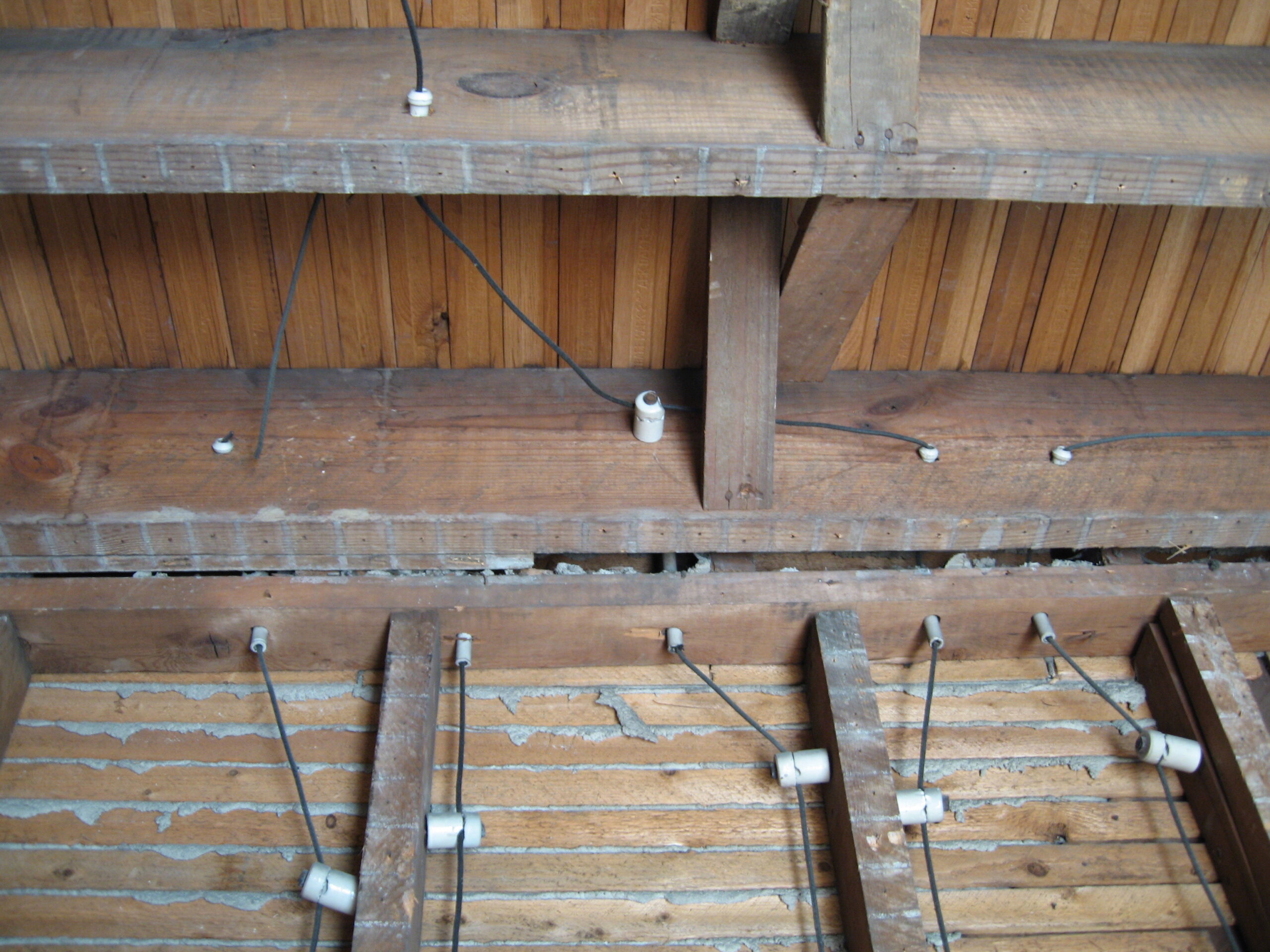
Wiring From Another Era: Knob and Tube
If you’ve ever peeked into an attic, crawl space, or basement in an older building or home and noticed little white porcelain pieces attached to framing, you may have been looking at Knob and Tube (K&T) wiring. It’s a piece of electrical history that still shows up regularly in our region.
When discovered, the first two questions are often: “Is it active or live?” and “Is it dangerous?” Assuming the answer to the first question is “yes”, then the third question is: “Do we need to replace it?”
Knob and Tube is an early wiring method used in many homes and buildings starting in the late 1800s and continuing until sometime around the 1940s. A key characteristic is separate hot and neutral conductors through framing on porcelain supports, and the wiring method typically has no equipment grounding conductor – the “ground wire” common in modern wiring.
Knob and Tube became prevalent in “then modern” buildings because it worked well. Electrical use was lighter – literally – as electric lights were just starting to replace gas lamps. Things like electric ranges, microwaves, air conditioning, electric refrigerators, and computers were not even on the horizon. The porcelain knobs and tubes were a practical way to route individual conductors through wood framing and protect them as they passed through joists and studs.
Since the late 1800s, the demand we place on our electrical systems has significantly increased. Over the decades (and century) old K&T circuits have been extended and spliced (often outside of modern electrical junction boxes), insulation has been added around conductors, and modern loads have been added to these old circuits. After 70+ years, old K&T insulation is often becoming brittle, and joints/ connections are not as robust as they used to be when first installed.
Because this wiring method is now so old, removing and replacing active K&T is increasingly becoming the leading “good idea” for safety, reliability, and future use – even if it is still functional.
There’s also an insurance conversation that’s worth having sooner rather than later. If you know your building, home, or cabin still has active K&T wiring, consider talking with your insurance agent now and ask directly whether the property is covered for electrical fires in its current condition. Our business insurance broker has told us that many major carriers are hesitant to write new policies – both homeowners and commercial – on properties with active K&T until it’s removed and replaced. We have also worked with clients who were unable to obtain coverage for that same reason.
If you have a structure with active K&T – or are unsure if what you see is active – consider working with one of the electrical contractors in the region to assess the situation before you make any further plans. Dealing with Knob and Tube is more challenging than most older wiring methods, and while I like “DIY” projects, this is not one I would recommend to most folks.
This column is looking for reader feedback and questions. If you have an electrical question or are curious about how something works related to your electrical system, send over an email.
————————————————————–
The advice provided in this column is intended for general informational purposes only. If you have specific concerns or a situation requiring professional assistance, you should consult with a qualified professional for advice or service tailored to your individual circumstances. The author, this newspaper, and publisher are not responsible for the outcomes or results of following any advice from this column. You are solely responsible for your actions.