
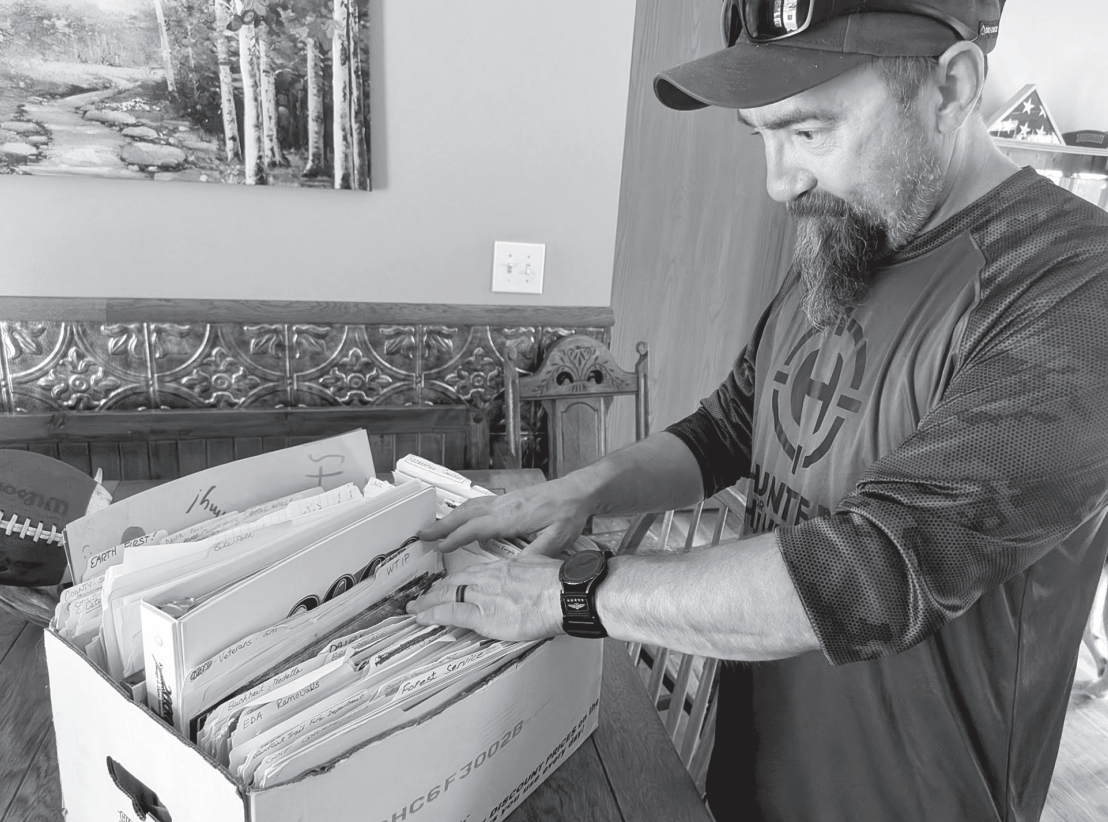
GRAND MARAIS – When Benny Silence handed me the box of his mother’s writing, he had tears in his eyes.
The box, full of handwritten notes the late Rhonda Silence kept during her decades reporting local news across Cook County and the Boundary Waters region, is a treasure chest of local news. Inside the white cardboard box are Rhonda’s journalism notepads, scribbled ideas and quotes on all kinds of different stationery, documents she requested from various agencies, thank-you cards from people she wrote about, and other items tracing her career. The contents of the box are a time capsule of journalism from the best reporter I’ve ever worked with.
Rhonda Silence, 68, passed away at her home in August 2025. When it came to sharing local news, Rhonda was the embodiment of a community journalist. She would press her sources for information, sometimes unrelentingly so, but did it with diplomacy. Rhonda was fearless, but respectful, in her process of collecting and sharing local news.
Before she joined WTIP radio in Grand Marais in 2016, Rhonda served as editor of the community newspaper in Cook County for 16 years, first for the Cook County Star and then for the Cook County News-Herald after the two papers merged.
Along the way, she covered many stories specific to the Boundary Waters Canoe Area Wilderness. The July 4, 1999, blowdown storm was one, and there’s a large folder inside the box detailing her coverage of the event. Her notes, including one written on Budget Car & Truck rental stationery, record how much acreage was damaged by the legendary wind event that swept through the wilderness, literally breaking hundreds of thousands of trees in the process.
There’s also her coverage of a controversial snowmobile trail that ran from McFarland Lake to South Fowl Lake on the far eastern side of the Boundary Waters.
“It is a struggle between the longtime local residents to replace a historical trail they have used for years, and the outside groups,” Rhonda told the Star Tribune about the snowmobile trail.
Those “outside groups,” Rhonda told the Star Tribune, “are just causing a lot of hard feelings for the people who live on the lake, and the ice fishermen who want to catch a walleye, to ride a trail to their favorite fishing spot.”
Rhonda, who was more than 20 years my senior, taught me a lot about a healthy newsroom. Opinions can vary, and you can have your own, but a media company should be a platform for varying perspectives. Rhonda lamented the fact I was quick to interview Becky Rom, the longtime national chair of the Campaign to Save the Boundary Waters, when news surfaced about a proposed copper-nickel mine on the edge of the BWCA Wilderness, without considering other voices. Rhonda would then contact Nancy McReady from Conservationists with Common Sense, or others, to broaden and diversify our coverage. It made me uneasy at first, but in hindsight, it’s the right way to cover complex stories like proposed mines near the Boundary Waters.
It was Rhonda who first introduced me to the concept of environmental advocacy itself being an industry. The amount of influence environmental groups had and continue to have – be it those advocating to protect the BWCA, or larger organizations like Wilderness Watch and the Sierra Club – needed scrutiny as well. Indeed, the road to environmental protection is lined with deep pools of money and backroom conversations with politicians, Rhonda would claim. And she’s right. Minnesota state Sen. Grant Hauschild, a Democrat who represents the Boundary Waters region at the state Capitol, talks about this, too. Let’s get it in the open, Rhonda would plead. Let’s tell the truth.
Rhonda grew up in Grand Marais, moved away for 20-plus years, and held a variety of jobs before returning to Cook County in 1995. She worked for a stint at Arrowhead Electric Co-operative near Lutsen before she started at the local paper. After that, she took the leap to the news department at WTIP, where she remained until retiring in 2022.
Working with Rhonda and learning more about the diverse uses and history of the BWCA Wilderness had a tremendous impact on my ability to tell stories from this place. Reviewing her personal notes on stories about the Boundary Waters, news that dates back decades, reinforces that. It’s also a reminder that these stories we think are so crucial, and so timely now, are often just a new version of something that’s been happening for decades. Her notes from June 2000 about the U.S. Forest Service initiating an analysis to determine if the BWCA day use motor permit quotas for Moose, Saganaga, and South Farm lakes were excessive read as though they were written this summer. News headlines and history tend to repeat themselves. After reviewing the box of Rhonda’s notes, that became shockingly clear to me. Many of the stories dated from the 1990s and early 2000s remain in play today.
Along the way, Rhonda covered many stories beyond the Boundary Waters. Her notes about local elections, city and county governments, local tragedies and hard times the community went through are in the individual folders holding her notes and files. There’s also a folder labeled “letters.” Inside it are many dozens of handwritten cards and printed emails from people responding to her coverage of various stories Rhonda reported on over the years. The narratives vary, but the general tone of those letters is some version of “Thank you, Rhonda. You did good work covering an important topic.”
The box Benny Silence handed me this week is a reminder that the best reporters are the ones who can step back and see the whole picture, while also holding an opinion on what’s happening around them. Rhonda’s collection of reporter notes is the living embodiment of this. The box, Rhonda’s writings, and her work are living history being documented for some greater purpose. I’m someone who doesn’t cling to possessions, but Rhonda’s box of notes, the one her grown son handed over with tears in his eyes, will travel with me for the rest of my days.