


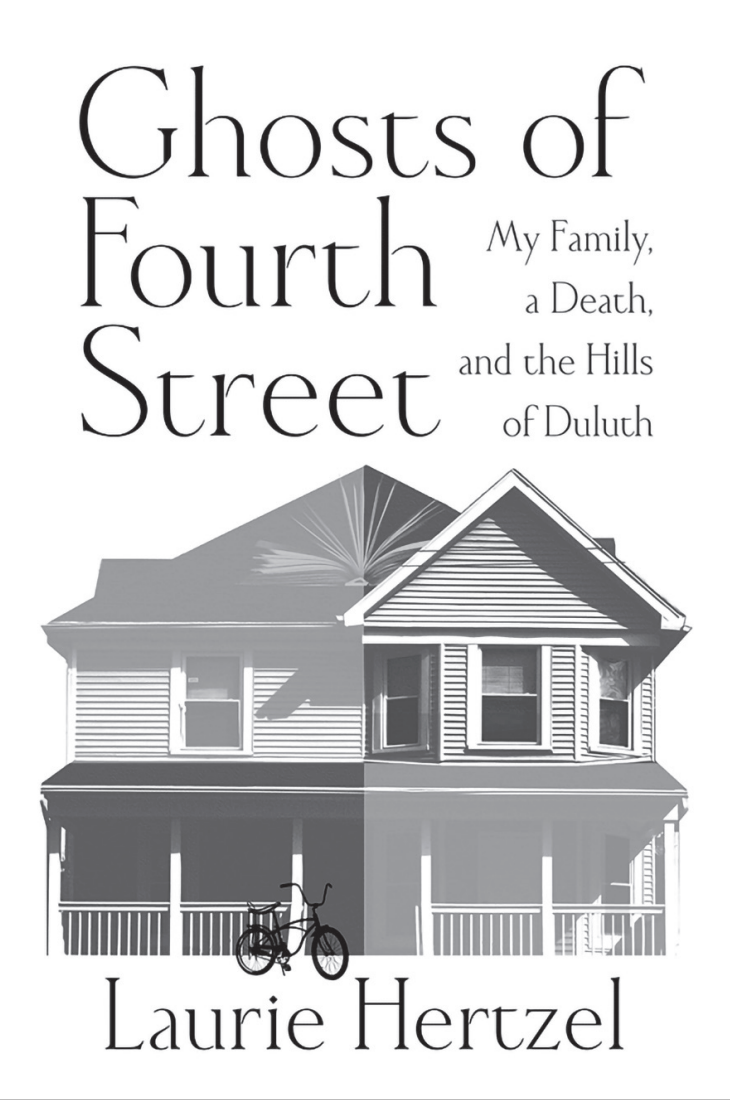
Though Laurie Hertzel is best known for her long career as a journalist, editor, critic, and teacher, I was most interested in the little girl she writes about in her new memoir, a girl she says she still feels very familiar with.
“I remember my childhood vividly,” she said. “The girl that I was, I remember.”
It is that girl who guides much of Ghosts of Fourth Street: My Family, a Death, and the Hills of Duluth, Hertzel’s newest memoir and her most personal work yet.
Hertzel’s career has long been rooted in storytelling. A lifelong journalist, she spent fifteen years as the books editor at the Minneapolis Star Tribune and now reviews for the Boston Globe, Washington Post, and Los Angeles Times. Her earlier memoir, News to Me, won a Minnesota Book Award, and she has taught at the Loft Literary Center, Ohio State University, and now serves as a Distinguished Professor of Practice in the University of Georgia’s MFA program.
Though some of that vivid recall is likely tied to the tragedy that occurred when Hertzel was nine, her perspective was also shaped by her place in the family. As child number seven of ten, she did not quite fit with the big kids or the little kids and often found herself watching from the edges.
“I did do a lot of observing,” she said. “I sat under the dining room table, and I watched what was going on.”
That instinct to watch from the edges started early. In a house crowded with ten children, Hertzel carved out quiet corners wherever she could find them.
“There was a little coat closet between the front hallway and the kitchen,” she said. “I used to go in there and hide behind the coats and sit there and listen to what was going on.”
She was not close to any one sibling, she said, and often felt like she was trying to figure out who everyone else was.
Her parents shaped that watchfulness in different ways. Her father filled the house with stories, family legends, neighborhood tales, bits of history told and retold. Her mother offered almost none. The contrast became one of the book’s central themes: the stories that defined the Hertzel family, and the silences that surrounded the aftermath of the day her brother died.
Books were always the place she could disappear. Reading was valued in the family, but for her it was more than that. It was a way to slip out of the noise and into a world she could control. She found pockets of quiet in the basement, the back bedroom, even the bathroom, which she noted “was really not a popular thing for me to do, given that there were 12 people in the house and essentially one bathroom.”
Hertzel’s world shifted when her brother died, a loss that marked her childhood even as the family rarely spoke of it.
“We just did not talk about it,” she said. “There was never a time when we all sat around the dining room table and said, ‘We need to talk about the day John died.’”
As a nine-year-old, she had no one her age to process it with, and the silence that followed became its own kind of weight. As she grew older, Hertzel found herself returning to that day again and again, trying to understand what she had witnessed and what she had not.
“Memory is very unreliable,” she said. “These are the powerful, strong memories that I have. But is this really what happened? I do not know.”
When she compared her recollections with those of her siblings, some details aligned and others did not, a reminder that each of them had lived through the same moment from a different vantage point.
Hertzel began writing about her brother’s death long before she ever imagined a book. As a teenager, and later in her twenties, she kept returning to the same scene, trying to understand what she had witnessed as a child.
“Sometimes you write toward an understanding,” she said.
When she entered her MFA program years later, she planned to write nature essays, but the memories surfaced again.
“I started writing these reminiscences of growing up,” she said. “They kind of all came together and became my thesis.”
At the time, the material felt too raw to share. Her father had died, but her mother was still alive, and Hertzel knew the story would be painful for her to read.
“I wrote it for myself,” she said. “And I just kind of put it aside.”
Still, the pull of the story never fully left her. She kept thinking about her brother, about the poems he wrote, and about how few people remembered him. In early drafts she included his poems in full, but copyright restrictions prevented her from keeping them in the final version. It remains a disappointment.
“I wanted people to remember his poems,” she said.
As Hertzel continued writing, the memoir became less about the single day her brother died and more about the long shadow it cast, the ways a family rearranges itself around a loss it never fully discusses. The book is as much about memory as it is about grief, and about the stories we inherit without realizing it.
Shaping that material was not easy. Hertzel had to decide what belonged on the page and what did not, what she remembered clearly and what she could only approach through feeling.
“You have to make choices,” she said. “You have to decide what story you are telling.”
Now, with the book finished and in readers’ hands, Hertzel is ready to talk about the story she once kept tucked away. Sharing it publicly has brought its own kind of clarity.
“It feels like the right time,” she said.
It is a story that resonates far beyond her own family, with anyone who has lived through a loss, or grown up in a house full of noise and secrets, or tried to piece together a childhood from fragments that do not always agree.
Hertzel will discuss the memoir, the writing process, and the questions that guided her work during her upcoming events. She will appear in Duluth on April 9, where she will be in conversation with novelist Leif Enger. She will also give a solo reading in Grand Marais on April 25, followed by a question and answer session. Additional events, including a signing at Fitger’s and an appearance at the Bayfield bookstore, are planned for May, with details to be announced on her website, lauriehertzel.net.
When I told Hertzel I missed her family when I reached the last page, I asked whether she would ever consider writing more about them. She laughed and replied, “My God, they would kill me.”
No more Hertzels, at least not for now. Her next book, she told me, will be about her dog, Angus, the anxious and big-hearted companion who starred in her long-running Puppy Chronicles column. I told her I would be eager to read that one too.