


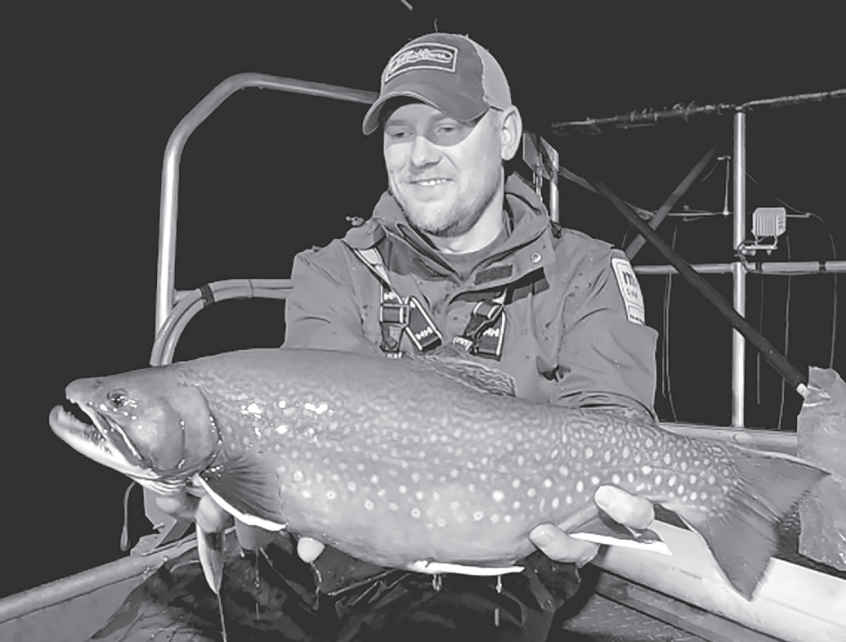
GRAND MARAIS – The Minnesota Department of Natural Resources is considering shutting down fall fishing in the harbor of this Lake Superior tourist town to protect brook trout that were only recently discovered to be spawning here.
Unwanted angler pressure on the brook trout, known as “coasters” or “coaster brook trout” in Lake Superior waters, is adding to the urgency of the DNR’s consideration to shut down the harbor to fall fishing. “Although the fishing season for brook trout is closed when fish are present in the harbor, anglers are still impacting the population while fishing for other species,” the DNR states in a survey currently available for the public to weigh in on regarding the possible closure of the Grand Marais Harbor to fall fishing.
If approved, the harbor would close to fishing for all species Sept. 30 each year, likely starting in 2027. It would include only the area inside of the harbor’s breakwall perimeter and the interior shoreline of the harbor, which includes the docks near North House Folk School, the municipal campground, and the shoreline near the old Coast Guard building. The closure would run through December. In addition to the closure, the harbor would be listed as a designated spawning bed and fish preserve, according to the DNR.
The potential closure of the harbor to fall fishing follows a recently discovered shoreline-spawning coaster brook trout population in Minnesota waters of Lake Superior. This harbor is one of only two or three known shoreline-spawning habitats for coaster brook trout, according to a new report from the DNR focused on the spawning brook trout in the Grand Marais Harbor.
Paddle & Portage media spoke with numerous DNR officials for this story. They confirmed that “dozens” of anglers in recent years, including local anglers, Duluth residents, and people traveling from the Twin Cities, have caught coaster brook trout in the harbor during late October and early November when the coasters are spawning there. At least one angler told the DNR they were “fishing for salmon” and “accidentally” caught a coaster. Salmon fishing is open continually in these waters, while brook trout season ends Sept. 30 in Minnesota’s Lake Superior waters. The issue has not been with harvesting brook trout, the DNR official said. The issue is anglers catching the brook trout out of season, posing for photographs, and then releasing the fish.
Some of the fish spawning in the Grand Marais Harbor during recent years are the Nipigon strain, meaning they are descendants or traveled from Canada’s Nipigon River, a world-class trout fishery. Other fish are the Isle Royale strain of coaster brook trout, according to Cory Goldsworthy, the DNR’s Lake Superior area fisheries supervisor based in Knife River. The DNR estimates approximately 300 adult brook trout, some of them measuring 25 inches in length, used the harbor as a spawning ground during between late October and early November in 2025. The notion to close the harbor to fall fishing would eliminate the gray area some anglers might take in saying they are fishing for another species and that they then “accidentally” caught a coaster brook trout.
“These proposed changes are intended to bring clarity to complex rules and strengthen fish conservation efforts which, in the long run, would improve fishing in these waters,” said John Dunn, DNR fisheries rules and regulations coordinator.
The story of coaster brook trout in Lake Superior is one of redemption. The trout, which were once abundant along the North Shore, were nearly fished to extinction in the late 1800s and into the 1900s, which also included an era of habitat destruction in the 1900s. That near-collapse was followed by a multi-decade rehabilitation by the DNR and partners, including the Grand Portage Band of Lake Superior Chippewa.
“Coaster brook trout are culturally important, socially important, and recreationally important in Lake Superior,” Goldsworthy said.