


The trailhead for the Bean and Bear Lakes Loop was booming last Friday, on a lovely mild yet late September day, just on the cusp of fall colors. It seemed perfect for holding the trail’s ceremonial ribbon cutting, celebrating the completion of an extensive rehaul to make it safer and more durable for years to come. The mood was light and casual, with speakers routinely pausing to allow hikers, and at one point a full ATV, to pass by.
The crowd gathered just west of the City of Silver Bay included several notable figures, among them Minnesota Representative Roger Skraba, Silver Bay Mayor Wade LeBlanc, and Silver Bay Councilor James FitzGerald. Superior Hiking Trail Association Development and Communications Director Mackenzie Foley began the event by thanking attendees, board members, elected officials, volunteers, members, funders, and donors. “It really takes everybody coming together to make things like this possible,” she said, handing off to Superior Hiking Trail Association Board Chair Myrtle Turnquist for an explanation of the project.
Turnquist described the 6.5-mile Bean and Bear Lakes Loop as “well-known, well-loved, and a well-used section of the Superior Hiking Trail,” popular on social media and with over 17,000 annual user visits. Partly because of its popularity and the wear and tear as a result, the loop’s renovation has been on the Superior Hiking Trail Association’s agenda for over a decade. The Association launched the Trail Renewal Program in 2017, soon after receiving aid from the Legislative-Citizen Commission on Minnesota Resources (LCCMR)’s Environment and Natural Resources Trust Fund (ENRTF), which continued to fund the project through the bulk of its expenses into 2025.
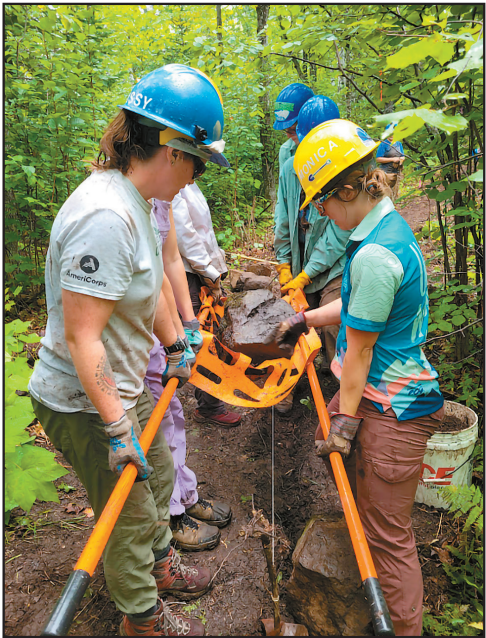
An assessment of the trail by volunteers and contracted experts concluded with several proposed improvements, among them rock armoring, boardwalk installation, stone steps, and significant trail rerouting. A similar assessment for the attached campsite was reviewed by Dr. Jeffrey Marion, now-retired U.S. Geological Survey Recreation Ecologist, who specializes in sustainable campsite management. The project was off to a strong start.
Unfortunately, the COVID pandemic put a temporary halt to the project, delaying substantial progress for two years until 2022. When workers felt they could finally safely collaborate again, the Association partnered with Trail Eyes LLC’s Tim Malzhan to complete a 1,800-foot reroute with support of 1,400 volunteer hours. Although the renovated portion of the trail was a success, the challenging terrain and complex scope required taking a step back to find a more efficient way to tackle the project as a whole. The trail was eventually temporarily closed for two years of intensive renovations in 2024 and 2025, which Turnquist described as scary to do, especially during peak season. The public handled the situation well, however, and by 2026 the trail reopened, needing only touch-ups before its completion.
She thanked builders Trail Source, Trail Eyes, Great Lakes Trailbuilders, and the Conservation Corps of Minnesota and Iowa for their work on the project, as well as North Country Trail Association, Rocksteady Running, and Unruly Women for their financial contributions.
Superior Hiking Trail Association Trail Operations Director Tamer Ibrahim was next to give his perspective on the renewal project. Turnquist introduced him as having overseen the entire project, developed the scope of the work, hired and supported the contractors, and directed volunteers. Ibrahim began in 2017, with the initial completion of the Superior Hiking Trail. The start of the Trail Renewal Program afterwards was meant to take “a more strategic approach to maintaining the Superior Hiking Trail with a focus on long-term sustainability of the trail as well as user safety and enjoyability.” This, he stated, would be a stronger alternative to applying “band-aid fixes” to issues as they appeared across the 300-mile trail.
After a review of which sections of trail needed help the most, Bean and Bear was identified as the worst of the worst, hindered by steep terrain and a high number of visitors. Including volunteers in renovating the trail was a top priority for the Association, and they provided training in skills such as trail construction, trail drainage, building with stone, boardwalk construction, and campsite sustainability. The Association now takes the stance of constantly assessing trail conditions and planning new projects. “Know that we’re constantly planning for the future,” Ibrahim said. “Can’t stand still for too long.”
Tettegouche State Park Manager Katie Foshay expressed her thanks on behalf of the Minnesota Department of Natural Resources (MnDNR), noting “people come from near and far to experience the Superior Hiking Trail and the incredible landscapes along Minnesota’s North Shore” and their shared goal of ensuring trails such as the Bean and Bear Lakes Loop can endure for generations. She highlighted the additions of stone steps to protect eroded sections and boardwalks to shelter vulnerable plant life as two examples of improvements, making the new version of the trail both safer and more sustainable.
LCCMR Assistant Director Mike Campana followed by giving more information on the main source of funding for the project, the Environment and Natural Resources Trust Fund. The fund, which is supplied by the state lottery, has been in use for nearly 40 years to support “projects across Minnesota that protect, conserve, preserve, and enhance Minnesota’s air, land, water, fish, wildlife and other natural resources”. He provided several other examples of the types of projects aided by the fund, like the Silver Bay Multi-Modal Trailhead Center, the University of Minnesota Duluth’s Natural Resources Research Institute, a collaboration between MnDNR and the 1854 Treaty Authority on moose, and work with Great Lakes Aquarium to restore lake sturgeon to the St. Louis River. The fund also supports the Wolf Ridge Environmental Learning Center, Osprey Wilds, and scholarships for kids across state.
Demand for projects to be funded, he added, “just keeps getting greater” with every year. “While we provide the funding, it’s really the dedication of organizations like the Superior Hiking Trail Association, their volunteers, their supporters,” that make the projects happen.
Finally, Minnesota Representative Roger Skraba took a turn speaking about his enthusiasm for the trail renovations, especially as an appointed member of LCCMR for the past three years. “I’ve been a trail person my whole life,” he said, mentioning his time with the Mesabi Trail Work Group and stating his love for activities that “get people outside,” enjoying themselves and learning.
The speeches were followed by the ceremonial ribbon cutting, pausing once again to let a good-sized group of hikers pass by. The trail clearly has not suffered from its temporary closure or changes, and will hopefully provide many years of happiness to those who choose to follow its path.