


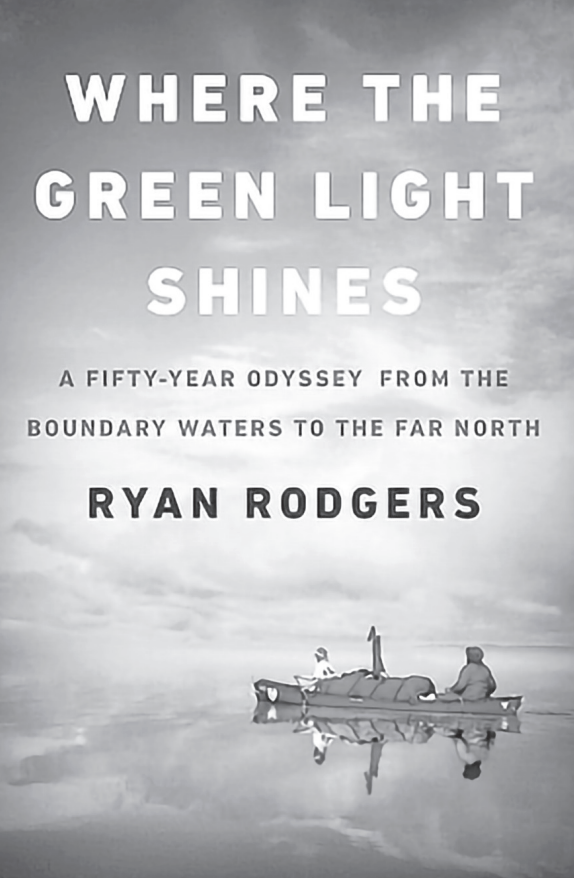
I caught author Ryan Rodgers after he returned from Isle Royale, where he had spent the last stretch of summer canoeing and hiking with his family. He called it a “last hurrah,” a quiet trip marked by good weather and almost no bugs, the kind of late-season luck northern paddlers hope for.
It was a fitting place to find him. Rodgers’ new book, Where the Green Light Shines: A Fifty-Year Odyssey from the Boundary Waters to the Far North, traces the adventures of legendary Minnesota canoeist Bob O’Hara, a man who spent more than six decades traveling through some of the most remote rivers on the continent.
Rodgers came to O’Hara’s story almost by accident. Years ago, while working on a book about cross-country skiing, someone told him he needed to talk to “this guy.” O’Hara had been a long-time ski coach. Rodgers reached out, and O’Hara replied with a canoeing résumé so dense with remote rivers and unfamiliar place names that Rodgers wasn’t sure if it was real.
“I wasn’t sure if he was pulling my leg,” he said.
But the more he researched, the more he realized the résumé was accurate. He wrote a couple of articles about O’Hara, and those pieces eventually led to the book.
When Rodgers began the project, he didn’t consider himself an expert on the far north. He had read Canoeing with the Cree and author Sigurd Olson, but not much else. Once he committed to the book, he immersed himself in the history of the region, reading widely about Arctic expeditions, Inuit travel traditions, and the explorers who first mapped the northern waterways.
“A lot of these rivers I had never heard of,” he said. “I tasked myself with reading as much as I could about the far north.”
The deeper he went, the more he realized how vast and varied the landscape truly is.
That sense of discovery shaped the book. Rodgers wanted to write more than a biography. He wanted to understand what draws people to places where weather, water, and luck determine the outcome of a day. O’Hara’s story offered a way in.
“It’s one of these remaining wildernesses on the globe,” Rodgers said. “I didn’t really know there was so much land up there and the variety of the land.”
To capture that world, Rodgers spoke with many of the people who had paddled with O’Hara over the years.
“Bob’s gone on trips with over 100 people,” he said.
Many were eager to talk, and several shared journals from their journeys, some written more than fifty years ago.
“One trip in particular, I had three different journals to go on,” Rodgers said. “It made for a well-rounded perspective of what had happened.”
Those journals revealed a pattern. For many of the paddlers, the trips were transformative.
“They had realizations during these trips that had changed the rest of their lives,” Rodgers said. The intensity of the experience pushed people to reevaluate everything. O’Hara, meanwhile, simply kept going.
“He was fully devoted to basing his year and his life around taking an annual far north trip,” Rodgers explained.
Portraying O’Hara presented its own challenges.
“It was a little difficult having so much of the book be based on one person,” Rodgers said, but O’Hara proved to be a compelling subject. “He’s very dedicated. He’s like a passionate teacher. He’s also very feisty. He can be cantankerous.”
That dynamic shaped the trips.
“It was something you had to learn to deal with that he was in charge,” Rodgers said. “It was his trip. He had planned it, so things were going to go his way.”
The trips themselves were dangerous. Many took place hundreds of miles from the nearest town with no way to communicate with the outside world.
“Now I can satellite text from anywhere on my phone,” Rodgers said. “But for decades they had no means of communication with the outside world, which is becoming a harder and harder thing to imagine.”
Even so, no one ever died on O’Hara’s trips, and no one suffered a serious injury. Some journeys pushed the limits of what was possible. O’Hara once attempted to paddle the Northwest Passage, not realizing that the route he envisioned was essentially impossible at the time because the water remained frozen year-round.
On another trip, he planned to travel up a river that did not even have a name, then portage to another that had never been run in its entirety.
“Just doing these really bold trips with the least amount of information possible,” Rodgers said. “There were some really impressive journeys he took.”
Choosing which trips to include was its own challenge. Rodgers wrote far more material than he could use, then pared it down.
“Some good material was left, but ultimately you can’t include everything,” he said. “It just gets too long.”
Rodgers has been traveling across the state to talk about the book, meeting readers who know O’Hara’s story firsthand. At a recent event in Brainerd, a man in the audience had paddled with O’Hara on routes decades earlier. At a Duluth bookstore event, two of the men profiled in the book came to hear Rodgers speak. Sharing the story with people who lived parts of it has been one of the unexpected joys of the tour.
He believes readers are drawn to O’Hara’s journeys because they remind us of something easy to forget.
“I think we’re a very cautious people,” Rodgers said. He sees it on hiking trails and in everyday life, in the way modern adventurers carry layers of backup devices and satellite messengers.
O’Hara’s trips, he said, offer a different perspective.
“I think it’s good to read about people who are taking real risks,” he explained. “They’re not necessarily being reckless, but it’s a good reminder that people are still capable of doing these impressive journeys without several sets of redundant safety features.”
For Rodgers, that is the lasting message of O’Hara’s story.
“We can still be bold,” he said. “Adventure still exists.”
Rodgers will bring that message to the Grand Marais Public Library on Saturday, September 12 at 6 p.m., where he will read from the book, talk about the writing process, and share photographs from O’Hara’s extensive far-north collection. Many of the images never made it into print, but they capture the stark beauty of the tundra rivers and the quiet determination of the paddlers who traveled them.
The author is looking forward to returning to the North Shore.
“I’m always eager for an excuse to go to Grand Marais,” he said. “Kind of Minnesota’s cool town on the big lake.”