Without Election Judges, aka Poll Workers, secure and honest voting would not happen. County Auditors, the dedicated senior election officials of Cook and Lake Counties, manage the administration of local polling places, vote tabulations, and ballot integrity. But it is the Election Judges, our neighbors and friends, who are the frontline officials at local polling places, ensuring elections run smoothly, securely, and fairly.
Every election year, a major recruiting effort begins to find and train enough Election Judges. Voter turnout in our two counties exceeds that of every county in Minnesota, and Minnesota’s turnout leads the nation. It takes many good people to support that turnout.
Asked how many people she is looking to recruit, Ronelle Radle, Interim Lake County Auditor, said, “We’ve never had too many Judges. We’re always looking for backup Judges who are trained and available to work Election Day.”
Working the polls on Election Day is a profound statement of a person’s belief in the democratic process. The time commitment is a bit longer than voting, but it is, and should be, a respected duty. To fill this critical role, you must be an eligible voter, be able to read, write, and speak English fluently, and be at least 18.
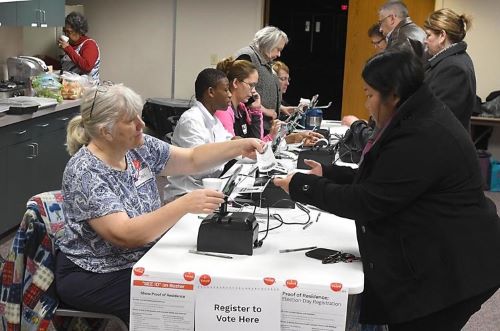
Judges help prepare the voting boundaries, set up voting booths and tabulators, and open the polling place in the morning. They greet voters, verify registration status, register new voters on-site, and assist individuals needing help completing their ballots. At the end of the day, they close the voting location, process and certify the precinct’s ballot counts, and safely pack the sensitive materials for return to the county courthouse.
Election Judges in Minnesota are considered paid officials. They receive an hourly rate for their time, including a few hours of training time. Cook County’s pay rate is advertised at $18 per hour. Lake County has not set its rate yet, but it will likely be similar.
Each Judge will complete a two hour online training session and will be certified upon completion. Head Judges in charge at polling places receive an additional hour of in-person training, a session that is also open to new judges who wish to attend. Minnesota state law requires employers to give their workers time off, with 20 days’ advance written notice, to serve as election judges. Individual election judges may choose to volunteer their time and waive their pay if they prefer to serve strictly as a civic service.
People who attend Minnesota’s partisan precinct caucuses in the winter of an election may express their interest in serving as an Election Judge. The party compiles a full list of those interested and delivers it to the Minnesota Secretary of State’s office; this long-standing process is a formal pipeline connecting grassroots political participants to the official staffing of polling places. By May 15th, the Secretary of State distributes these lists to the individual county auditors. Minnesota law requires counties to give top hiring preference to the names on these official party lists.
Once positions are filled with caucus attendees, preference is then given to those who have previously served. “We have many long-serving judges who are very good at what they do,” Radle said. She notes that their experience really helps new judges.
Finally, the public recruitment process will fill out the roster of judges, and as Radle said, there hasn’t been an election where they’ve had too many.
Finally, the state requires 50/50 partisan representation whenever two or more judges are performing certain administrative duties, including counting and reporting. The selection and orderly process is a deliberate system of checks and balances.
You might consider yourself independent and are hesitant because you don’t officially belong to a local political committee. For the purposes of being an election judge, the state considers you a member of a party if you simply support the general principles of that party’s constitution and either votedfor the majority of its candidates in the last election or intend to do so in the next one. But the applications for these positions also allow you to declare that you do not affiliate with either major party.
Serving as an election judge is a profound way to give to our community. Our elections are only as resilient as the people who step up to run them.
Cook County is offering full-or half-day shifts from 6 am to 10 pm for the Primary Election on Tuesday, August 11th, and the General Election on Tuesday, November 3rd. They also need Early Voting/ Absentee Election Judges, offering flexible part-time weekday hours, Monday-Friday, 8 am to 4 pm. Hours and Days will vary from July 27 to August 11 and from October 19 to November 3. For more information, contact Cook County Elections at (218) 387-3640 or email cortnee.bernier@cookcountymn.gov.
Lake County’s website, www.co.lake.mn.us/auditor/become-anelection-judge/, is where you’ll find more information and an application. Applications may also be picked up at the Lake County Auditor’s Office in the Courthouse. You may reach the office by phone at 218-834-8315 or by email at LakeCo.Elections@lakecountymn.gov.