


If you have electrical questions you’d like answered in a future edition of this column, send them to the Editor at northshorejournal@gmail.com, or email John directly at john@clovervalleyelectric.com.
Residential Surge Protection: What it is, Where it goes, and What to ask
A reader, Dave G., emailed to ask a question: he’d heard that a whole-house surge protection device can be installed “between the meter base and the meter,” and he wondered how that compares to other kinds of surge protection.
An electrical surge is a very short, intense burst of higher-than-normal voltage. Some surges can come from outside your home, like lightning in the area or electrical utility switching events. Others are more “homegrown” and happen every day when your well pump motor or mini-split compressor starts and stops – even devices like refrigerators, freezers, furnace blowers, or shop tools can create electrical surges. Most of the time you never notice surges, but if they occur with sufficient amplitude and/or duration, they can damage equipment.
Whole-home surge protective devices (SPDs) exist for exactly that reason. They are basically like plugging your whole home into a “surge strip”. SPDs act like a pressure relief valve: when voltage spikes, the SPD gives that energy a safer path to dissipate so the voltage does not build up across motor windings and equipment not designed for that level of potential energy.
There are SPDs designed for the meter socket called a “meter collar”, these devices get inserted into the electric meter socket jaws and stick out a couple of inches from the front of the meter enclosure. The utility meter then attaches to the “meter collar”. Installing this type of surge protection requires permission from the local electrical utility and adds complexity when replacement is needed because the utility meter must be disconnected to replace the device.
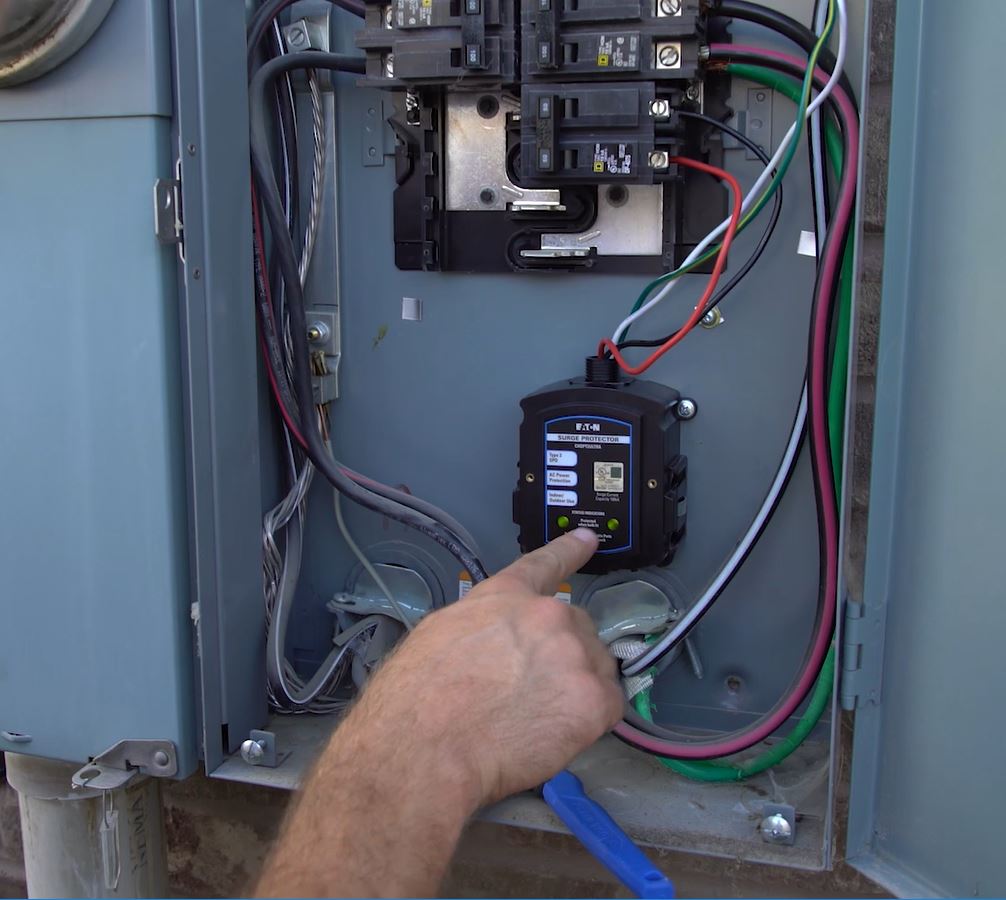
In most residential settings, the most common way surge protection ends up near the meter is with a meter-main enclosure, sometimes called a “farm panel.” It’s a lever-bypass meter socket combined with a small distribution load center (usually with 4-12 breaker slots). In that setup, an SPD can often be installed right in the service equipment enclosure, which keeps the installation simple and effective without relying on a separate gadget squeezed into the meter socket. As a plus, the surge arrestor can be replaced if failed without having to get utility permission to remove the electric meter.
There are generally three “types” of SPD – although it is possible to use the same model of SPD for different “types” of need. A Type 1 device is a service-entrance SPD, and that category includes meter socket enclosure style devices. A Type 2 device is commonly installed at the main panel or distribution equipment on the load side of the main overcurrent device. A Type 3 device is point-of-use protection at the equipment – plug-in strips or devices meant to protect sensitive electronics – like at an HVAC disconnect. In practice, these work best as layers: a service-level SPD to knock down incoming energy, and point-of-use protection for the most delicate or valuable gear.
The Minnesota Department of Labor and Industry’s 2023 NEC FAQ boils down the surge protection rules as applied locally. For dwelling units (and a few similar occupancies), surge protection is expected not only on new installations, but also when certain distribution equipment is replaced. The device needs to be a Type 1 or Type 2 surge protective device installed in or adjacent to the service or feeder distribution equipment that contains the branch circuit breakers, and it needs a nominal discharge current rating of at least 10 kA. They also call out the common “farm panel” or service/feeder combo panel: when that style of meter-main panel is mounted on the dwelling, surge protection is required in all cases. And for certain layouts, an exception allows the SPD to be located at the first downstream load center inside the dwelling.
Here’s the simple way to think about it: a whole-house SPD is there to reduce the surge energy that gets into your electrical system in the first place. Then, point-of-use protection can still make sense for the things that really don’t like extra energy – TVs, computers, networking equipment, and electronics-heavy appliances. If you have a home office, a smart-home hub, or a cabin with sensitive gear on a generator transfer setup, layering surge protection is usually the best approach. One place that most people forget they have electronics is in their LED lights – each light generally has its own driver made up of resistors, capacitors, and inductors – which are very susceptible to over-voltage events.
If you’re considering surge protection in your home or cabin, a good next step is to look at your service equipment layout and decide whether your best placement is in a meter-main enclosure or at the first downstream distribution panel – then consider point-of-use protection where you’d most hate to lose equipment. As always, if you want to get surge protection installed, but don’t really know how or where to install it, consider giving one of the local electrical contractors a call for assistance.
This column is open for reader feedback and questions. If you have an electrical question or are curious how something works in your electrical system, please send over a question.
John Christensen is a licensed Master Electrician in Minnesota and has a bachelor’s degree in electrical engineering from the University of Minnesota – Duluth. If you have electrical questions you’d like answered in a future edition of this column, send them to the editor, or email John directly at john@clovervalleyelectric.com
The advice provided in this column is intended for general informational purposes only. If you have specific concerns or a situation requiring professional assistance, you should consult with a qualified professional for advice or service tailored to your individual circumstances. The author, this newspaper, and publisher are not responsible for the outcomes or results of following any advice from this column. You are solely responsible for your actions.