


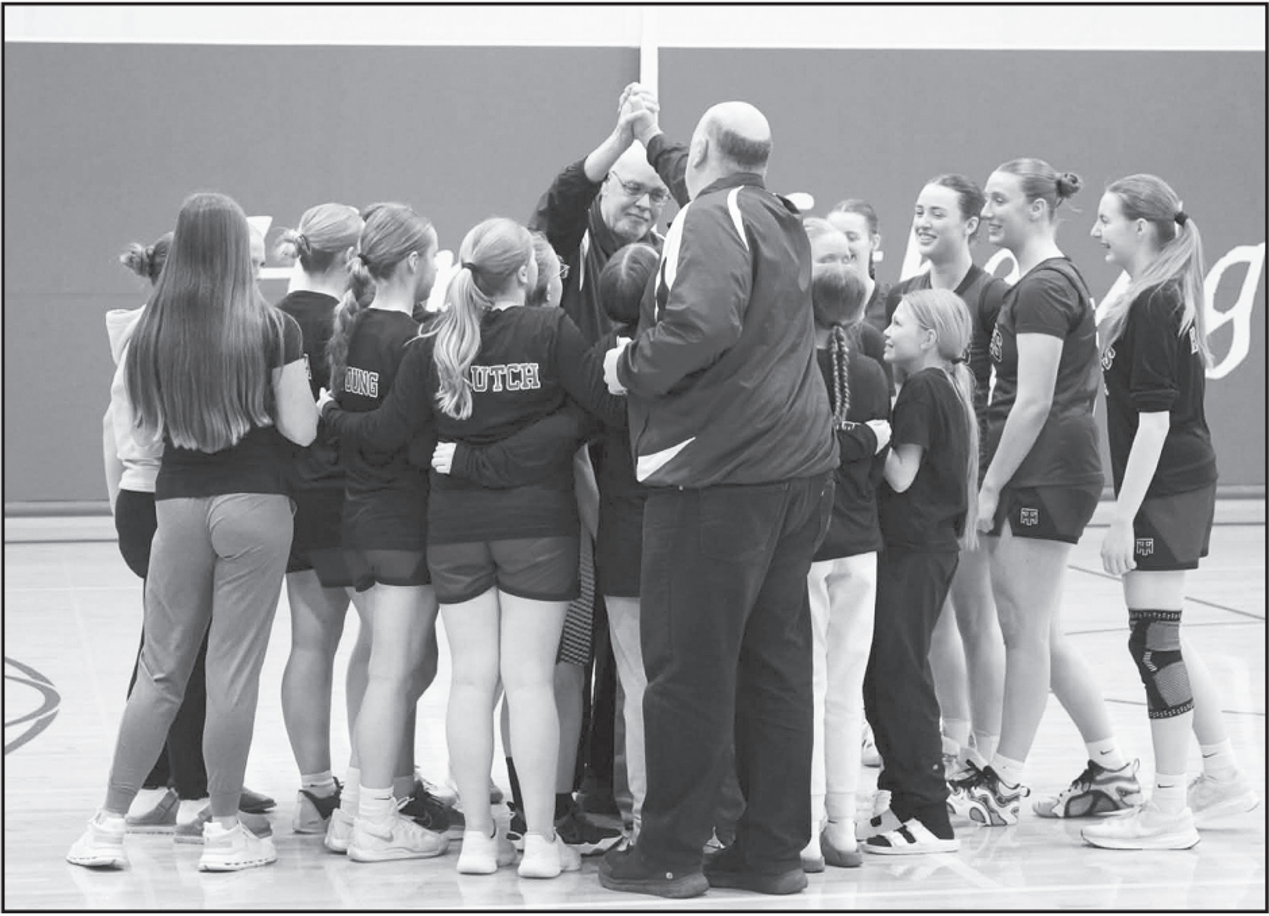
When the invite for Two Harbors girls basketball coach Rick Ray’s retirement celebration posted on Facebook, the first comment was a playful “He’s bluffing.” It made sense. Ray has talked about retirement before.
When I interviewed him last year after he hit 40 years with the girls program, he told me, “Preseason I told my family I thought this was it, but now that we’re into it, I think my plan is to maybe go one more.”
This time, he meant it. The announcement has been bittersweet for the basketball community and those closest to him.
“It’s hard to believe he’s closing this chapter. He’s been coaching my entire life,” said Molly Frank, the eldest of Ray’s three daughters. “For a few years it was always just one more year, so when he said back in January that it was time, I didn’t really believe him. Now that it’s real, it hits harder than I expected.”
Scott Ross, the current Athletic Director in Two Harbors and one of Ray’s closest friends, felt the shift too.
“He’s threatened retirement before. I always tell him, you’re not getting out,” Ross said. “This time felt different. It felt he was serious, and that was sad. As the season went on, you could tell he’s preparing himself for this being his last year. About halfway through the season, I came to the realization that he’s not coming back.”
Ross and Ray, along with Julie Benson, coached girls basketball together for twelve years of Ray’s forty-four-year career, which began with coaching the 7th and 8th grade boys team and a season with the 5th grade boys team.
“We were kind of a rarity, the staff never changed,” Ross said. “We were able to stay together all 12 years. That says a lot about those two. I thoroughly enjoyed what the three of us did in those 12 years.”
The trio built the program together, and Ross found partnership, mentorship, and friendship in the process.
“I totally relied on Rick and Julie for their knowledge, and I trusted them 100 percent,” he said. “If they had something to say, you listened to it because they’ve both been around for a long time. I felt like we were co-coaches all of us, just trying to make the program the best it could be.”
For a few years, Ross lived across the alley from the Ray family. After practice, the two would often call each other and talk basketball for another hour or more.
“He’s a pretty special guy,” Ross said. “He’s a godparent to one of our kids,”
Ray’s coaching career almost ended in 1998, when his wife passed away from cancer. Frank, then a sophomore, remembers the conversations and the moment she talked him out of stepping away.
In a previous interview, Ray told me, “In my mind, I was going to give up coaching, and she told me she thought that was a mistake. I needed to stay in coaching because my kids were coming up.”
It was the right move for Ray and his family.
“The basketball community became a source of strength during that time, helping him and my sisters and me navigate the loss of our mom. Together, through basketball, we found a way to heal and keep moving forward,” Frank said.
Ray felt the same way, previously stating, “I got to enjoy my kids. And the kids that I was coaching at the time helped me get through. They helped me deal with it. They helped my kids deal with it. It was kind of like one big family.”
It was also the right move for the basketball community, which he continued to pour himself into, always displaying an elevated level of dedication for the program and the girls he coached.
“He would do anything that he needed to do to help make our basketball program better,” Ross said. “He was at everything. The summer practices, the meetings, the summer leagues, everything. He didn’t miss. He just put so much time and effort into it, and that was a big reason for our success.”
Behind the scenes, Ray handled the details that keep a high school program running. “Nobody knows what goes on behind the scenes of a high school program,” Ross said. “Rick did so much of that. He’d get there early, he’d have things ready, whether it was a home game or an away game. The stats, the buses, all that kind of stuff. There’s so many things we didn’t have to worry about because Rick took care of it.”
Seeing the impact clearly, Frank said, “It’s hard to capture his 44-year legacy in just a few words. He had a rare ability to walk into a gym and instantly make everyone better, his team, fellow coaches, referees, opponents, everyone.”
Her sister Taylor saw it too. “I was truly blessed to be able to be coached by my Dad growing up,” said Taylor Nelson. “Not only did he have a strong foundation and understanding of the game of basketball, he also had an emotional awareness for the players he coached. He understood what to say, what not to say, and, most importantly, when to say it. His ability to connect with his players extended beyond the basic fundamentals of the game.”
Nelson experienced that connection in moments that stayed with her for more than twenty years. In the second round of the playoffs her senior year, the Agates trailed by double digits entering the fourth quarter.
“Our high school basketball careers seemed just moments away from ending,” she said. “During a free throw, I glanced over to the bench and locked eyes with my Dad. He said nothing, but simply nodded. Without saying a word, his eye contact said it wasn’t over. Before we all knew it, the game was over, and we were celebrating an overtime win.”
The following game, a semifinal loss to Crosby-Ironton, was her last.
“I went straight to my Dad, wrapped my arms around him, and cried,” she said. “Once again, he said nothing. He didn’t need to. He understood that words were not needed.”
Those moments echoed what her sisters felt, too. “For Taylor, Abby, and me, we were incredibly fortunate to live it, not just watch it,” said Frank. “We didn’t just see him coach; we were coached by our dad. The memories go far beyond wins and losses, late nights in the gym, car rides home, shared joy of individual and team success, and shared heartbreak of defeat. Being coached by him was something rare and deeply special, a gift we’ll carry with us for the rest of our lives.”
Her youngest sister, Abby Ray, remembers the lessons that came with being coached by him.
“If you ever had the privilege of playing for Coach Ray, chances are you heard him say, ‘Work hard and good things will happen.’ It was an honor to play for my dad because hard work wasn’t something he taught only on the court; he lived it and instilled it off the court as well,” she said.
After her knee injury, his message shifted. “The message became, ‘Play every game like it’s your last.’ It wasn’t directed solely at me, but was intended as a broader lesson, that one never knows when something may go wrong, and it could truly be your last game.”
Of course, it is one thing to coach other people’s children and another to coach your own. Ross, who coached two of Ray’s daughters, saw the challenge firsthand.
“It’s never easy to play when you’re the coach’s kid, and they made the most of it,” he said. “Seeing Rick with his daughters and coaching them, I thoroughly enjoyed that. Their relationship was tremendous, and I just enjoyed the way they communicated with each other.”
Ross shared a story from when Frank moved up to JV in 8th or 9th grade, and Ray struggled to give her minutes.
“We didn’t move her up to sit on the bench,” Ross told him. Ray worried about fairness and how it would look. Ross pushed him to see her as a player, not a daughter.
“Once he got over that hump, he started playing her,” Ross said. “She proved herself like we knew she would.”
Ray’s coaching style earned him respect across the region. He was never called for a technical foul in all his years on the bench. He was popular with referees and opposing coaches. He kept his players grounded.
“He never let the girls think they were too good,” Ross said. “Gotta get better every day. You better respect your opponent regardless of the record.”
Frank summed it up simply, stating, “He brought out the best in people and helped them believe in themselves. Above all, he made sure his players laughed, enjoyed the game, and left the gym a little better than when they arrived.”
“He was always fun to be around,” Ross agreed. “We’ve all heard all his jokes recycled over and over and over again. I always tell him one out of every 25 are worth listening to. You still laugh at them.”
And chances are, the jokes, the support, and the presence will continue.
“I’m sure he’ll be at all the games,” Ross said. “He’s the biggest Agate and Storm fan I know. He bleeds Maroon and he takes a lot of pride in what the kids accomplish.”
“While his role may look different now, one thing I know will never change, he’ll always be the biggest fan in the stands, with the same love for the game and the people in it,” Frank concurred.
Those who spent years beside him, or years being coached by him, carry a deep sense of gratitude.
“I’m proud of him, and his career, and just to have been a small part of it,” said Ross.
Abby felt the same way, stating, “Beyond congratulating you on your retirement, I owe you a very big thank you for always pushing me to be a better player, and more importantly, a better person.”
“I want to say congratulations and express my appreciation for my Dad’s guidance, love, and constant support over the years, both on and off the court,” said Nelson.
And of course, he’s the kind of coach who could always find his way back if he wants to.
“It doesn’t mean the door has to stay completely shut,” said Ross. “He’s always welcome back.”
Come say congratulations in person, and a Happy Birthday, at Coach Ray’s Retirement Celebration, held at the Moose Lodge 1463 in Two Harbors on Saturday, March 14. The party is scheduled from 3 to 7 PM and is open to all.