


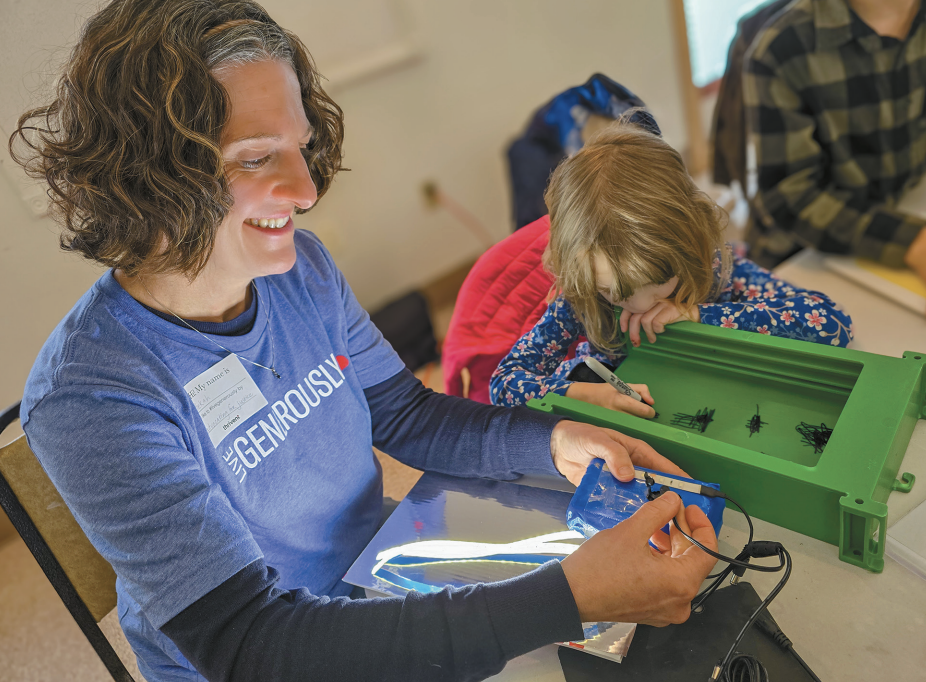
On Sunday, February 22, at 2 p.m., North Shore Financial Group/Thrivent of Beaver Bay will host a gathering at the Beaver Bay Community Center to assemble 100 portable solar light kits for Ukraine, aiming to replicate last year’s success.
Three dozen people of all ages showed up to lend a helping hand last year. When assembly was complete, the people enjoyed snacks and beverages provided by a Thrivent Action Team grant. Then the units were securely packed up for shipment to Ukraine, where the first person to open a kit will be Ukrainian.
Dave Nonnemacher, executive director of The New Horizons Foundation-USA (NHF-USA), will be on hand to help assemble the Ray of Life solar light kits and share stories about the positive impact these lights/chargers have had on real people living under constant bombardment by Russian weapons. These kits are currently being prioritized for families in Ukraine who are living without power due to the ongoing war. Nonnemacher is a significant force in the Northland, specifically around Cook and Lake Counties, for coordinating these builds.
Designed for remote villages by New Vision Renewable Energy in West Virginia, the finished light kits are roughly the size of a cereal box and serve as a “lifeline” for people in the “gray zones” or combat zones of Ukraine. The 4-5 lb unit consists of a solar panel, a high-quality lithiumion battery, bright LED light strips, and a USB charging port for mobile phones—a communications lifeline that lets families stay in touch amid the chaos and confusion the Russian invasion is causing.
Kit assembly involves connecting the LED strips to a reflective backing and installing the battery and solar controller into the housing. A key part of the Ray of Life project is that every builder writes a personal note or drawing for the Ukrainian recipient and tucks it inside the box. Once built in the Northland, the logistical chain ends with the Mariupol Chaplains Battalion, which delivers them to “gray zones” where the electrical grid has been destroyed.
The war has now been going on for nearly four years. What the Kremlin originally intended as a “three-day” operation to capture Kyiv has instead turned into a prolonged war of attrition across Ukraine. Russia’s strategy has shifted heavily toward destroying civilian infrastructure. Ukraine is facing its most severe energy crisis since the start of the full-scale invasion. Following intensified Russian strikes throughout late 2025 and into mid-January 2026, the situation has become critical, with millions of people currently without consistent power.
This Russian strategy makes the work of people like Nonnemacher— who began responding to the crisis shortly after the 2022 invasion— more critical as the war enters its fourth year. He has made eight trips to Ukraine to help set up logistics for delivering the finished kits and to identify other needs of the Ukrainian people. He and NHF have facilitated the delivery of donated fire trucks to assist emergency responders. The Lutsen Volunteer Fire Department donated its expired turnout gear to Ukrainian firefighters through NHF.
On January 14, 2026, President Zelenskyy declared an energy emergency. Massive strikes have hit major cities including Kyiv, Odesa, Dnipro, Lviv, and Kharkiv. While the energy crisis affects the entire country, its impact differs between urban and rural areas. In rural regions, particularly in the south and northeast (near the front lines), the situation is often more permanent but less “visible” in the news. Villages near the front lines have often been without power for months or even years because the infrastructure is too damaged to repair or is under constant fire. This context explains why projects like Dave Nonnemacher’s “Ray of Life” are so critical; they provide decentralized, off-grid power (solar lights and chargers) that allow families to have light and communication even when the national grid is entirely dark.
Nonnemacher addressed the importance of the light kits, saying, “Light brings hope, and hope keeps people alive.”
While the scale of the war can leave one feeling helpless, the Beaver Bay community is proving that ‘helpless’ is not ‘hopeless.’ When neighbors come together to provide one kit, a small act becomes a powerful movement.
Nonnemacher believes that the people of Ukraine will overcome the Russian aggression. “Showing up and being present is very important,” he said.
To donate, make your check out to the New Horizon Foundation USA and mail it to PO Box 368, Beaver Bay, 55601, or drop it off at the Thrivent office at 1008 Main Street in Beaver Bay, or bring it to the Beaver Bay Community Center the afternoon of February 22.
Inside the Ray of Life Kit
• Solar Power: A 10W solar panel that charges even in the indirect light common in Eastern Europe.
• Storage: A high-capacity lithium-ion battery that provides 10–21 hours of light on a single charge.
• Output: Three ultra-bright LED light strips capable of illuminating an entire room (roughly 1,000 lumens).
• Connectivity: A USB charging port that acts as a lifeline, allowing families to keep mobile phones powered for emergency alerts and family contact.
• Durability: Housed in a compact, portable case (about the size of a cereal box) designed to withstand the rugged conditions of “gray zone” basements.