


Bail decisions often draw intense public scrutiny because they affect public safety, individual liberty, and public confidence in the justice system. They are also frequently misunderstood, in part because a judge’s perspective is necessarily different from that of everyone else involved.
Judges do not approach bail from a single perspective. We must weigh public safety, victims’ rights, the presumption of innocence, and constitutional limits at the same time. Unlike advocates or the public, judges cannot rely on instinct, emotion, or outcome-based hindsight. Bail decisions must be grounded in law and made early in a case — often with limited information and before full facts are tested in court.
That legal framework begins with a principle that surprises many people: In Minnesota state courts, pretrial release is the presumption, not detention. This is not a policy preference or personal philosophy. Local Judge’s View: Bail Isn’t a Gut Reaction By Steve Hanke It is a constitutional mandate. Minnesota’s Constitution provides an affirmative right to bail, and that principle is reflected throughout our statutes and court rules. Bail is not punishment. Guilt has not yet been determined.
Bail is best understood as a process, not a single decision.
The process begins with arrest. After an arrest, a person may be released directly by law enforcement through a citation or conditional release authority, or the suspect can be held in custody pending a court appearance. Whether someone is held depends on the offense, public safety considerations, and statutory authority.
If a person is held, the first appearance in court, often called an arraignment, typically occurs within 48 hours. If the person is released earlier, the first appearance is scheduled later. At this hearing, the judge informs the defendant of the charges, advises the defendant of key constitutional rights, and determines whether the defendant qualifies for a public defender. The judge also first addresses bail and pretrial release.
Because release is the legal starting point, a judge’s task is not to ask whether detention might feel safer or more satisfying in the moment. The law requires a narrower and more disciplined inquiry: Can this person be released under conditions that reasonably manage risk and ensure court appearance?
Minnesota law directs judges to consider specific factors, including the seriousness of the alleged offense; the strength of the evidence; prior criminal history; court-appearance record; risks to victims or the community; and the person’s employment, housing, family ties, and financial resources. Judges may also use the Minnesota Pretrial Release Evaluation Form and Assessment Tool, a structured, pointbased assessment that estimates the risk of nonappearance and the risk to public safety.
After weighing these factors, a judge may order release without conditions, set monetary bail, or authorize release with conditions. Even when a defendant is conditionally released, an unconditional bail amount is still required.
Bail amounts are not unlimited. For most misdemeanors and gross misdemeanors, Minnesota law caps bail at no more than twice the maximum fine for the offense. The statutes include defined exceptions allowing higher multiples — such as four, six, or 10 times the maximum fine — for certain offenses, including specific DWI and domestic-assault cases. In some situations, such as qualifying DWI arrests, judges are required by statute to set bail at the maximum amount. These limits reflect a legislative judgment that pretrial detention should not turn solely on a person’s ability to pay.
Supervised pretrial release, often overseen by probation, is one of the most effective tools available. Conditions often include no-contact orders, sobriety monitoring, treatment requirements, GPS monitoring, geographic restrictions, and regular check-ins. These agreements are enforceable, and judges may revoke release if conditions are violated. Bail decisions are not fixed: Bail conditions may be reviewed and modified at any hearing during the life of a case, as circumstances change.
Viewed in full context, bail decisions are not snap judgments. They are legal determinations guided by constitutional principles, statutory limits, structured risk assessment, and ongoing judicial oversight — all careful efforts to balance safety, fairness, and the rule of law.
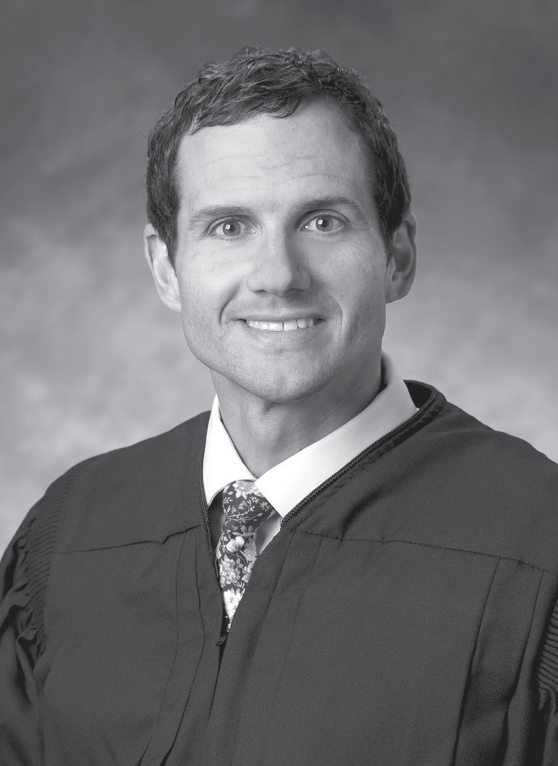
Steve Hanke is a 6th Judicial District judge in the Lake County Courthouse in Two Harbors and in the Cook County Courthouse in Grand Marais. He is a former deputy Duluth city attorney. His father and grandfathers served in the military.