
The story of the North Shore’s churches is, at its heart, the story of the communities themselves. It is a narrative written by Scandinavian fishermen, deep-woods loggers, Ojibwe settlements, and the modern-day residents who call this rugged coast home.
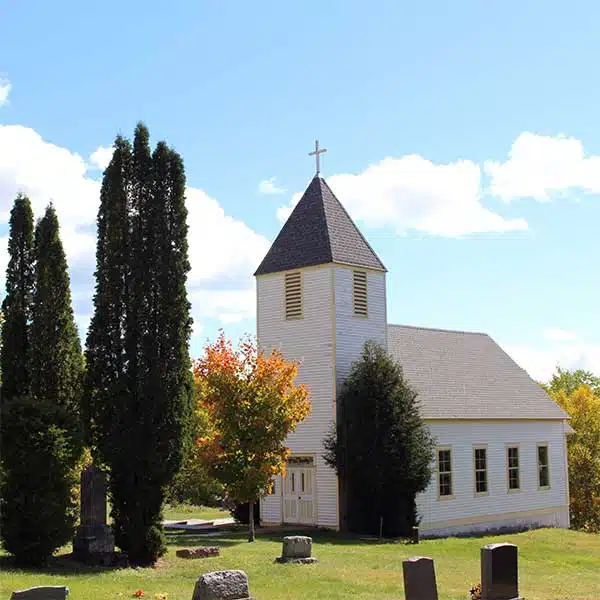
Driving Highway 61, you’ll be seeing the white steeples set against the deep blue of Lake Superior and the dark green of the boreal forest. Along the North Shore, several historic and active churches sit directly on or very near Highway 61 in the small towns nestled between Two Harbors and Grand Marais.
These aren’t just buildings; they are the anchors of the North Shore community, surviving fires, economic shifts, and brutal winters for over a century. Like everything North Shore, these spaces are evolving—serving as community centers, arts venues, and historical landmarks.
These churches provide an essential “safety net” for the North Shore food security programs. For some, the churches are quiet sanctuaries for visitors looking to escape the “buzz” of the busier summer months.
Today, Minnesota’s religious landscape mirrors national trends, showing a steady “middle-of-the-pack” level of religiosity compared to the rest of the U.S. While a large majority still identify with a faith, active participation—specifically weekly attendance—remains a much smaller slice of the population.
The latest data from Pew Research and Gallup show that roughly 71% of Minnesotans say “yes” when asked if they identify with a specific religion or church. About 63% of adults in the state identify as Christian.
Minnesota remains a national outlier for its high concentration of Lutherans, who make up nearly 23% of the population. Approximately 29% of Minnesotans identify as “religiously unaffiliated” (atheist, agnostic, or “nothing in particular”).
There is a significant gap between identifying with a church and actually attending one. About 21% to 27% of Minnesotans report attending a religious service at least once a week. This number has largely stabilized in 2025–2026 after the sharp declines seen during the pandemic.
If you expand the criteria to include those who attend “at least once a month,” the number jumps to roughly 33%.
While Minnesotans are slightly less likely to attend weekly services than the average American, they are slightly more likely to maintain a formal “belonging” to a denomination (particularly Lutheran and Catholic). This suggests a strong cultural connection to the church as an institution, even if it doesn’t translate to sitting in a pew every Sunday morning.
Cook County has one of the most unique religious profiles in the state. It is significantly more “independent” and has a much higher percentage of people who do not belong to a formal church. Lutherans, about 28%, are still the largest single group, but it is less dominant than in Lake County. At about 14%, Catholics have a smaller footprint than Minnesota’s average.
Cook County has a robust “Independent” streak, with churches like the Evangelical Free Church and Grand Marais Christian Church seeing higher per-capita engagement than in southern counties.
Due to the presence of the Grand Portage Band of Lake Superior Chippewa, there is a significant (and often under-reported) adherence to traditional Anishinaabe spirituality.
Cook County has one of the highest rates of religiously unaffiliated residents in Minnesota, roughly 42%. Many residents describe their “cathedral” as the woods or the lake itself.
Lake County has a more “traditional” religious profile, largely due to the settled industrial communities of Two Harbors and Silver Bay. Lutherans at 38% are the dominant group, split primarily between the ELCA (Evangelical Lutheran Church in America) and the LCMS (Missouri Synod).
Catholics at 22% are a strong presence, especially in Silver Bay, which was built as a “company town” in the 1950s with a high concentration of Catholic workers.
Unlike Cook County, the survey showed that just 26% of Lake County residents claim to be religiously unaffiliated.
Some of the churches along the Shore
Beaver Bay Community Church is an intergenerational congregation located right in the heart of Beaver Bay, that features a ministry focused on serving the entire North Shore community.
Palisade Baptist Church, situated just off the highway, is just east of Silver Bay. It offers a traditional worship experience in a scenic wooded setting.
St. Mary’s Catholic Church in Silver Bay serves the local Catholic community and visitors alike. It offers a diverse schedule, including Saturday evening and Sunday morning Mass. The church remains open daily for visitors who wish to stop for quiet prayer.
Lutsen Lutheran Church is a landmark ELCA congregation situated directly on Highway 61 in Lutsen. It provides a picturesque setting for its Sunday morning services and serves as a longstanding gathering place for area residents.
Zoar Lutheran Church, located just south of Lutsen in Tofte, is perched along the highway with a rich history dating back over a century. Founded by Norwegian settlers, it continues to welcome locals and tourists alike.
The Common Thread
Whether the narrative is one of Lake County’s institutional continuity or Cook County’s independent, nature-based spirituality, the common thread is service. These congregations, which have sung together and served each other for over thirteen decades, remain the steady “rock” upon which the North Shore community is built.