
History doesn’t repeat itself, but often rhymes. On February 17, 2026, a massive blizzard shut down Highway 61, trapping travelers and silencing the North Shore. It was a record-breaking storm—unless your name is Maurice (Morrie) Moen. For Morrie, a blizzard on February 17 is more than news; it’s his birthright, his lucky star.
A century earlier, on February 17, 1926, a young woman, nine months pregnant, Morrie’s mother-to-be, left the family farm in a feat of North Shore endurance, braving a massive blizzard to travel six miles to the hospital in Two Harbors. With her husband working at the Two Harbors ore docks, she made the six-mile trek by horse and sleigh alone over drifted roads to reach town. Morrie was born that very day. To celebrate Morrie at 100 is to celebrate a century of Two Harbors’ history, beginning with a mother’s courage in a whiteout.
Growing up, Morrie was the third of four Moen children, with two brothers and a sister. Life on the farm shielded the family from the worst of the Depression and shaped their early years.
“Work was hard to find,” Morrie said. He told how his father took odd jobs, including shoveling gravel to build roads. “We lived hand to mouth, but always had food on the farm.”
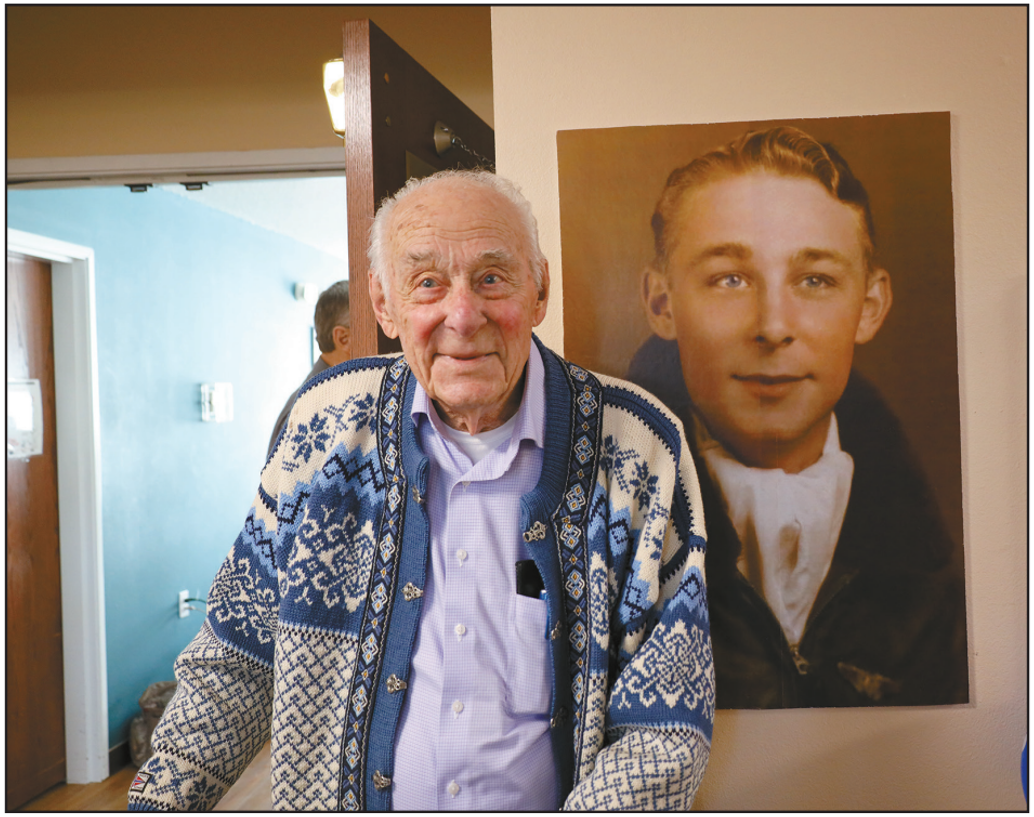
Now, at 100, Morrie has a warm, friendly face that belies his age—he could easily pass for 80.
Later, as Morrie reached high school age, World War II was raging. He studied Morse Code at Two Harbors High School. At the beginning of senior year, Morrie and three friends signed up to serve and were allowed to finish school before they were called up. Morrie chose the Army Air Corps.
In 1944, all four were notified to appear at Fort Snelling in Minneapolis on graduation day for induction. They missed commencement, and Morrie didn’t get to see his high school diploma until he came home on leave after basic training.
After basic training, Morrie went to radio operator school and put his Morse Code skills to use. The Army then wanted him to attend gunnery school, planning to send him to Europe to fly on B-17 bombers. Before he went, the war in Europe ended, so they didn’t need him.
Instead, the Army scheduled him for the South Pacific, sending him to the California Air Transport Command. Lady Luck intervened again when the war with Japan ended before he flew combat missions. He did, however, fly material replenishment flights across the Pacific as the plane’s radio operator. With a stop in Japan and time to spare, Morrie and a friend toured Tokyo. At six feet tall, Morrie remarked how he towered above the local population.
On the return of his second flight, which would have been in late 1945 or early 1946, the four-engine airplane made a refueling stop at Hickam Air Force Base in Hawaii.
On the way to California, one engine failed, so the plane returned to Hickam. After a restart, they took off again. Past the point of no return, that engine and another quit, and a third sputtered. As the plane limped into California airspace, fog covered the airfield, so it was redirected to Nevada. The fog followed. “Then we were getting a little concerned,” Morrie said. “It was a spooky flight.”
Morrie was discharged in 1947 and returned to Two Harbors to start civilian life. That year, he married a high school classmate, Margie, and they had four children—two boys and two girls. Their marriage lasted 52 years. After Margie passed, Morrie married another classmate, Elaine Melby, and they were together for 18 years.
Morrie has 14 grandchildren, 30 great-grandchildren, and one great-great-grandchild on the way. Near his chair at home, an electronic frame scrolls through all the family photos, keeping him in touch with his offspring.
After the war, Morrie worked at a local appliance store repairing radios, then joined DM&IR at an entry-level job. He moved from replacing fire bricks in steam locomotives to a cost estimator role at Duluth headquarters.
He took early retirement during a downturn in the railroad industry. Soon after, he suffered angina and had a successful double bypass operation.
“I’ve been pretty lucky,” Morrie said.
Morrie’s family marked his birthday with cake and coffee at his home at Waterview Shores. The Two Harbors Ukulele Group (THUG) performed on that Sunday before his birthday. Then, on the night the blizzard began, they shared a birthday dinner with him at Ledgerock Grill in Larsmont.
Today, Morrie’s story stands as a testament to the fact that, while the technology of the North Shore changes, the fierce spirit required to survive its winters remains the same.