


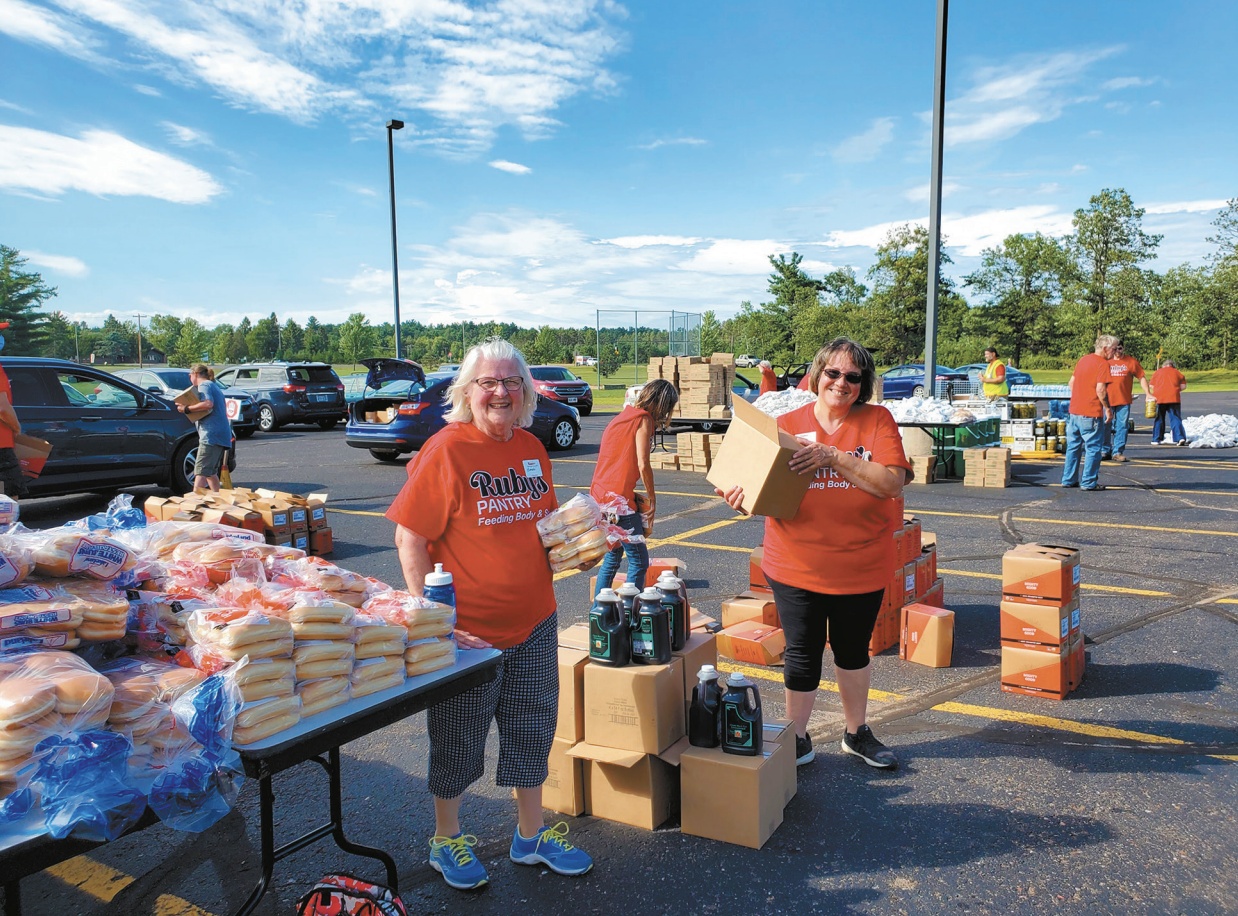
PINE CITY – The biggest problem, they said about Ruby’s Pantry, was how it ended.
A lack of communication. The immediate shutdown of the nonprofit’s website. Blocking site leaders across the Midwest from their usual communication pathways.
These were some of the feelings of frustration cited by nearly a dozen people directly involved with Ruby’s Pantry, a Minnesota-based nonprofit that distributed surplus food for more than 20 years. Ruby’s top officials announced last week that the organization was immediately ending operations at 85 sites spread primarily across Minnesota and Wisconsin, with other locations in Iowa and North Dakota as well. The abrupt cease to operations includes the pantry distribution sites in Silver Bay and Grand Marais.
Ruby’s Pantry, according to its now shuttered website, collected more than 21 million pounds of food and served more than 650,000 people each year, dating back to 2003, distributing the rations primarily in rural communities like those on the North Shore and Minnesota’s Iron Range.
The Northshore Journal spoke with Ruby’s Pantry site leaders at numerous locations in Minnesota and Wisconsin following the sudden closure. While all expressed sentiments of sadness – specifically in how cutting off a food source people came to rely on will be challenging for their communities – some of the site leaders and former employees of Ruby’s across the Upper Midwest were not shocked by the closure.
“All of us are at a loss for words on how this came to an end,” said Troy Pietroske, who’s been a site leader at a Ruby’s distribution site for nearly 20 years in Sheboygan, Wisc. “We aren’t shocked that it happened, necessarily. We knew there were some financial challenges; it’s just that all of us volunteers get an email one day that says, ‘we’re done.’”
Many people who were directly involved with Ruby’s Pantry told this newspaper they were aware the organization was struggling financially. However, the abruptness of the closure, a general lack of communication from Ruby’s headquarters with volunteers who’d been around for decades in some instances, the seizing of money from bank accounts tied to the various Ruby’s distribution sites, turning off the company’s website, and the leadership team shutting down all lines of communication from the nonprofit’s headquarters didn’t sit well with longstanding volunteers.
“My biggest issue is just how it ended,” said Esther Maina, a site leader for Ruby’s Pantry based in Hayward, Wisc. “A lot of people put their heart and soul into this. It’s heartbreaking.”
The Origins of Ruby’s Pantry Ruby’s Pantry started in 2003
Ruby’s Pantry started in 2003 and was the vision of its founder, Lyn Sahr. A preacher who bounced around from church to church in the North Branch and Pine City area, two small towns just north of the Twin Cities, Sahr named the organization after his grandmother, Ruby Flodin. Sahr was not shy about making a direct tie between his Christian faith and that of the numerous nonprofits he founded over the years, which include Home and Away Ministries, Ruby’s Heart, and Ruby’s Pantry. Sahr passed away in April 2023 at the age of 74.
After his death, Lyn’s daughter RoxAnn Sahr stepped into a leadership role with Ruby’s Pantry. RoxAnn was familiar with operations at Ruby’s, having worked in the administrative office before her father’s passing. Assisting with administrative duties following Lyn Sahr’s death was RoxAnn’s sister, Tami Martinson.
Both RoxAnn and Martinson declined to be interviewed for this story. Another of Lyn Sahr’s daughters, Nicole Schwidder, was listed as the board chair of Ruby’s Pantry in the nonprofit’s most recent tax filing. She also declined to be interviewed for this story. Throughout it
Throughout its 23-year history, the Sahr family focused on the narrative of growing a Christian organization from a “pickup load of food” to one that possessed “two distribution centers, nine semi-trucks and handled (the distribution of) nearly one million pounds of (food) per month.” In 2025, the company said on its now defunct website, “Ruby’s Pantry handles over 34 million pounds of food each year and serves over 300,000 families a year with shares of food. For a $25 share donation, guests receive an abundance of groceries that would normally be food suppliers/distributors overage and surplus that would normally end up in landfills.”
The majority of people the Northshore Journal interviewed for this story praised the overall mission of the organization. Providing food at a low cost to people is a good thing, was the general sentiment. That mission became more challenging, they said, following Lyn’s passing.
“Lyn was a nice enough man,” said Stan Skaggs, a former employee of Ruby’s Pantry. “He knew how to work the system in terms of it being a nonprofit. He could talk anyone into anything. He was a preacher and a businessman at his very core. But when he died, I think people everywhere were wondering how long it would last.”
Skaggs, who lives about 15 miles from Ruby’s headquarters in North Branch, said the local chatter near North Branch was that things weren’t going well with Lyn Sahr’s daughters running the entire operation.
“They just didn’t know how to pull those strings like Lyn did,” Skaggs said. “Everything changed when he passed away.”
Numerous site managers and other volunteers with Ruby’s Pantry said another change that seemed to impact operations following Lyn Sahr’s death was the departure of the nonprofit’s program manager, Tracy Bauer.
Laurie Kallinen, the Silver Bay volunteer coordinator for Ruby’s Pantry for the past 13 years, until last week’s shutdown, said communication with the main office in North Branch became more difficult after Bauer left the organization about a year ago. Kallinen and others interviewed for this story were never told why Bauer left the organization. Multiple phone calls and text messages to Bauer from this newspaper went unanswered.
“She was so good at what she did,” Kallinen said of Bauer. “Whenever we had a problem or a question, she would get right on it. When she left, it was very noticeable.”
How It Ended
For months leading up to the March 31 shutdown, officials at the organization’s headquarters said the nonprofit had fallen on hard financial times. An email that a former Ruby’s site leader sent last week to this newspaper made it clear the organization was struggling financially. The email, dated Jan. 17, was originally sent from RoxAnn Sahr, who became the nonprofit’s executive director following her father’s death in 2023.
“As we closed out the year, our financial picture is concerning,” RoxAnn wrote in the email, which had a subject line of “Ruby’s Pantry Urgent and Prayerful Request for Financial Partnership.”
RoxAnn explained in the January email that Ruby’s closed 2025 showing a loss of more than $450,000. Tax records from the year before show Ruby’s Pantry lost more than $1 million in 2024. That being the case, the nonprofit still had about $21.5 million in assets. During recent years, Ruby’s Pantry received large sums through various gifts, grants, contributions, and membership fees, averaging $45 million annually between 2020 and 2024.
Site leaders and warehouse employees the Northshore Journal spoke with said they were a step or more removed from where the vast sums of money were coming and going. Mike Fisk is a former employee of Ruby’s Pantry at its branch in Luck, Wisc. He said that Lyn Sahr had “good intentions” in his heart, but that the organization often felt “stretched thin” and operated in a way that was “complicated, not streamlined.” When Lyn Sahr passed away, Fisk said he felt it would only be a matter of time before Ruby’s Pantry ended its operations.
“Lyn and I had our differences, but his heart was in the right place,” Fisk said. “He wanted to help people, but you know the saying ‘thy will be done?’ With Lyn, it was always ‘my will be done.’”
Skaggs, who worked in the nonprofit’s main warehouse making about $16 per hour for many years, said Lyn would talk people into donating things that had little or nothing to do with food. He recalls automobiles being donated to Ruby’s, including one that RoxAnn later drove.
“One time Lyn had us drive down to somewhere south of the (Twin) Cities to pick up some stereo equipment,” Skaggs said. “Then we drove it over to a building he owned in Wisconsin and dropped it off, and it was like, ‘Okay, not sure what this is all about?’”
As the financial picture grew more bleak during recent years, local distribution sites needed to bring in, and share, more revenue with the nonprofit’s headquarters in North Branch, RoxAnn said in her January email. Furthermore, Ruby’s headquarters were going to start charging more per share, RoxAnn suggested, while the local sites could take less money. Historically, the local sites would keep about two dollars from every $25 share to pay for overhead costs, advertising, and various fees involved with distributing the food each month, from trash bills to renting forklifts, Esther Maina explained of the Wisconsin site she helped run for more than a decade. Under the new formula RoxAnn and the leadership team at Ruby’s proposed, the price for a box of food from Ruby’s would go up to $30, while the local sites could keep just one dollar. That wasn’t going to work for many of the local sites, according to Maina, which relied on a certain percentage of the sales in order to function on the ground level.
Regardless, the email from RoxAnn in January said some of the local sites were keeping too much money, suggesting that more needed to reach the headquarters to help the nonprofit be sustainable into the future.
“Many sponsoring churches and sites have not been able to follow the Memorandum of Understanding commitment to provide an additional offering twice each year (May and September) designated specifically for Ruby’s Pantry operational costs. This past year, only nine sites participated, totaling $14,100,” she wrote. “We also recently sent a letter to 86 sites asking for assistance. That request resulted in only $750 in donations. This was deeply discouraging, especially when many sites currently hold $5,000–$30,000 in their Ruby’s Pantry site accounts.”
When Ruby’s shuttered operations last week, someone from headquarters started to take money from the bank accounts managed by the various site leaders, Maina and other former site leaders told the Northshore Journal. A sum of $2,500 was withdrawn March 3 from the Hayward, Wisc., bank account, Maina said, leaving them with about $1,700. Complicating matters, Ruby’s headquarters shut down a Facebook page the site leaders used to communicate with each other. A new, independent page has since been created, with site leaders in Minnesota and Wisconsin explaining that they had to put a hold on ACH transactions in fear that funds might be taken by Ruby’s headquarters.
“We have bills to pay here locally,” Maina explained, “our garbage bill and other ongoing expenses involved with operating this in our community.”
About three weeks after the money was taken from the Hayward branch’s account, Ruby’s Pantry abruptly ceased its operations.
In the process of reporting this story, the Northshore Journal reached out to officials from the Minnesota Department of Commerce Fraud Bureau, the state’s attorney general’s office, and officials from the Bureau of Criminal Apprehension to see if any investigations are active specific to Ruby’s Pantry, Ruby’s Heart, Home and Away Ministries, or any other top officials involved with the nonprofit organizations founded by Lyn Sahr.
“The Minnesota Attorney General’s Office cannot confirm or deny the existence of any specific investigation,” said Brian Evans, the press secretary for the state’s AG office.
The other agencies we requested information from either did not respond in time for the deadline of this article or directed us to seek information from other branches of state government.
The only statement released by Ruby’s headquarters about the closure of the company reads, “Over the past several months, we have been thoughtfully realigning the work, structure, and focus of Ruby’s Pantry to ensure our mission remains at the center of everything we do. As part of this process, we have worked to better align community needs with our goal of operating in the most effective and seamless way possible. As a result, we have decided to end the operations of Ruby’s Pantry effective immediately. We recognize that this is difficult news to receive and do not take this decision lightly.”
A vague statement such as this, one that essentially says: “We want to do better, so we’re going to stop doing what we do,” provided little relief in the narrative. And for longtime volunteers like Pietroske, a site leader for a Ruby’s distribution site for nearly 20 years in Sheboygan, Wisc., transparency on why the organization closed would have been the right move.
“Just air your dirty laundry,” he said. “If you can’t make payroll, just say it. People will understand. But the lack of communication, that’s how rumors start.”
What Happens Next
It was common to see long lines for the Ruby’s Pantry distribution events in Grand Marais. Cars would be parked in a line stretching for blocks near the local school or community center in town, where people would pay cash or use a voucher in exchange for a box of food. A similar scene took place in many of the 85 distribution sites across the Midwest.
In the aftermath of the March 31 announcement that Ruby’s Pantry was shutting down its operations, site leaders and community members are working to find solutions to help people access food. Site leaders in Duluth, Hayward, Sheboygan, and other locations across the Midwest shared that they are engaging in conversations this week about how to carry some version of Ruby’s Pantry forward, even if they do so independently.
Locally, members of a “food access council” are working to improve how people get food, according to Cook County Public Health and Human Services Director Grace Grinager. A group of community members met April 1 in Grand Marais to discuss how people can work together and find new ways of getting community members food now that Ruby’s Pantry is no longer an option, Grinager said.
“We want to use this moment as an opportunity to ask ourselves how well the current programs and systems we have in place work,” she said, “to ensure that all community members have enough nutritious food to meet their needs throughout Cook County.”