

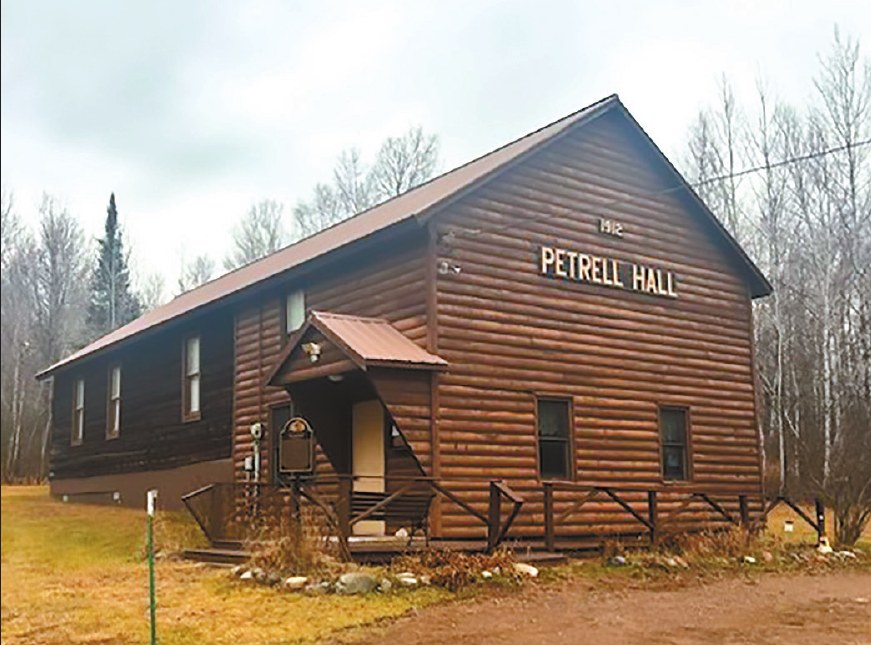
When I met JoAnn Olson for a story about Brimson’s monthly Coffee and Book Chat, I arrived early and found myself once again admiring Petrell Hall. I had visited the historic site before, when community members gathered there in the aftermath of the 2024 wildfires. This time, I had a chance to take a closer look at the log building that has stood at the center of the community for more than a century.
It quickly became clear that Olson’s appreciation for Petrell Hall, located in Fairbanks Township, runs much deeper than simple admiration. As she shared stories of dances, generations of local families, it became apparent that she knew not only the hall’s history, but the history of the people who built it.
A few weeks later, I visited Olson at her home a few miles away from Petrell Hall to learn more. What began as a conversation about a building soon became a lesson in the history of a community, the immigrants who settled it and the people who have worked to keep their stories alive.
Olson first came to the Brimson area in the early 1990s after spotting a newspaper advertisement for an old homestead. The moment she stepped out of the car, she said, the smell of the air brought her back to summers spent on her grandparents’ farm in central Minnesota.
She bought the property and never looked back. Instead, she began looking backward.
Drawing on her background in education, Olson became fascinated by the area’s past. Over the years, she immersed herself in local history, interviewing descendants of Finnish homesteaders, gathering family photographs and preserving stories that might otherwise have been lost.
“I’ve been immersed in this for a long time,” she said.
Her interest was never centered on famous figures or political leaders.
“Everyday people had not had the coverage that they should have in history,” she said.
That philosophy guided years of work, including an oral history project called Children of the Finnish Homesteads. Olson recorded interviews with second-generation Finnish Americans, collected and identified family photographs, and helped preserve those materials through the Iron Range Research Center.
For Olson, places like Petrell Hall matter because they tell the story of an isolated corner of northeastern Minnesota.
“This is where my heart is as a historian and educator,” she said of the passion that eventually led her to the history of Petrell Hall itself.
The hall stands on land once owned by Edvin and Olga Petrell. According to historical records Olson helped compile, the couple sold three acres to the Fairbanks Finnish Work People’s Society for $15. The property’s purpose was clearly stated: it was to serve the “social uplifting of the working class forever.”
Built in 1912 by members of the society, Petrell Hall became far more than a community building. Trees from the property were harvested, lumber was cut by volunteers, and labor was donated. Community members came together to create something they could not have built alone.
At a time when roads were rough, neighbors lived miles apart, and modern conveniences were few, the hall served as a gathering place where residents could learn, celebrate, organize, and connect with one another.
“Petrell Hall was the social and cultural center of the neighborhood,” Olson said.
The importance of what those volunteers built has not gone unnoticed by historians. Olson frequently points to the work of Professor Arnold Alanen, who described Petrell Hall as one of the few remaining Finnish American buildings in the nation that can trace its origins to farmers and industrial workers who supported progressive political causes.
For Olson, that distinction places the hall’s significance well beyond the Brimson area and underscores why its preservation matters. That spirit of cooperation was woven through nearly every aspect of life in the community.
“When you think about farmers in general, with the cooperatives, the granges, all these type[s] of organizations were put together so people could come together and help each other as a group,” Olson said. “You were stronger and had more resources possibly available to you.”
The hall reflected those values. Throughout the early decades of the 20th century, Petrell Hall hosted dances, meetings, educational programs, holiday celebrations, poetry readings, funerals, theatrical productions and civic gatherings. It served as a polling place and remains one today.
A lending library operated from the hall with books selected by local resident John Laskinen, who filled the shelves with novels, poetry, biographies, history books, and even volumes on astronomy and physics. According to historical accounts, community members appreciated the wide variety of reading material available. Reading and education were highly valued among the Finnish immigrants who settled the area.
“They generally knew how to read and write,” Olson said of many of the early settlers. “So they were a little more educated than some of the immigrants that came over.”
The hall’s stage became another focal point of community life.
One of the most colorful figures associated with the hall was Laskinen. According to Olson’s research, Laskinen directed plays and helped make Petrell Hall’s stage a vibrant center of community life. Olson described him as a contortionist, acrobat, clown, and sword swallower whose many talents entertained audiences and helped bring performances to life.
“You imagine?” Olson said with a laugh. “We had talent out here.”
Music was equally important, with frequent dances drawing residents from throughout the area. Traveling accordion players stopped by, local musicians took the stage, and neighbors gathered to socialize after long days spent farming, logging, or working to establish homesteads in the wilderness.
According to Olson, dancing became such a regular part of community life that it was simply expected. Weekly dances were once a fixture of life in the community.
The hall also served practical purposes. Women organized sewing circles and created handmade goods that were sold during community events. Basket socials and fundraisers helped finance projects and support causes. During World War I, residents sold handmade flowers and organized events to raise money for soldiers.
One of Olson’s favorite photographs shows community members gathered around wagons while raising money for “the boys overseas.” Another captures women who knitted socks and mittens, embroidered linens, and contributed countless volunteer hours to community causes.
Among the people preserved in those photographs is Maija Malkki, a local midwife. Malkki appears in photographs carrying what Olson suspects held coffee and baked goods for workers building the hall. She walked from her home on Breda Road to community gatherings and became one of the many everyday figures whose story helps bring the area’s history to life.
The hall was not the only educational institution in the area.
The Finnish settlers placed a high value on learning, and the community’s first school was established in a small log building in 1908. Later, School No. 55 replaced it, providing local students with a larger educational facility. Students who wished to continue beyond eighth grade could attend high school elsewhere with support from the county school board.
Those details help tell a larger story. What emerged around Petrell Hall was not simply a building, but a community that valued education, culture, and civic participation.
“The people were the ones that determined what was going to be in the hall,” Olson said. “So that’s like freedom to me.”
More than a century later, descendants of the founding families still maintain ties to the hall.
Among them is Kay Kingsley, the granddaughter of Edvin and Olga Petrell. Kingsley joined Olson during my visit and shared family stories connected to the hall’s beginnings.
Although her grandparents died before she was born, Kingsley grew up hearing about the family and remains proud of the role they played in local history. She pointed to the gravestone created for Olga by Edvin, a stonemason by trade, as one visible reminder of the family’s presence in the community.
“It’s very distinctive,” Kingsley said.
The family’s connection to the area extends beyond the hall itself. Kingsley spoke of former family property, old farm buildings and stories passed down through generations. Some structures were repurposed and rebuilt over the years, including materials salvaged from an old family barn.
While the hall began with her family’s land donation more than a century ago, Kingsley said seeing the building still standing today provides a tangible connection to relatives she never had the opportunity to know personally.
That wildfire remains a painful chapter for many area residents, including Olson. She and her husband were among those forced to evacuate. Although their newer home survived, older log buildings, antiques, and personal possessions were lost when fire swept through the area.
The experience reinforced for her how quickly physical connections to the past can disappear. It also renewed her determination to preserve the stories that remain.
Over the years, Olson and co-chair Kathy Unger have devoted countless hours to promoting Petrell Hall and preserving its history. Together, they helped organize the hall’s centennial celebration in 2012.
Through the Petrell Hall Centennial Committee and later the Friends of Petrell Hall, volunteers raised funds, improved the building, installed exhibits, and hosted community events.
Olson fondly remembers pancake breakfasts that drew large crowds.
“We used to have the most wonderful pancake breakfasts,” she said. “It was top-notch.”
The committee also installed historical displays documenting the hall’s story and worked to ensure that future generations would understand its significance.
Today, however, Olson and Kingsley both worry about what comes next. Many of the volunteers who carried the preservation effort are older now. Some have passed away. Sustaining the same level of activity has become more difficult.
“We don’t have that commitment,” Olson said while discussing the challenges of maintaining the building.
In Olson’s view, preserving the hall does not require dramatically changing it. Rather, it requires the kind of regular care that has allowed it to survive for more than a century. The building needs continued upkeep, cleaning, maintenance, and community involvement if it is to remain a living part of the area’s history rather than simply a relic of the past.
That concern echoes another observation from Professor Alanen, who noted that the hall’s survival is due not only to the skills of its original builders, but also to subsequent generations who devoted time and resources to its maintenance. He expressed hope that future generations would show the same dedication during the hall’s second century.
Yet Olson remains hopeful.
“It’s worth preserving and taking care of it,” she said.
Perhaps that is why Olson continues telling its story. For her, preserving the building is about more than maintaining an old structure. It is about honoring the people who built it, gathered there, raised families nearby, and helped shape a corner of northeastern Minnesota.
As one of the historical quotations featured in the hall’s exhibits puts it:
“These pioneers have passed into history. As we remember all those who have gone before us, they still live in our hearts. We hope that coming generations will cherish and care for the landmarks and memories as we have done.”
And more than a century after its doors first opened, Petrell Hall is still waiting for the next generation to do exactly that.