

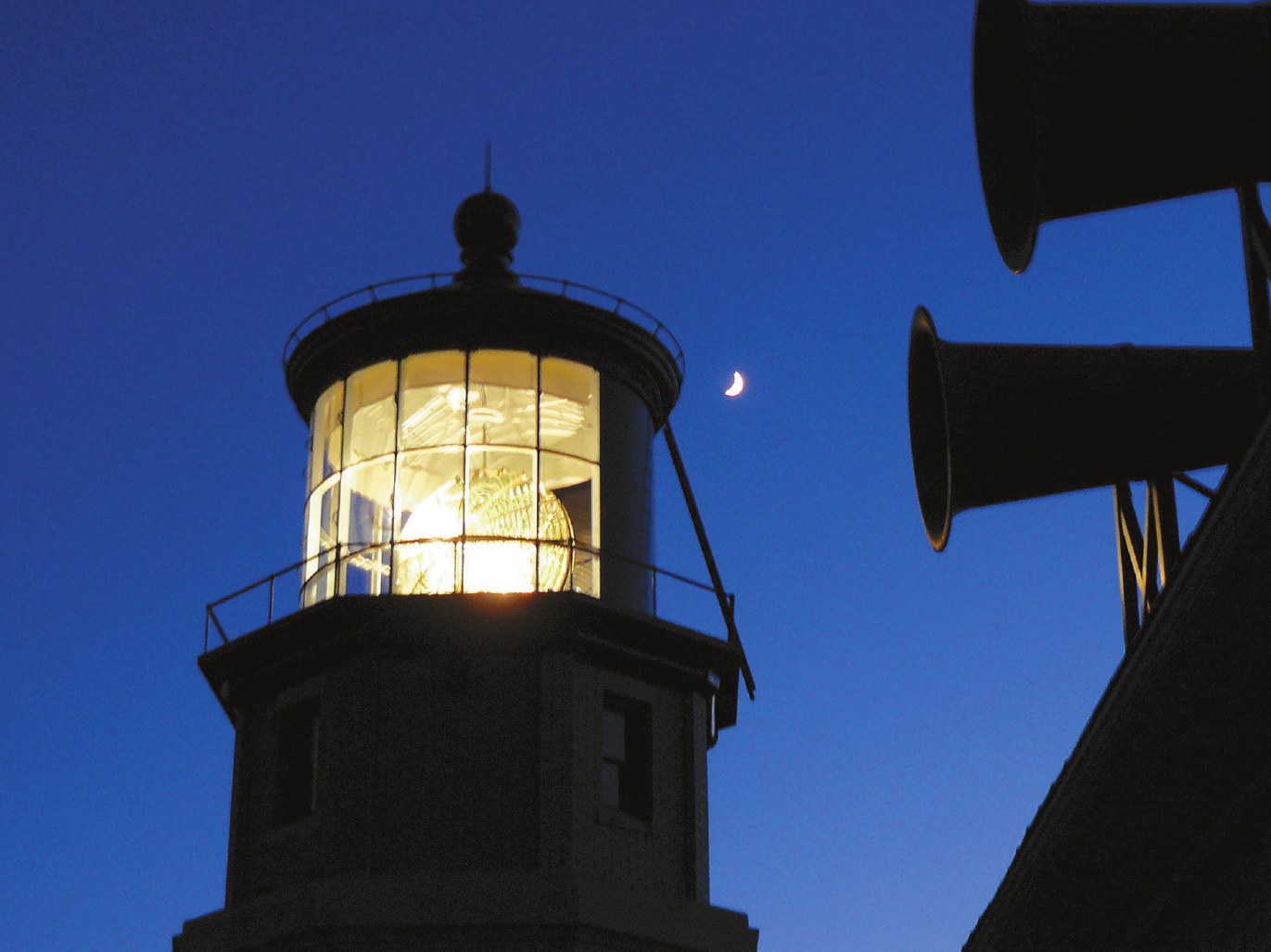
The Wreck of the Edmund Fitzgerald is Gordon Lightfoot’s ode to the disaster that struck 51 years ago on November 10th. The ballad, full of the fury of nature and the pain of loss, has struck many over the decades. One among them was former Split Rock Lighthouse Site Manager Lee Radzak, who, on hearing the song, decided to begin what would become an annual tradition: lighting the beacon of Split Rock for those lost on the Fitzgerald and their surviving families. This year marked the 41st anniversary of the event, now being run by Site Manager Hayes Scriven.
This past November 10th was a bright and crisp day, perfect for the largely outdoors event and about as far from stormy as one could imagine. Part of what makes the Fitzgerald’s tale so grim, however, is the speed at which the weather changed that evening in 1975 – “The gales of November,” as Lightfoot calls it in the ballad. Over the course of the ship’s last journey from Superior to its end just 17 miles from Whitefish Point, Michigan, it entered into a storm with recorded winds of 95 mph and 35 ft waves. Another freighter, the Arthur M. Anderson, had joined the Fitzgerald at Two Harbors and fought through much of the same storm, managing to reach safety. The ship attempted to help the Fitzgerald but lost contact, with the Fitzgerald’s final message being simply “We are holding our own.”
Since the 50th anniversary last year, Scriven has seen a surge in curiosity from younger generations regarding the disaster. While he is happy to see interest in the region’s history and hopes it will spark people to educate themselves, he sees respect as key to truly understanding the tragedy. “We have to remind people that this is a very recent episode in our history,” he emphasized. “We want people to understand that it’s new, it’s still raw for a lot of people.”
This understanding, Scriven noted, is not only towards the Fitzgerald’s lost crew and their families, but about Lake Superior itself, with a goal of the memorial being to “remind people of the power of the Lake, and to respect the Lake.” He pointed to two relatively recent events, the rescue of four sisters by the Coast Guard in 2025 and the unfortunate death of a man in Marquette, Michigan earlier this month after he was swept into Lake Superior, saying, “We need to understand that this stuff is still happening.”
He reflected on how “a lot of times, society doesn’t change until a big tragedy does take place to cause that catastrophic change in policy and procedure.” He hopes educating people on the past will help better “inform our future decisions.” Split Rock’s goal as a historical site, to him, plays an important role in that, using “history as a tool for education,” with the Fitzgerald being one of those important lessons.
The ceremony included similar sentiments in a speech from Commander John Botti, Commanding Officer of US Coast Guard Marine Safety Unit, Duluth and Western Lake Superior’s Captain of the Ports and Officer in charge of Marine Inspections. “Out of the grief of 1975 came hard lessons,” he stated, calling the number of safety improvements made after the loss of the Fitzgerald “bought at the highest possible price.” Every safe vessel transit since, he said, is part of the legacy of the crew: “A legacy that has since ensured they would be the last major commercial laker to be lost upon these waters.”
“For nearly two decades,” Botti said, the Edmund Fitzgerald “sailed with purpose, transporting iron ore across Lake Superior to the industries that powered our nation. She was a symbol of strength. A symbol of reliability. And a symbol of American progress.” Gatherings like those at Split Rock, he added, allow the memory of the ship and its crew to be kept alive. “Today we honor that memory. We reaffirm our commitment to ensuring that the lessons of that fateful November day are never forgotten.”
Scriven recounted how “Lake Superior, the largest and the most treacherous of the Great Lakes, holds approximately 350 shipwrecks, with around 50 of those resting in Minnesota waters,” stating that “through this annual memorial we remember every one, every ship, every sailor, every story that the Great Lakes still hold beneath the surface.”
The Coast Guard stood at attention during proceedings, after which there was a singing of the Navy Hymn, also known as Eternal Father, Strong to Save. The song has long been used during services on the water and is known for its repeating last line, “for those in peril on the sea.” This, in turn, was followed by the ringing of a ship’s bell: 29 times for each member of the Fitzgerald crew lost at sea, and one final toll for all those lost on the Great Lakes. The tolling, which Scriven described as the “Muster of the Last Watch,” accompanied each ringing of the bell with the name of a crewmember and their role on the ship. According to Scriven, “The muster is a traditional nautical ceremony of remembrance” for those lost at sea. When a crewmember is lost during a voyage, the bell would be rung at the time their watch was mustered, and their name was called for the first time after the loss. “In place of their response of ‘Aye aye’, the ringing of the bell signified their absence, preserving their place among the crew.” In the absence of the ship and with all hands lost, he explained, a ceremony would instead be held on shore. The large crowd surrounding the lighthouse was silent throughout, watching and waiting as the bell tolled one by one, with its final ringing accompanied by the beacon of Split Rock being lit in the now-darkened sky.