


If you live in Lake or Cook County, I’m sure you have noticed the blanket of wildfire smoke we’ve been under for the last week. Warmer temperatures and persistent drought conditions make it easy for fires to start and quickly spread out of control, and with so many wildfires at such a large scale burning just north of us in the Boundary Waters and Canada, it seems hard to know when we can expect them to be contained or extinguished. By the mercy of the wind direction, it seems we may be waiting for a while.
If you’ve heard folks talking about AQI, shooting out different numbers on different days, what they are talking about is the Air Quality Index.
AQI was developed by the U.S. Environmental Protection Agency to provide a simple way to report daily air quality conditions. Minnesota AQI numbers are determined by measurements of five pollutants: 1.) Fine particles, 2.) Ground-level ozone, 3.) Sulfur dioxide, 4.) Nitrogen Dioxide, and 5.) Carbon monoxide. Below is a table found on the MPCA’s website for reference.
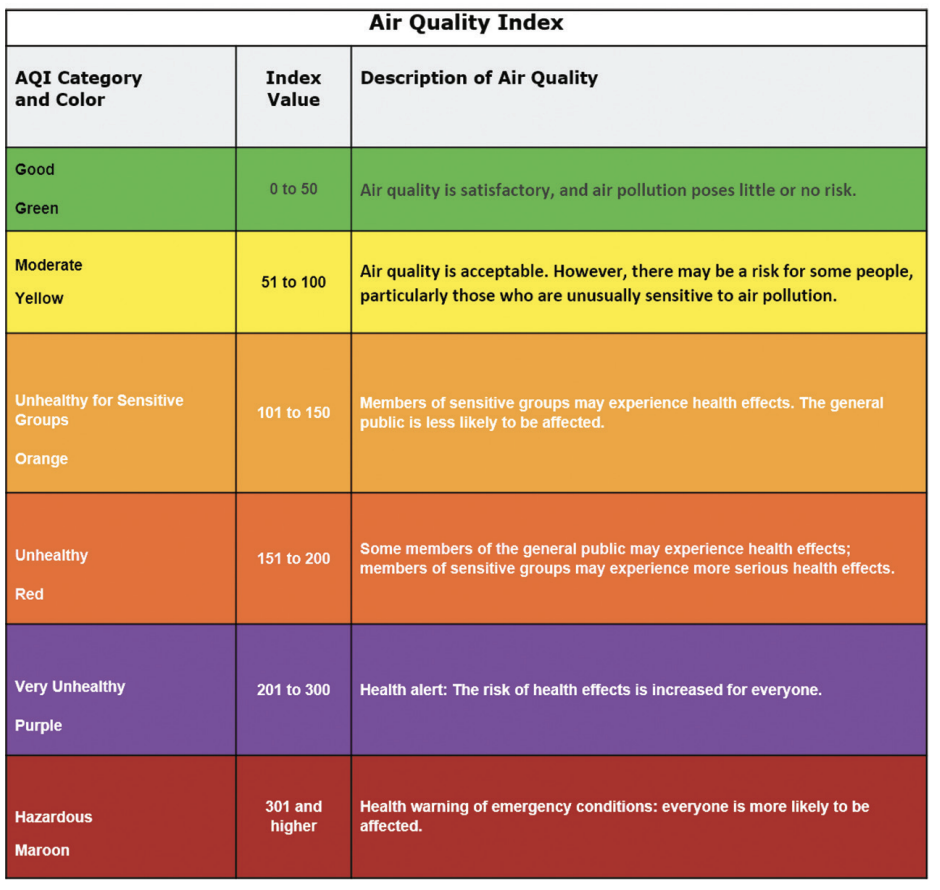
So, in a nutshell, we would like the AQI to be between 0-100 for it to be considered acceptable and safe air to breathe. Older adults, children, people with lung/heart disease, pregnant women, people with asthma, COPD, and other health concerns are at a higher risk when the AQI is anything over 100. Last week the region unfortunately saw AQI numbers in the 900 range and even 1000s, which is quite honestly off the charts. Many of us experienced headaches, stiffness in our throats, shortness of breath, and other impacts. Plans and events were canceled. That blanket of smoke was considered “emergency conditions,” aka Extremely Dangerous for everyone.
How can we protect our loved ones in these conditions? Limit time outside, especially exerting yourself in thick smoke. Wear an N95 mask outside, or on extreme days, a P100 respirator mask. Close the windows in the home. Stay hydrated. Consider investing in an air purification system. You can find decent air purifiers for under $100, but the cheapest DIY option would be to use a box fan and purchase 1- 4 MERV 13 filters.
A MERV rating is a filter’s ability to capture particles between 0.3 and 10 microns (µm) and ranges from 1-16. These filters are commonly used in central heating, ventilation, and air conditioning systems. Filters with higher values are able to catch smaller contaminants like smoke, bacteria, and viruses. There are also HEPA filters, which are efficiency particulate air filters. These are common in air purifiers and are roughly equivalent to a MERV17.
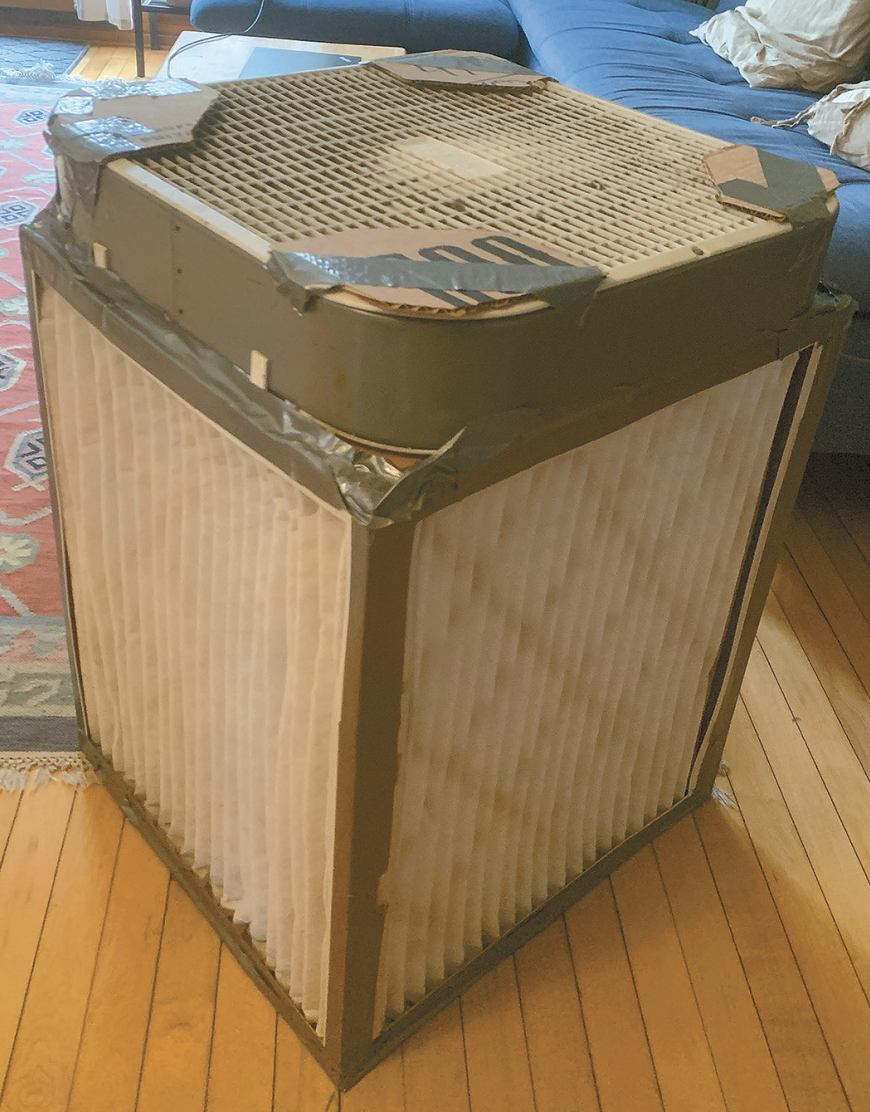
To build a budget air filter for your home, all you need is a box fan, a MERV 13 filter, and some duct tape. The simplest version would be to tape a MERV 13 filter to the back of your box fan. Make sure the airflow arrow is pointing towards the fan. When the fan is turned on, it should be pulling air THROUGH the filter. Be sure that the fan and motor are clean because dust and lint can cause the fan to overheat and cause a fire hazard. Also, it is best if the filter is the same size as the fan. A standard box fan is 20”x20,” so buy a 20”x20” filter. One inch thick will do, but two inches thick is even better.
Another option, even more effective, is to use four MERV13 filters and tape them together upright into a square cube. Make it so the directional arrows indicating the proper airflow are all pointing toward the inside of your cube. Cut a piece of 20”x20” or two 10”x10” pieces of cardboard to use as the base. Lay the cardboard base on the ground and attach the filter box to it. Then place the box fan pointing up on top of the filter box you just created. Try to get a tight seal with the tape between all of the filters and the fan, as well as the cardboard base. This setup is pulling air through the filters on all 4 sides and then blowing filtered air out into your space. To increase the efficiency of your air filter, you can also create a shroud for the outside of the fan. This can be made from cardboard as well. Go ahead and cut cardboard out to cover the corners of the fan so that only the width of the blade of the fan is pushing air out. Secure that cardboard on the outside of the fan with duct tape and seal all of those edges. This will make the airflow stronger and generate a stronger pull through the filters and out through the fan.
These DIY purifiers are very effective! Be sure to keep an eye on the filters and when they start to discolor or grey. It will be time to replace them. They are not just good for wildfire season and can be used to reduce allergies, filter out pollen, help reduce fumes from paint or chemicals, and airborne bacteria. According to the CDC, these DIY air filtration units – also called a Corsi-Rosenthal Box – can reduce exposure up to 73%, depending on the structure of the unit, filter thickness, and fan airflow. If you decide to purchase a portable air filter for your home, make sure to get one with a HEPA filter. There are many websites on the internet that provide more detailed instructions with diagrams and photographs to help you put this together. Just simply Google “DIY box fan air purifier” or look up the Corsi-Rosenthal Box.
Many households on the North Shore do not have air conditioning units because we’ve been lucky enough for temperatures to rarely climb into the upper 90s or 100s. Unfortunately, that seems to be changing along with the frequency and ferocity of wildfires. When it’s so smoky that you have to close your windows and doors, but it’s also hot out, this is not a great combination. Another thing to consider to keep loved ones comfortable and healthy in these conditions is to invest in some kind of air conditioning unit. You can kill two birds with one stone by finding an AC unit that also has air purification, but these units can be a bit more spendy. A cheap window unit with a DIY box fan purifier works just as well. There are also ways to build DIY air conditioning units that use ice. The simplest option would be to place a large bowl of ice in front of your fan. As the ice melts, the fan blows chilled air across the room. Otherwise, there are several blueprints online showing how to build one, including one made out of a styrofoam cooler, PVC pipe, and a small fan.
Download the EPA AirNow Interactive Map App on your phone for quick access to current AQI levels, or you can find the levels listed on weather websites such as AccuWeather or state websites like the MPCA.
Navigating extreme weather conditions can be overwhelming. Hopefully some of this information helps. Stay safe.