


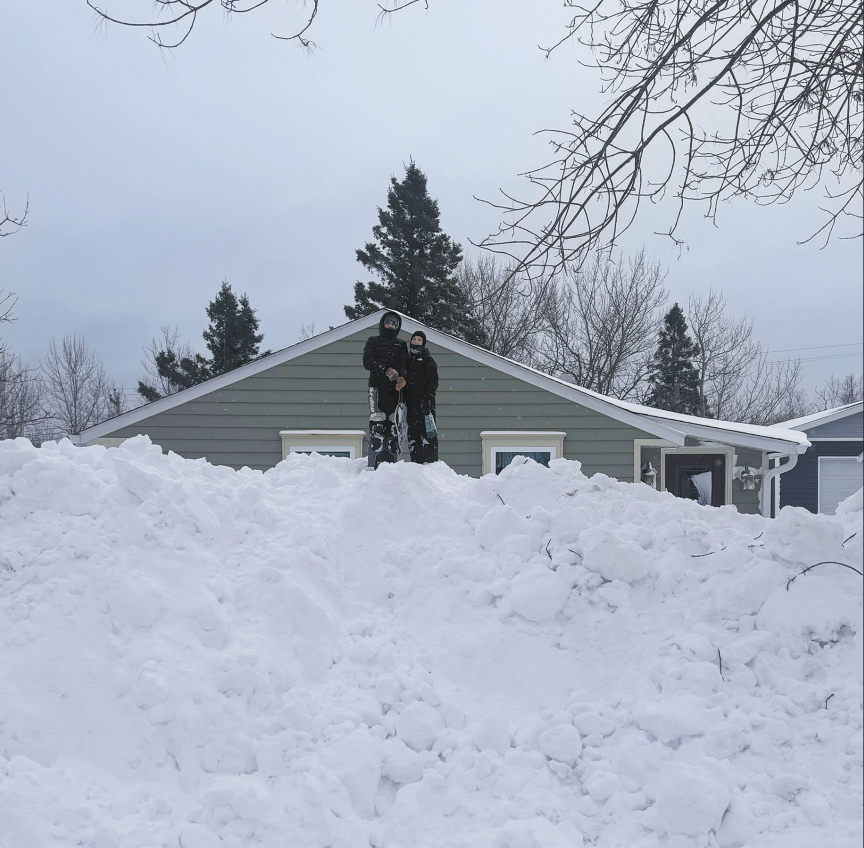
From Tuesday morning, February 17th, through Thursday evening, the 19th, a record-breaking “lake-effect” blizzard gradually intensified along Minnesota’s North Shore, paralyzing the region from Duluth to the Canadian border and forcing MnDOT to close Highway 61 for a time as up to four feet of snow fell. For plow operators clearing coastal arteries and off-grid homesteaders in the backcountry, the storm offered a brutal, two-and-a-half-day reminder of Lake Superior’s atmospheric power.
Most businesses stayed closed on Wednesday. Grand Marais realtor Terry Backlund, a lifelong Cook County resident, posted on Facebook, “I don’t recall a storm in Grand Marais that closed down everything, except the GMSB [Grand Marais State Bank], Hospital, and the County and State garages. Crazy drifting.”
Driven by a collision of moisture-heavy air from Lake Superior and a stagnant Canadian front, the storm began Tuesday and didn’t just dump snow for hours; it snapped trees and closed businesses until Thursday. This system turned Highway 61 into a challenge even for the most seasoned locals.
Against this backdrop, Silver Bay resident Jon Nelson parked his trucking business to focus on snow removal around Finland during the storm, and for a few days after. He said, “The snow was insanely heavy with ice underneath.” Out the door by 6 am on Wednesday, he didn’t get home until 11:30 that night. Knowing that a celebration of life was scheduled that weekend at the Clair Nelson Center in Finland, Nelson made sure its parking lot was cleared. He was still moving snow on Saturday.
Between Tuesday and Thursday afternoon, continuous wind and snow reshaped the landscape into more than a winter wonderland. During the heart of the storm on Wednesday, Grand Marais recorded wind gusts up to 69 miles per hour. (Hurricane-force winds start at 74 miles per hour.)
During the first 24 hours, from Tuesday afternoon onward, Finland recorded three feet of heavy, wet snow. By Thursday morning, five miles away, Wolf Ridge Environmental Learning Center reported almost four feet before the storm broke.
Bob Geatz of Silver Bay is the head of maintenance at the Wolf Ridge Environmental Learning Center in Finland and is responsible for the safety of the 22 naturalists who reside there. He spent Tuesday and Wednesday nights on site. With a small crew, two plow trucks, and a skid steer to keep access to the Center open, Geatz said they did at least four turns pushing snowbanks back to make space for more falling snow. “It was a’comin’ down,” he said.
Multiple times during the storm, Geatz was forced to idle his truck in total whiteouts. During one of these pauses, he glimpsed a flash and questioned his dashboard. Then thunder rattled the air. “That thunder and lightning were crazy,” he said.
As conditions worsened, on Wednesday morning, MnDOT made a rare decision to close Highway 61 from Duluth to the Canadian border due to severe whiteout conditions, icy roads under the snow, and a rockslide that had entered the highway west of Beaver Bay. While MnDOT frequently issues “No Travel Advised” alerts for the North Shore, a full, formal closure of Highway 61 from Duluth to the Canadian border is a rare and extreme “tactical” decision.
To put the significance of this decision in context, before this 2026 storm, MnDOT had closed Highway 61 during notable past blizzards—April 2023, February 2007, the Halloween Blizzard of 1991, and the 1975 “Edmund Fitzgerald” storm—all due to extreme conditions.
When you hear that the road is closed from “Brighton Beach to the Border,” it means the state has determined that the risk of a “mass stranding” (where hundreds of cars get stuck and plows can’t reach them) is higher than the risk of cutting off the towns. In recent years, MnDOT has become slightly more proactive about “pre-emptive” closures. They’ve learned that it is easier to close the road before a semi-truck jackknifes and blocks a fleet of plows than it is to clear the wreckage in a whiteout.
Cove Point Lodge in Beaver Bay is one business that stayed open, sharing a Facebook video of staff celebrating their preparedness as a bearded employee stood in snow up to his armpits, broadcasting Cove Point as the place to be.
Returning to the impacts in the backcountry, Kaare Melby of Finland grew up on a remote, off-grid homestead in Finland, where he lives today with his wife and two daughters. Although connected to the power grid for years now, it is still accessed by a mile-long driveway that dips down through a valley and rises to the house. For about one-eighth of a mile of that driveway, Melby reported drifts of heavy snow up to 10 feet high after the storm ended on Thursday. As of the 24th, the drive is still not passable by car, but they have cleared a walking path through the drifts to a family car they keep parked at the road. “It’s all part of living here,” Melby said, “and walking is part of our life.”
One casualty of the storm at the Melby homestead was the fiber-optic line linking them to the internet. A plow severed it.
Events like this intense storm show how communities come together to help each other cope. Melby credits his friends and neighbors for helping him clear as much of his driveway as possible.
“At 40 now, it’s definitely a challenge living on the homestead,” Melby said. “But it gives me the opportunity to teach my kids what I learned growing up here.”
With snowfall rates between two and three inches per hour for more than a day, this winter storm is one for the record books. In particular, it made the town of Hovland, sitting alongside Lake Superior’s Chicago Bay, the “snow capital” of this event and the source of local pride (and exhaustion) for Hovlanders that comes with it.
Although Lake Superior always gets the last word on the weather, this storm above all highlights the decency and resilience of the people who call the North Shore home.