
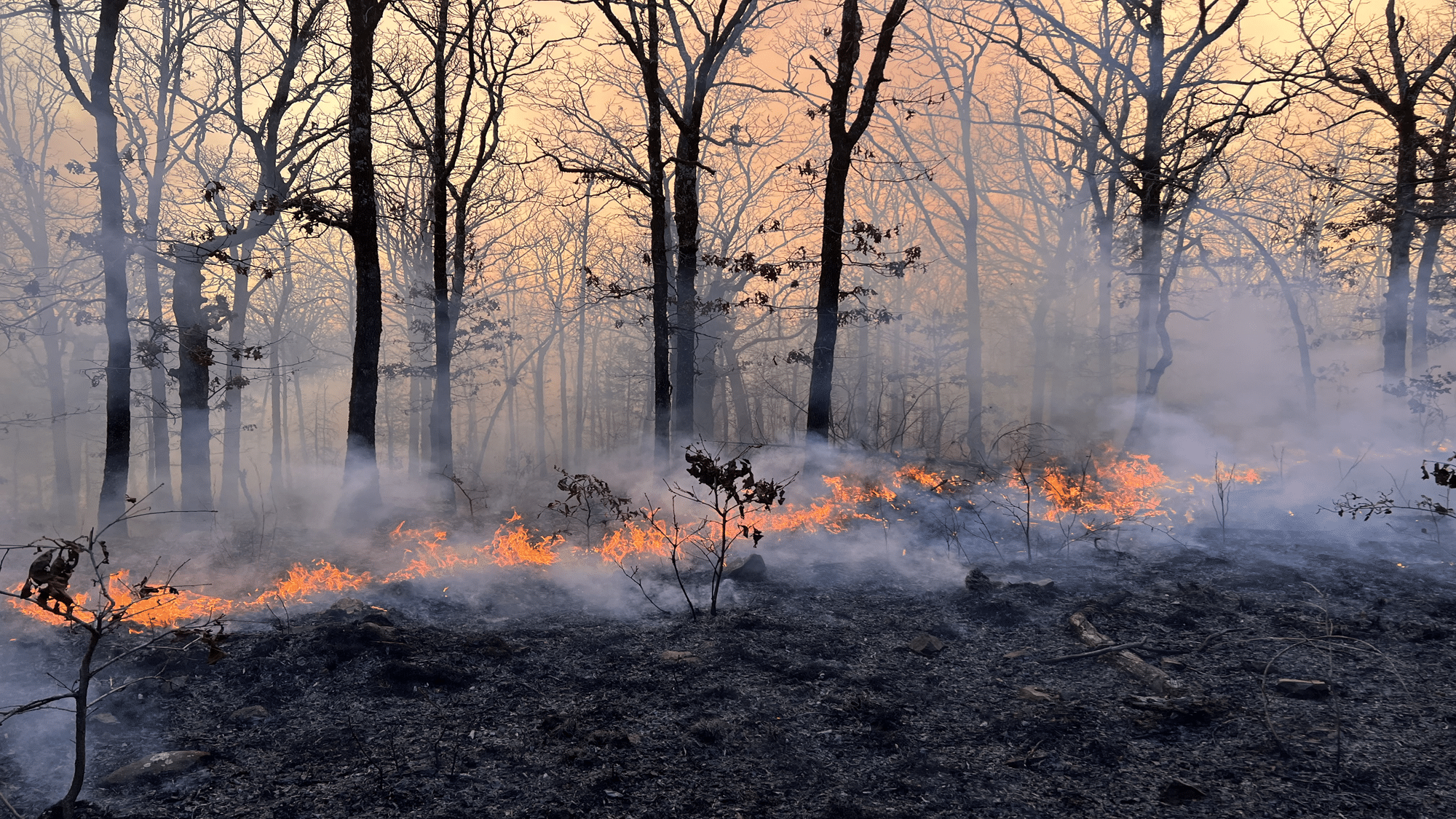
After last spring’s Brimson Complex Fire, many North Shore residents saw flames as something to fear. A recent presentation I attended via Zoom, titled The Role of Fire in Northern Forest Ecosystems, suggested a more complicated truth.
Advocates for the Knife River Watershed brought together experts Lane Johnson and Abby Andrus to explain why controlled, intentional fire may be key to preventing the kinds of destructive wildfires now becoming more common in northeastern Minnesota.
“What we’re talking tonight is really about learning and working to live with wildland fire,” said Johnson, a research coordinator and forester who works for the Cloquet Forestry Center and the University of Minnesota. “We just call it the cohesive strategy.”
Johnson explained that wildfire is “essential, life-giving, cleansing,” and can renew sites. Fire can modify soil, light, and nutrients to help forests regenerate.
“It can be considered an ecosystem service, even when it’s unplanned,” he said. “Fire is much bigger and more complicated than just a hazard or a tool. Fire is a caretaking obligation for the places that we care about.”
Minnesota has a long history with fire. According to Johnson, “Fire largely determined the composition and structure of the pre-settlement landscape. Not just parts of the landscape. The whole system is firedependent. The woods, the wildlife, and the waters are all shaped by fire.”
Red pine serves as a natural “time capsule” of fire history. Because the massive trees often survive burns, their inner rings preserve visible fire scars that allow foresters to reconstruct when and how often fire moved across the landscape. In a graphic shown during the presentation, those fire events declined sharply as European settlement expanded in the late 1800s.
These fires were not by accident.
“People have been shaping this landscape with fire for over 10,000 years,” Johnson explained. “This is sustainable Indigenous natural resource management. Burning made sense if you were trying to feed your community. Blueberries come back abundantly after fire.”
Unfortunately, in the early 1900s, prescribed fire by Native Americans was criminalized.
“Generational fire knowledge was cut off by colonization,” Johnson said. “For the last century, we said fires don’t belong in the woods.”
The result? Johnson stated we “created seas of balsam fir that are extremely fire-prone. If those areas burn now, everything could die.”
That dang dead balsam is a familiar thorn in the side around here. Lining roads across the region, it’s hard not to think about how quickly it can ignite and how nearly impossible it is to control once it does.
“In dense balsam fir, you’re not putting the fire out, you’re praying for rain,” Johnson said. “From a fire standpoint, parts of Minnesota now look more like Colorado or California.”
A century of suppression has left northern forests thicker, drier, and more volatile than they were historically, exactly the conditions that allow modern wildfires to burn hotter, faster, and more unpredictably.
For Johnson, this is the core reason prescribed fire matters. Controlled burns, he argued, are not about lighting fires for their own sake, but about restoring a natural process that once kept forests resilient. When used intentionally, fire can reduce dangerous fuel loads, protect long-lived trees like red and white pine, and create a healthier habitat for wildlife.
In other words, the goal is not to eliminate fire but to bring back “good fire” so communities are less vulnerable to catastrophic “bad fire.”
“We’re not just managing against risk. We’re managing for resilience,” Johnson said.
Even with that logic, putting prescribed fire back on the landscape has proven difficult. There are a lot of barriers to doing so.
“Most forest land in St. Louis County has no real pathway for prescribed fire,” Johnson said. “Agencies shoulder too much responsibility, leaving private landowners out. People don’t see fire as a missing piece of the landscape. There is no shared statewide vision for prescribed fire. We’re great at fighting wildfire, but not great at using fire.”
Johnson went on to explain that Minnesota should be burning about one million acres a year, but currently burns about 72,000 acres annually.
“Less than 10 percent of what’s needed is actually being treated,” he said. “Private land burning is essential to close that gap.”
That’s where Andrus, a community ecology strategist who works for Dovetail Partners in prescribed fire, forestry, and land management, can help.
“I see myself as a kind of prescribed fire ambassador for this region,” Andrus said. “I didn’t start out as a fire advocate. I just wanted to be a good land steward. There are a lot of resources out there, and I’m happy to help direct people to them.”
Andrus explained that even small steps can make meaningful differences.
“Prescribed fire doesn’t have to be huge or scary to be meaningful,” Andrus said. “You don’t have to burn 80 acres. There are small, accessible places to start.”
Communities working together is often the best way to make big changes.
“Sometimes just getting people together to work outside is part of the solution,” Andrus said. “Fire only works well when neighbors coordinate across a whole road or area.”
Andrus said that talking through concerns together is how real progress happens.
“My goal is to help people find their next step with fire, wherever they’re at,” Andrus said.
The Role of Fire in Northern Forest Ecosystems presentation is expected to be available on the Advocates for the Knife River Watershed website in the next coming weeks. View the video recording at akrw.org.
Residents interested in learning more about prescribed fire can contact Lane Johnson at lbj@umn.edu or Abby Andrus at abby.colehour@gmail.com. More information can also be found at minnesotafac.org, mnprescribedfire.org, and minnesotapba.org.