


A recent trivia question got me thinking about snowmen. First about snowmen’s noses (answer: Frosty’s was a button nose), and then about how snowmen are constructed across cultures and eras. Once that door opened, it was hard to close.
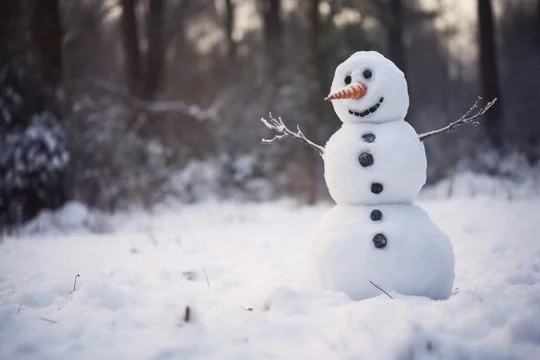
Most of my own creations have been what I would consider standard snowman fare: some kind of hat (though I do not always have a top hat at the ready in this day and age), a scarf, charcoal from the BBQ bag for eyes and buttons, a carrot for a nose, and some stray sticks stuck into the sides for arms.
My snowmen have always been full-bodied and three-tiered. It is tempting to roll that bottom snowball until it is hugemongous, but experience has taught me that you have to remember you will eventually need to lift a head up there on top of a torso. Ambition has its limits when snow is involved and that fluffy stuff can sure get heavy.
Once I dug deeper into the snowman history, I learned that snowmen have been around far longer than I expected. The earliest known snowman appears in a 1380 Book of Hours. Apparently, if you didn’t get a Nintendo Switch for Christmas back then, you still had to find something to do.
In the Middle Ages, snow figures even doubled as political commentary. Snow was free, readily available, and the evidence of the political statement would literally melt away before anyone could get in trouble. Michelangelo, the artist, not the Ninja Turtle, once sculpted a snowman in 1494 for the ruler of Florence. Snowmen appeared in some of the first photographs ever taken, proving that even early photographers could not resist a good snowman.
As my snowman snowshoe rabbit hole continued, I saw images of snowmen from around the world and found that snowmen are constructed a bit differently and a bit the same. In the United Kingdom, snowmen are traditionally built with just two spheres. It seems efficient, but also a little like they gave up halfway to go get to the hot cocoa part of the process. Japan also favors a two-tiered approach, where snowmen are called yuki-daruma. Suddenly, my three-snowball snowman loyalty felt less universal.
That discovery made me think back to one of my favorite snowmen memories. One year, my husband surprised me with a very tiny snowman built on the banister of our front porch. He was maybe ten inches tall and had a tiny carrot nose my husband had carefully sculpted from a real carrot. He had twigs for arms. A bright red piece of ribbon was all the little guy needed for a scarf, and somehow that made him feel complete.
It turns out that little porch snowman may have had more cultural backing than we realized. In Sweden, snowmen are often built small and simple, sometimes placed in public spaces (like train stations) for many to enjoy. Our tiny snowman lasted until spring, though his nose needed to be replaced a few times. His red scarf, coincidentally or not, may have brought us good fortune, according to Chinese tradition where red hats and scarves on snowmen symbolize luck.
In the United States, snowmen tend to lean toward German traditions, complete with coal eyes, carrot noses, and donning winter apparel. That felt familiar, if a little predictable. After reading further, I found myself drawn to Finland’s approach, where snowmen are often built on frozen lakes or wide, snowy expanses. There is something delightful about the idea of running into a snowman while out snowshoeing or ice fishing, like an unexpected winter friend in the wilderness.
Other traditions lean more toward practicality. In Russia, snowmen are often topped with buckets and outfitted with brooms, while in Switzerland, brooms sometimes serve as arms. I couldn’t help but think that’s a handy place to store that snow sweeper for getting all the snow off your truck.
Some snowmen are closely tied to celebration. My ancestors in Norway built snowmen as part of the Christmas holiday, which is something I may need to consider incorporating into our own celebrations in the coming years. Iceland also weaves snowman building into winter festivals and community gatherings, which feels like winter done right.
And then there are the snowmen that fully embrace whimsy. Scottish snowmen have been known to wear kilts and carry bagpipes and in Canada snowmen look like they are ready to jump into a hockey game on the ice, wielding hockey sticks and wearing full hockey gear.
Beyond fun, snowmen apparently serve practical purposes as well. Building them is good exercise and good for mental health, but they can also help compact snow in high-risk avalanche areas. As they melt, snowmen can provide water for plants and soil, and in some parts of the world they are even used to measure snowfall and track weather patterns. I did not expect snowmen to be pulling that much weight.
After reading about all these traditions, it struck me how funny it is that we are all doing the same simple thing with snow, just in our own ways. Some places stack two spheres, some stack three. Some add red scarves for luck, some add buckets or brooms. Some dress their snowmen in kilts, and some build them small enough to perch on a porch rail. Whether they stand on frozen lakes in Finland, greet commuters in Sweden, or show up at winter festivals from Norway to Iceland, every version is just a community shaping winter into something a little more human. Maybe that is the real tradition we all share.