


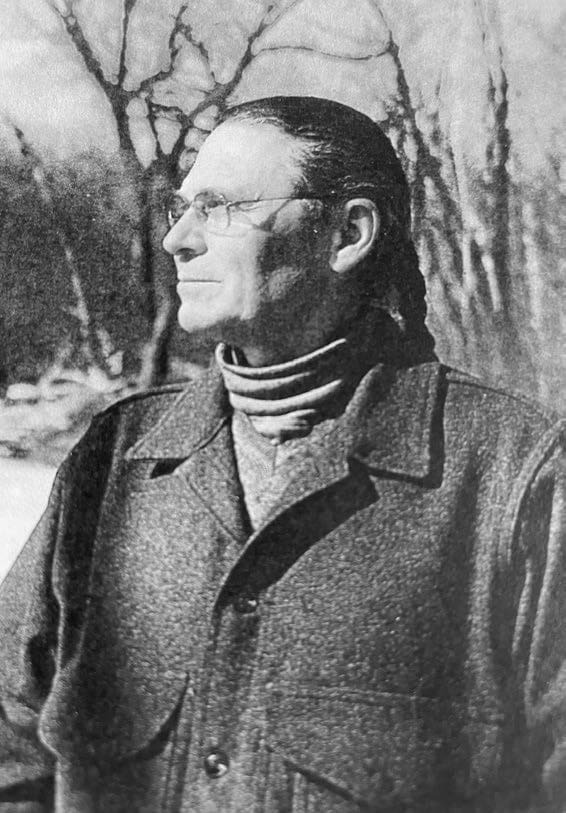
I turned seventy-six a couple of weeks ago. That fact and the end of the year have got me thinking about time. “Where the heck does it go?” is the question many of us ask. I have had a very full, adventurous life and still have good health, but the passage of time becomes more poignant and mysterious the older I get, especially as another year closes out. As I reflect on time, I’m going to use the word “time” multiple times in this essay as a symbol of the seconds of time ticking past in the six or seven minutes it takes to read this article. I appreciate the time you take to read it.
Europeans first recorded a definition of time in the abstract sense as “time is an indefinite continuous duration” in the late 1400s. Since then, we have used the word and concept in so many ways. “Time of day” (a greeting or withholding), “the times” (current age), “behind the times” (old fashioned), “ahead of one’s time” (progressive), “time warp”, “time traveling”, “time and again” (repeatedly), “from time to time” (at intervals), “do time” (prison sentence), “in time” (not too late), and “on time” (punctual). “About time” (ironically for long past due time), “next time” (future), and “time off” (from work) are additional uses.
Time is measured in many ways. The Earth’s seasonal tilting on its annual rotation around the sun created the original timekeeping methods. “Sun time” measured day/night, the seasons, and a yearly repetition. Sunlight reaches our earth in eight minutes. Light from the closest star system takes 4.3 years, and starlight from Orion is 430 years old by the time we see it. Even stars are measured in differing times. Older societies recorded the passing of time in various ways. Some built monuments like Stonehenge and the pyramids of Egypt and Mayan Central America that aligned with annual sun and moon events. Others painted a yearly symbol representing one major event on an animal hide called a “winter count”. Each year’s image was added in a spiraling form for a long accounting of lived experience. Time itself is abstract, but the passing of it is exceedingly poignant.
The importance of time passing led humans to develop methods to measure time in smaller increments. Sundials and shadow clocks have been around since 1500 BC, but required natural sunlight. The invention of water clocks measured time with the flow of water, so they could be used at night. China developed candle clocks around 520 AD, which used burning candles marked at intervals. Tower-based mechanical clocks came to Europe in the 1300s, with portable clocks and watches added in the 1500s.
Newer mechanical timekeepers created even more precise measurements in minutes and seconds. Airports, train schedules, and busy ocean ports all rely on timing to the minute and second. More accurate timing is needed for space travel, so nature again held the source. Atomic clocks use the natural “resonant frequency of atoms” to measure the exact moment of launch, trajectory correction, and re-entry. Precise time is imperative to work in space.
Most work schedules don’t need such exact time measurement. Many of us work eight hours a day for five work days. Start and stop times are scheduled and usually quite routine. Other work is not so routine. Farming relies on “sun time” for seasonal planting and harvesting, often working day and night. My wife’s educational career was divided into hourly meetings requiring a close relationship to scheduled time. My work time as a building contractor was measured by the week and month on projects lasting from several days to sixteen months. I was less scheduled by the clock than my educator/ administrator wife.
Most living things measure time in “life times”. The adult mayfly lives 24 hours, while a Great Basin Bristlecone Pine can be 4,850 years old. In America, the average lifespan for men is 75.8 years and for women is 81.1 years. Those averages belie the wide-ranging individual time of living. Some babies sadly pass within moments of birth, while the oldest person currently in America is 115 years old. Ancient Hindu texts teach that we are each born with a fixed number of breaths (heartbeats are sometimes included). Yoga practices were developed as a way to conserve the breaths we have to elongate our lives. Calm, efficient breathing was the goal. A yoga lifestyle tries to avoid stress, anger, and conflict, all of which speed up breathing and shorten a lifetime. Both yoga and meditation focus on each breath to experience being “in the moment,” which eliminates the focus on the passage of time in hours and minutes as well as past and future. Only the present moment is experienced with each breath.
The demands of modern living make it very difficult to stay in the moment. Sometimes the past haunts us while the future nervously beckons. My mother and father were kept busy raising six children on a limited budget. Their retirement plans included a cabin in northern Michigan. But my father’s allotted breaths and heartbeats ran out when a heart attack took him at forty-three, leaving my thirty-nine-year-old mother home with three children. Their “future” never arrived. I don’t know if “mindfulness” (the current term for being in the moment) would have made any difference to either of them. But I learned to be grateful for the time I have. I remember to be in the moment whenever the demands of modern living don’t override that powerful lesson in my father’s untimely death.
So in the time we each have left, may your heart beat in kindness and you breathe in the fullness of a good life until the last breath granted to you has passed. Happy New Year. Use it well.